What's new

Newbie to Bottles, Is this old?

metaldetectingtaylor

Full Member
Joined
Mar 21, 2011
Messages
155
Reaction score
120
Golden Thread
1
Location
Massachusetts
🥇 Banner finds
1
Detector(s) used
Minelab Explorer SE Pro
Primary Interest:
All Treasure Hunting
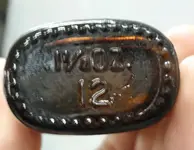
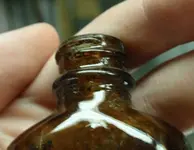
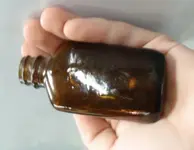
I found this at a house that dates to late 1700's. I figured this was early 1900's? I have no clue. any help would be great. It looks like a medicine bottle to me. It says 1 1/2 oz and then 12 underneath that.
 

Attachments

  • P5080217.webp
    P5080217.webp
    24.3 KB · Views: 349
  • P5080214.webp
    P5080214.webp
    43 KB · Views: 355
  • P5080219.webp
    P5080219.webp
    33.6 KB · Views: 346
Harry ~

Please don't think I'm following you around, as that is not my nature or intent. But I just happened to see this post and decided to comment on it myself. Of course you already nailed this one to a "T" :icon_thumleft:

The following is copy/pasted from a website (with a slight bit of editing) and focuses on the little bumps around the base of the bottle, which are commonly referred to as "Stippling." (Note: I didn't know what "terminus post quem" meant the first time I came across it either- so I looked it up and basically it means ... "Proof based on extensive research - with no other logical explanation to refute it." [ or something like that ] :icon_scratch:

SBB

It is not precisely certain when stippling first originated, although it likely first appeared in 1940 on bottles produced by the Owens-Illinois Glass Company when they began using their proprietary "Duraglas" bottle making process (Toulouse 1971). This likely terminus post quem is supported by date codes noted by the author and others on bottles made by that company (Lockhart 2004d; empirical observations). So if one has a machine-made bottle with a stippled base one can be quite certain that it dates from 1940 or later.

P.S. ~ Stippling was invented to allow the hot bottle to be slightly raised when it came out of the mold, thus allowing it to cool "slower" than if placed on a solid steel surface. The slower cooling prevented cracking that sometimes occurred during earlier processes.
 

Users who are viewing this thread

Latest Discussions

Back
Top Bottom