
You are using an out of date browser. It may not display this or other websites correctly.
You should upgrade or use an alternative browser.
You should upgrade or use an alternative browser.
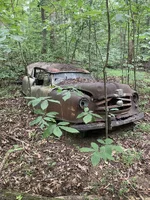
Old car
- Thread starter mjb Mike
- Start date

Oldrvrrat57
Hero Member
What detector were you useing!!! Cool old car! Looks like the 50s

- Joined
- Aug 8, 2005
- Messages
- 8,985
- Reaction score
- 36,748
- Golden Thread
- 0
- Location
- Beautiful Florida
- Primary Interest:
- Relic Hunting
You're gonna need a jump box.

jewelerguy
Gold Member
Pretty sure that's a 1950 Nash Rambler

Red-Coat
Gold Member
- Joined
- Dec 23, 2019
- Messages
- 7,925
- Reaction score
- 25,156
- Golden Thread
- 0
- Location
- Surrey, UK
- Primary Interest:
- All Treasure Hunting
A tin of T-Cut and a Cuban mechanic would soon have that back on the road.


Crow
Silver Member
- Joined
- Jan 28, 2005
- Messages
- 4,774
- Reaction score
- 13,639
- Golden Thread
- 0
- Location
- In a tax haven some where
- Detector(s) used
- ONES THAT GO BEEP! :-)
- Primary Interest:
- Other
Great picture.
There is something eerie and beautiful about car graveyards as they are memory-like ruined buildings of times past. They are a close personal reflection of us, nostalgic memories of a simpler time. It makes you wonder who the people were who once drove them, what was their story. Most are long dead, and kids are retired.
There are a few photographers who travel world photographing abandoned car grave yards.


Some as you can see are returning back to nature.
Amazing picture these photographers had captured.
Crow
There is something eerie and beautiful about car graveyards as they are memory-like ruined buildings of times past. They are a close personal reflection of us, nostalgic memories of a simpler time. It makes you wonder who the people were who once drove them, what was their story. Most are long dead, and kids are retired.
There are a few photographers who travel world photographing abandoned car grave yards.
Some as you can see are returning back to nature.
Amazing picture these photographers had captured.
Crow

- Joined
- Feb 9, 2020
- Messages
- 10,323
- Reaction score
- 23,382
- Golden Thread
- 0
- Location
- Eastern Ohio
- Detector(s) used
- XP Deus
XP Deus 2
Minelab E-Trac
- Primary Interest:
- Metal Detecting
Cool old car !

Crow
Silver Member
- Joined
- Jan 28, 2005
- Messages
- 4,774
- Reaction score
- 13,639
- Golden Thread
- 0
- Location
- In a tax haven some where
- Detector(s) used
- ONES THAT GO BEEP! :-)
- Primary Interest:
- Other
Here is some more


It is interesting and sad to see them rusting into oblivion. They are a reflection of us and our own mortality. Our preoccupation with a motor car that most people from that era before cars could not comprehend.
I am still an old petrol head but the world is going electric and mass production on imaginable scale. . With a global population exceeding 8 billion, there are only about 1.45 billion cars currently on the road. That equates to roughly one car for every 5.5 people globally, though ownership is heavily skewed toward wealthier nations. Over 1.5 billion cars have been produced globally since mass manufacturing began over a century ago. The worldwide motor vehicle production rate has grown exponentially, exceeding 90 million vehicles manufactured annually in recent years.
The United States produces approximately 20 to 22 motor vehicles per minute (roughly 1,200 to 1,300 per hour). This estimate is based on an annual national output of roughly 10.5 million cars, SUVs, and commercial trucks.
China produces approximately 57 to 60 vehicles per minute on average nationwide. Driven by ultra-fast, AI-powered automation, leading manufacturers like BYD roll a brand-new electric vehicle off the production line every 60 seconds, while the Xiaomi EV factory in Beijing averages one every 76 seconds.
You can buy a new car these day by time warranty run out its ready for the scrap heap.
When old cars from past eras come to die to rust in peace. You can see nature reclaiming them.
Crow
It is interesting and sad to see them rusting into oblivion. They are a reflection of us and our own mortality. Our preoccupation with a motor car that most people from that era before cars could not comprehend.
I am still an old petrol head but the world is going electric and mass production on imaginable scale. . With a global population exceeding 8 billion, there are only about 1.45 billion cars currently on the road. That equates to roughly one car for every 5.5 people globally, though ownership is heavily skewed toward wealthier nations. Over 1.5 billion cars have been produced globally since mass manufacturing began over a century ago. The worldwide motor vehicle production rate has grown exponentially, exceeding 90 million vehicles manufactured annually in recent years.
The United States produces approximately 20 to 22 motor vehicles per minute (roughly 1,200 to 1,300 per hour). This estimate is based on an annual national output of roughly 10.5 million cars, SUVs, and commercial trucks.
China produces approximately 57 to 60 vehicles per minute on average nationwide. Driven by ultra-fast, AI-powered automation, leading manufacturers like BYD roll a brand-new electric vehicle off the production line every 60 seconds, while the Xiaomi EV factory in Beijing averages one every 76 seconds.
You can buy a new car these day by time warranty run out its ready for the scrap heap.
When old cars from past eras come to die to rust in peace. You can see nature reclaiming them.
Crow

Red-Coat
Gold Member
- Joined
- Dec 23, 2019
- Messages
- 7,925
- Reaction score
- 25,156
- Golden Thread
- 0
- Location
- Surrey, UK
- Primary Interest:
- All Treasure Hunting
I took these pictures in Solitaire, in the Namib desert. Last fuel and rest stop in nowheresville before venturing into the Sossusvlei sand dunes where 'Mad Max: Fury Road' was shot.


ConceptualizedNetherlandr
Silver Member
- Joined
- Apr 17, 2014
- Messages
- 3,510
- Reaction score
- 4,498
- Golden Thread
- 0
- Location
- Sagittarius A*
- Primary Interest:
- Other
How would those cars get there?Great picture.
There is something eerie and beautiful about car graveyards as they are memory-like ruined buildings of times past. They are a close personal reflection of us, nostalgic memories of a simpler time. It makes you wonder who the people were who once drove them, what was their story. Most are long dead, and kids are retired.
There are a few photographers who travel world photographing abandoned car grave yards.
View attachment 2260280
View attachment 2260281
View attachment 2260282
View attachment 2260283
View attachment 2260284
View attachment 2260285
View attachment 2260286
View attachment 2260287
View attachment 2260288
View attachment 2260289
View attachment 2260290
Some as you can see are returning back to nature.
Amazing picture these photographers had captured.
Crow
Crow
Silver Member
- Joined
- Jan 28, 2005
- Messages
- 4,774
- Reaction score
- 13,639
- Golden Thread
- 0
- Location
- In a tax haven some where
- Detector(s) used
- ONES THAT GO BEEP! :-)
- Primary Interest:
- Other
They all answer the mating call of the rumbling big block V8.How would those cars get there?


All jokes aside people collect cars. They sit on properties left to rust. I have friend has every car he has ever bought 30 odd cars on his property. When he dies his family will take them to scrap yard or sell what they can. There is scraps yards all over the world where owner dies no one wants to take over the property and the cars are left to rot to nature. People see dumped car and dump their cars in remote rural or forested areas.
This place below has been nicknamed cavern of lost souls old cars fridges etc. Would not be surprise there is no a few bodies down there either. A toxic nightmare.
Out of mind out of sight.
This problem is occurring all over the world excessive consumption and over commercialism creating waste.
The US historically exported millions of tons of plastic waste annually. While international restrictions (like China’s ban and tighter UN regulations) have forced a shift, the US still offshores large quantities of mixed, contaminated, or single-use plastics to nations like Malaysia, Vietnam, and Indonesia. Scrap Metal: Scrap metal is one of the largest exported recovered materials. Millions of tons are sent overseas annually, with top destinations including Bangladesh, India, Indonesia, and Vietnam. Hazardous Waste: The US regularly exports hazardous wastes and shredded tyre-derived fuels, frequently shipping them to processing and manufacturing hubs in South Korea.
Let it be stated USA is not alone exporting their crap. Yes, the UK is one of the world's largest exporters of waste, shipping hundreds of thousands of tonnes of recyclable materials—primarily plastics, scrap metal, and paper—overseas each year. Because domestic recycling capacity is limited, it is often cheaper for councils and private companies to export waste than to process it at home. That is why the UK has fly tipping problem like that cavern in wales. the average person cannot afford dump fees.
Plastics: The UK exports around 675,000 tonnes of plastic waste annually. The primary destinations include Turkey, Malaysia, and Indonesia. Metals & Paper: The UK exports millions of tonnes of scrap iron, steel, and paper waste, primarily to India, Vietnam, and Egypt.
While some of this material is legitimately recycled, environmental groups heavily criticise the trade as "waste colonialism". Much of the exported waste often ends up being burned, dumped, or mismanaged in countries with weaker environmental controls.
Yes, Australia still exports millions of tonnes of waste and recovered materials annually. While a national phase-out scheme restricted raw recyclables, exporters can still ship properly processed waste and materials (like scrap metal and processed paper) if they hold a valid Department of Climate Change, Energy, the Environment and Water (DCCEEW) Waste Export Licence.
crap Metal: Makes up about 64% of total waste exports (approx. 2.3 million tonnes), primarily sent to India, Bangladesh, Indonesia, Vietnam, and Malaysia.Paper and Cardboard: Nearly 1 million tonnes are exported annually for recycling, primarily to Indonesia and Malaysia. Plastics: Only processed, high-value materials (like flakes or pellets ready for new products) are exported, with major destinations being Malaysia and Indonesia. Hazardous Waste: Includes lead and heavy metal slags, largely exported to South Korea. Tyres: Some shredded tyre-derived fuel is exported for use in cement kilns in India and Malaysia. It might sound all well and good by tip fees making dumping some items prohibitively expensive.
Once again the three countries mention are not the only offenders.
A lot of waste ends up in Pacific. I sailed through this shit several years ago. The Great Pacific Garbage Patch spans an estimated surface area of 1.6 million square kilometers. This is roughly twice the size of Texas or three times the size of France.
All of this plastic breaking down into microplastics gets into the food chain. Do you have kids or grand-kids? Well your kids or grand kids may never have grand children. Human studies, alongside animal research, link microplastic accumulation in semen and testicular tissue to reduced sperm count and impaired sperm quality. These particles carry endocrine-disrupting chemicals (like phthalates and BPA) that interfere with testosterone production and spermatogenesis. Hormonal Interference: Plastics and their additive chemicals behave like estrogen in the body, which can suppress testosterone production and trigger oxidative stress that damages sperm DNA.
Spermageddon.
So ya male descendants will be shooting blanks in another 50 years time if they are all not transgender with diabetes and high estrogen levels.
Yeah so you see our arrogant legacy to world from our virtue signaling from the so called free western world is utter garbage.
Crow
Last edited:
mjb Mike
Bronze Member
- Joined
- Feb 10, 2021
- Messages
- 1,069
- Reaction score
- 3,299
- Golden Thread
- 0
- Location
- southern mayland
- Primary Interest:
- All Treasure Hunting
- #15
Thread Owner
Ive been an automechanic for 44 years love seeing old car pics.it is a little sad to me too.
Crow
Silver Member
- Joined
- Jan 28, 2005
- Messages
- 4,774
- Reaction score
- 13,639
- Golden Thread
- 0
- Location
- In a tax haven some where
- Detector(s) used
- ONES THAT GO BEEP! :-)
- Primary Interest:
- Other
Yeah I get you the first thing I think when I see these pictures is what can I salvage. I grew up in generation that fixed things today every thing is disposable, throw away.Ive been an automechanic for 44 years love seeing old car pics.it is a little sad to me too.
Crow

- Joined
- Mar 16, 2011
- Messages
- 15,108
- Reaction score
- 20,201
- Golden Thread
- 1
- Location
- San Diego
- 🥇 Banner finds
- 1
- Detector(s) used
- Equinox 800/900, Fisher Impulse AQ, E-Trac, 2 Excal 1000's, White's TM808, VibraProbe, 15" NEL Attack, Mi6, Steath 920ix and 720i scoops, TRX, etc....
- Primary Interest:
- All Treasure Hunting
The solution to this dumping is to require any manufacturing of an item be restricted to items that can be unmade too. Add a recycling fee to the sale of the item to cover all recycling costs......like what they do with aluminum cans and bottles.They all answer the mating call of the rumbling big block V8.
All jokes aside people collect cars. They sit on properties left to rust. I have friend has every car he has ever bought 30 odd cars on his property. When he dies his family will take them to scrap yard or sell what they can. There is scraps yards all over the world where owner dies no one wants to take over the property and the cars are left to rot to nature. People see dumped car and dump their cars in remote rural or forested areas.
This place below has been nicknamed cavern of lost souls old cars fridges etc. Would not be surprise there is no a few bodies down there either. A toxic nightmare.
View attachment 2260323
View attachment 2260324
View attachment 2260325
View attachment 2260326
Out of mind out of sight.
This problem is occurring all over the world excessive consumption and over commercialism creating waste.
The US historically exported millions of tons of plastic waste annually. While international restrictions (like China’s ban and tighter UN regulations) have forced a shift, the US still offshores large quantities of mixed, contaminated, or single-use plastics to nations like Malaysia, Vietnam, and Indonesia. Scrap Metal: Scrap metal is one of the largest exported recovered materials. Millions of tons are sent overseas annually, with top destinations including Bangladesh, India, Indonesia, and Vietnam. Hazardous Waste: The US regularly exports hazardous wastes and shredded tyre-derived fuels, frequently shipping them to processing and manufacturing hubs in South Korea.
Let it be stated USA is not alone exporting their crap. Yes, the UK is one of the world's largest exporters of waste, shipping hundreds of thousands of tonnes of recyclable materials—primarily plastics, scrap metal, and paper—overseas each year. Because domestic recycling capacity is limited, it is often cheaper for councils and private companies to export waste than to process it at home. That is why the UK has fly tipping problem like that cavern in wales. the average person cannot afford dump fees.
Plastics: The UK exports around 675,000 tonnes of plastic waste annually. The primary destinations include Turkey, Malaysia, and Indonesia. Metals & Paper: The UK exports millions of tonnes of scrap iron, steel, and paper waste, primarily to India, Vietnam, and Egypt.
While some of this material is legitimately recycled, environmental groups heavily criticise the trade as "waste colonialism". Much of the exported waste often ends up being burned, dumped, or mismanaged in countries with weaker environmental controls.
Yes, Australia still exports millions of tonnes of waste and recovered materials annually. While a national phase-out scheme restricted raw recyclables, exporters can still ship properly processed waste and materials (like scrap metal and processed paper) if they hold a valid Department of Climate Change, Energy, the Environment and Water (DCCEEW) Waste Export Licence.
crap Metal: Makes up about 64% of total waste exports (approx. 2.3 million tonnes), primarily sent to India, Bangladesh, Indonesia, Vietnam, and Malaysia.Paper and Cardboard: Nearly 1 million tonnes are exported annually for recycling, primarily to Indonesia and Malaysia. Plastics: Only processed, high-value materials (like flakes or pellets ready for new products) are exported, with major destinations being Malaysia and Indonesia. Hazardous Waste: Includes lead and heavy metal slags, largely exported to South Korea. Tyres: Some shredded tyre-derived fuel is exported for use in cement kilns in India and Malaysia. It might sound all well and good by tip fees making dumping some items prohibitively expensive.
Once again the three countries mention are not the only offenders.
A lot of waste ends up in Pacific. I sailed through this shit several years ago. The Great Pacific Garbage Patch spans an estimated surface area of 1.6 million square kilometers. This is roughly twice the size of Texas or three times the size of France.
View attachment 2260328
All of this plastic breaking down into microplastics gets into the food chain. Do you have kids or grand-kids? Well your kids or grand kids may never have grand children. Human studies, alongside animal research, link microplastic accumulation in semen and testicular tissue to reduced sperm count and impaired sperm quality. These particles carry endocrine-disrupting chemicals (like phthalates and BPA) that interfere with testosterone production and spermatogenesis. Hormonal Interference: Plastics and their additive chemicals behave like estrogen in the body, which can suppress testosterone production and trigger oxidative stress that damages sperm DNA.
Spermageddon.
So ya male descendants will be shooting blanks in another 50 years time if they are all not transgender with diabetes and high estrogen levels.
Yeah so you see our arrogant legacy to world from our virtue signaling from the so called free western world is utter garbage.
Crow
ConceptualizedNetherlandr
Silver Member
- Joined
- Apr 17, 2014
- Messages
- 3,510
- Reaction score
- 4,498
- Golden Thread
- 0
- Location
- Sagittarius A*
- Primary Interest:
- Other
For example, first pic in post 7. How do they get there? Tow truck backs them in? Pushed from behind? Seems unlikely they would be this way. What is the image source?
Red-Coat
Gold Member
- Joined
- Dec 23, 2019
- Messages
- 7,925
- Reaction score
- 25,156
- Golden Thread
- 0
- Location
- Surrey, UK
- Primary Interest:
- All Treasure Hunting
For example, first pic in post 7. How do they get there? Tow truck backs them in? Pushed from behind? Seems unlikely they would be this way. What is the image source?
That particular image is of the former Châtillon car graveyard in Belgium, often called the "Traffic Jam Forest". There used to be hundreds of vintage American and European vehicles, many reportedly driven there and abandoned by US troops after the end of World War II and added to over the years. The site was cleared by Belgian authorities in 2010 due to environmental and other concerns

Chatillon Car Graveyard in Belgium
Last edited:
Crow
Silver Member
- Joined
- Jan 28, 2005
- Messages
- 4,774
- Reaction score
- 13,639
- Golden Thread
- 0
- Location
- In a tax haven some where
- Detector(s) used
- ONES THAT GO BEEP! :-)
- Primary Interest:
- Other
My apologies for the pictures I posted; I was not clear on the locations, as they are from various locations. Some are in Sweden, Belgium, Australia, and the USA. The cave with the dumped car, called the Cave of Lost Souls, in North Wales, was cleaned up as well in Belgium. All these places are private properties.
Crow
Crow





Featured Treasure Finds
Featured Treasure Finds
Similar threads

- Replies
- 4
- Views
- 510


- Replies
- 5
- Views
- 594

Users who are viewing this thread
Total: 1 (members: 0, guests: 1)















