Just tidying up some blasts from the past (including some very ancient ones), largely for the benefit of anyone searching the site for information.
Neat find.
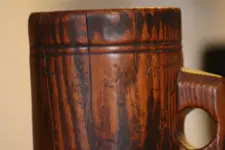
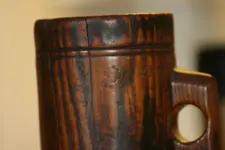
This would be called a ‘treen’ (literally ‘of the tree’) measure and the term is used to describe all manner of small utilitarian items hand carved from wood in olden times. Although such measures were indeed used aboard ships as rum measures and for other purposes (a Royal Navy item would be marked with the ‘broad arrow’ to indicate it was government property) they were more widely used by merchants, market traders, shops and taverns. They were used both for dry goods and liquids (especially beer), and the actual capacity was usually carved somewhere along the rim (or sometimes together with the crown mark).
The ‘VR’ mark with the crown is a ‘capacity mark’, indicating that the vessel has been approved by an official Weights and measures Inspector as being the correct (marked) capacity. Such marks became a nationwide legal requirement in Britain in 1836, but had been voluntarily self-applied by some makers prior to that, as well as having been formally enforced by some city authorities such as London & Westminster. Also, unmarked vessels which remained in use after 1836 were habitually officially marked retrospectively.
Until about 1878 each town generally had its own style of mark. From roughly 1879 onwards a uniform style was adopted consisting of a crown, the monarch’s title (as VR, GR or ER) and a number to denote the location where it was inspected. Measures often received multiple inspections during their lifetime and may carry several verification marks. Sometimes inspectors merely stamped a two digit number under the original mark to denote the year of re-inspection.
The other mark is a bit of a mystery. I would like to think it’s ‘G III R’ for George III (1760-1820) but, although I could persuade myself the first letter is a ‘G’ (looks more like a ‘C’ to me), the second letter doesn’t look at all like an ‘R’ (seems to be a ‘W’ or an ‘M’). The crown is also atypical of George’s royal cipher. My best guess is that this is a pre-1836 self-applied mark by, and for, the maker, but with an intentional resemblance to George III’s cipher. Note also that there appears to be an ‘AR’ mark alongside it, sometimes seen on early measures and of uncertain meaning, but usually with a crown above it.
So, I would think this is probably a late Georgian measure which has subsequently been officially inspected in Victorian times, between 1838 and 1879 (but likely the very beginning of that period).