What's new

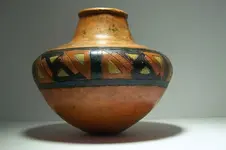
Old Incised Great Plains Painted Pottery Jar

Kevin D

Jr. Member
Joined
Nov 24, 2015
Messages
65
Reaction score
111
Golden Thread
0
Primary Interest:
All Treasure Hunting
Dear Members,

Many of us are already aware of the problem of a lack of documentation of pottery of the Great Plains tribes including the Cheyenne. And, as many were nomadic people, pottery was probably not very useful due to the fragile nature of it . When the tribes moved to a new location in search of say buffalo, the pottery could simply break so it is rarely found today. And only as a matter of conjecture, most of any of the pottery would have been made for a special use.
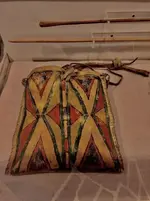
The lack of documentation on the pottery of these people led me to make comparisons of the complex nature of the artwork of the present example to other disciplines of textile art of of the Great Plains tribes. For example, the blackened green stripes around the jar, can also be found in some parfleches. Below is such an example with a blackened green stripe on a Sioux parfleche as can similarly seen in blackened green bands of the jar
And, also as a matter of conjecture, the complex nature of the artwork would have been done in keeping with a complex and great Native Society

Cheyenne Warring Societies theme


The pottery of the Great Plains tribes was typically made from a lump of clay, rather than the coil method as had been used by other tribes. One can see that the interior was “scooped” out from the “lump” in the Great Plains manner, with possibly some influence showing in the shape as might have been learned from Mexican neighbors of the Cheyenne to the south

The complex geometric motif implementing the number 4 in the pattern with fine blackish lines is commonly found in the decorative arts of the Great Plains tribes
The value of the jar comes by a literal interpretation on all of the symbolism employed in the design arrangement- The military theme would be of a military nation origin, one that was concerned with maintaining balance with power in unity of its segments of people used to protect a life of harmony within its borders, a great Native American spiritual goal of the military unit

Symbolism:
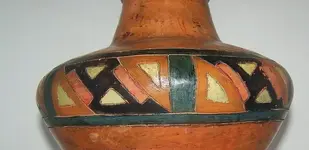
The choice of geometric shapes, triangles and stripes and colors, in the repeating pattern, six sets in all shows a great deal of symbolism for interpretation in the context of a warring theme of a great Native American nation organized as a military unit with the central theme of maintaining balance and harmony for its people

The ceremonial jar was painted in both war paint colors, and in a color that was used to convey a message of harmony

The war paints yellow, orange and deep red with only traces of red remaining on the smaller stripes show ones willingness to fight fiercely till death in battle. Black is symbolic of strength and power but it can also mean victory as face paint rather than war paint
A Native American belief held that the wearer of triangles and stripes when drawn in war paints would have supernatural powers bestowed upon them in battle.

The greenish tone color of the neatly laid out borders to the north, south and between each set conveys a message of harmony with the power to maintain it as signified by the black tones

The 4 larger and smaller triangles, point in all directions. The number 4 also denotes completeness in all of the directions, having 8 in all would compound the strength in symbolism

The repeating pattern of sets forms a well drawn circle, each set represents 1 of the warrior societies of the Cheyenne Nation, such as the Dog Soldiers, and all segments were made exactly the same to show none were above or to be treated differently from the others. The six societies together complete the circle signifying unity among them in the struggle to maintain balance and harmony

H: approximately 7 1/2"

Condition: much of the burnishing has worn away, paint losses, slight cracking


Thank you for your comments

Kind regards

Kevin

012518-1.webp
082018-a.webp
082018-b.webp
082018-c.webp
082018-d.webp
 
Last edited:
Upvote 6
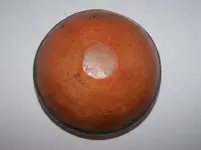
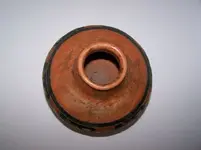
Observing carefully at the soot-covered base interior there is a second set of impressed marks which together resemble a circle and a band or a thick line
I don't see it.
 
I don't see it.
Hi,
please tap on the thumbnail to bring up the photo, thanks

further, I just inserted a photo to make it easier to see
 
Last edited:
Hi,
please tap on the thumbnail to bring up the photo, thanks
I did. I still don't see anything inside there. I see some cracks, some spots, and a large shadow. Are you saying the shadow is the circle?
 
I did. I still don't see anything inside there. I see some cracks, some spots, and a large shadow. Are you saying the shadow is the circle?

the marks are to the left of the eyes of the bird, just as small but distinctive from the bottom cracks , and not part of any shadows. I added a new photo circling these impressions
 
Last edited:
the impressed marks are to the left of the eyes of the bird, just as small but distinctive from the bottom cracks , and not part of any shadows. I added a new photo circling these impressions
Thanks. I see what you're talking about but I don't think it's a significant or intentional feature. Compare it to the artwork on the outside which is very distinct, clear, and intentional. I just don't see anything like that on the inside. But I don't think that detracts from the piece in any way -- it's a beautiful piece.
 
Thanks. I see what you're talking about but I don't think it's a significant or intentional feature. Compare it to the artwork on the outside which is very distinct, clear, and intentional. I just don't see anything like that on the inside. But I don't think that detracts from the piece in any way -- it's a beautiful piece.
Hi Robert, thank you, very much appreciate having your comments!

Very glad too I was able to make the right adjustments to the photo so you can see the imagery left by the circle and band impressions, while we also can disagree on their making or the intent then of the artist in putting them there in the clay.
 
as a potter myself, who uses natural dug clays and forms bowls using "by hand" methods... I can state with some authority that what you are seeing are natural impurities that are exposed during the firing process. I hope this helps.
 
No offense but your pot looks just like a modern decorative Mexican Olla. You say you found this in a thrift shop. Does it have any provenance? Do you have a theory how the pot was fired or where the paints came from? Is there a proposed time period?

Interesting theory I hope it pans out for you. Best of luck on your research.
 
as a potter myself, who uses natural dug clays and forms bowls using "by hand" methods... I can state with some authority that what you are seeing are natural impurities that are exposed during the firing process. I hope this helps.
thank you for your insight!- glad to know you are a potter- (I'm a collector) -

The two sets of marks are impressions which were purposely placed in the clay by the artist before it dried- The impressions by the movement of the clay around them were made when the clay was still wet- we are seeing both sets of marks by design then, rather than by some coincidence or random occurrence, and not done in the firing process as you might have thought

And again, they resemble symbols already found in the 19th C artwork of the Kiowa and the closely associated Plains Apache, giving further evidence of a direct connection of these two cultures to the origin and of the jar.
.
 
Last edited:
Below is a link to an ebook titled the "ARCHEOLOGICAL EXPEDITION TO ARIZONA IN 1895" by Jese Fewkes. Scrolling through the book, there is an account of the Sikyatki dig that took place in a study of the Pueblo life in a prehistoric period.
I discount anything Fewkes wrote. Having lived and worked with the Hopi I learned that virtually everything he wrote about their culture and language was false and easily demonstrated as false. The dude made stuff up for a living.
 
No offense but your pot looks just like a modern decorative Mexican Olla. You say you found this in a thrift shop. Does it have any provenance? Do you have a theory how the pot was fired or where the paints came from? Is there a proposed time period?

Interesting theory I hope it pans out for you. Best of luck on your research.
Hi,
thank you, regrets, no it has too much age and Plains detail -by the colors chosen, the use of straight line geometric shapes and how these come together in the development of the rectangular pattern giving us context in its messaging or statement. the symbolism of the marks also play a role on that.
The general shape or form however, which I believe you might be referring too is more similar to some Apache vessels w/ perhaps some physical similarities that might be found in other vessels, as well for the late 19th C period .

The above should provide better detail in each of these aspects -and a Mexican jar origin, aside from their general physical characteristics, below however was discounted at the start.

for the benefit of those who might not know what a modern or studio olla should look like, one is given in the link below. the clay used in the present example , however, is rough and raw w/ some fossil shell impressions found in its composition

https://www.liveauctioneers.com/item/158621937_signed-mata-ortiz-pottery-olla-vessel

plain, no decorative patterning, a late 19th/ 20th "olla"
 
Last edited:
here is a second example of an "olla" from around 1900, much different in appearance by the design elements, not Plains at all, and the age character is different between them. we see in the links, examples which are maybe more refined in their making than what we see in the raw more natural elements of this example.

the above gives important and connecting detail on the likely origin and how the Plains people, in general, acquired their paint by the end of the 19th C, which is where in the timeline the jar belongs by its character and detailing around it, thank you!


one more, early 20th C:

 
Last edited:
Dear Members,

Many of us are already aware of the problem of a lack of documentation of pottery of the Great Plains tribes including the Cheyenne. And, as many were nomadic people, pottery was probably not very useful due to the fragile nature of it . When the tribes moved to a new location in search of say buffalo, the pottery could simply break so it is rarely found today. And only as a matter of conjecture, most of any of the pottery would have been made for a special use.
The lack of documentation on the pottery of these people led me to make comparisons of the complex nature of the artwork of the present example to other disciplines of textile art of of the Great Plains tribes. For example, the blackened green stripes around the jar, can also be found in some parfleches. Below is such an example with a blackened green stripe on a Sioux parfleche as can similarly seen in blackened green bands of the jar
And, also as a matter of conjecture, the complex nature of the artwork would have been done in keeping with a complex and great Native Society

Cheyenne Warring Societies theme


The pottery of the Great Plains tribes was typically made from a lump of clay, rather than the coil method as had been used by other tribes. One can see that the interior was “scooped” out from the “lump” in the Great Plains manner, with possibly some influence showing in the shape as might have been learned from Mexican neighbors of the Cheyenne to the south

The complex geometric motif implementing the number 4 in the pattern with fine blackish lines is commonly found in the decorative arts of the Great Plains tribes
The value of the jar comes by a literal interpretation on all of the symbolism employed in the design arrangement- The military theme would be of a military nation origin, one that was concerned with maintaining balance with power in unity of its segments of people used to protect a life of harmony within its borders, a great Native American spiritual goal of the military unit

Symbolism:
The choice of geometric shapes, triangles and stripes and colors, in the repeating pattern, six sets in all shows a great deal of symbolism for interpretation in the context of a warring theme of a great Native American nation organized as a military unit with the central theme of maintaining balance and harmony for its people

The ceremonial jar was painted in both war paint colors, and in a color that was used to convey a message of harmony

The war paints yellow, orange and deep red with only traces of red remaining on the smaller stripes show ones willingness to fight fiercely till death in battle. Black is symbolic of strength and power but it can also mean victory as face paint rather than war paint
A Native American belief held that the wearer of triangles and stripes when drawn in war paints would have supernatural powers bestowed upon them in battle.

The greenish tone color of the neatly laid out borders to the north, south and between each set conveys a message of harmony with the power to maintain it as signified by the black tones

The 4 larger and smaller triangles, point in all directions. The number 4 also denotes completeness in all of the directions, having 8 in all would compound the strength in symbolism

The repeating pattern of sets forms a well drawn circle, each set represents 1 of the warrior societies of the Cheyenne Nation, such as the Dog Soldiers, and all segments were made exactly the same to show none were above or to be treated differently from the others. The six societies together complete the circle signifying unity among them in the struggle to maintain balance and harmony

H: approximately 7 1/2"

Condition: much of the burnishing has worn away, paint losses, slight cracking


Thank you for your comments

Kind regards

Kevin

View attachment 1623797
View attachment 1623798
View attachment 1623799
View attachment 1623800
View attachment 1623801
Hi All,
Update -
adding a new photo taken with different lighting to better highlight the rough exterior character w/some evidence of hand scraping around the top surface, and the age character w/its brownish patina around the base
Thank you!

,

Briefly, for the benefit of those who have not read through the pages, some very specific details of the design elements, in terms of color choices and combinations of them, shapes and their placement set the context for an interpretation of the complex minimalist pattern within the Plains culture: Black and yellow placed together at the center of each rectangle in the circle, for example, would signify a sacred place to the tribe or culture, such as a sacred mountain top w/territory represented by each rectangle. While color can have different meanings depending how it's used, yellow at the sacred center, should be understood to mean the creator color and the surrounding black color for the power and strength derived from there by the tribe or culture, represented by the small triangle in black.

Native strength at the ends of the rectangles, represented by the flesh-toned stripes, splotched with oxblood red paint sit adjacent to the larger triangles at the edge, a combination designed as a show of warrior and supernatural strength together. Oxblood red splotches, similarly found in the red splotches of ledger drawings, signify a warrior who has or is willing to shed blood in battle. However, this shade of red is readily found in the art of the Chiricahua Apache. The well-balanced pattern is reversible, and it should read the same w/ the jar positioned right side up or upside down


While some of the details which were developed early on in this project pointed to possible Cheyenne and Lakota connections, others on the other hand which came later will show a tenable one to the Kiowa, Plains or Kiowa Apache. On the ash covered interior base, two sets of marks were impressed into the clay while it was wet (by the way the displaced clay was pushed to form walls around them in making the impressions). The shapes of these match up w/ some imagery found in 19th century art of the Kiowa, and Plains Apache. It would be a matter of conjecture, as to whether these are distinctive signature marks of the artist or if they were put there for some greater significance in how the jar was meant to be used. However, as shown earlier, the shape of the jar w/ its rolled lip character, sloping shoulders, wide girth, and narrowing or conical base can be similarly found on some Apache jars from the period. it should also be noted that a sharply conical base might more likely be found on older 19th century jars, than generally anything later.
 

Attachments

  • thumbnail_IMG_8940a.webp
    thumbnail_IMG_8940a.webp
    54.8 KB · Views: 45
Last edited:
Hi All,
Update -
adding a new photo taken with different lighting to better highlight the rough exterior character w/some evidence of hand scraping around the top surface, and the age character w/its brownish patina around the base
Thank you!

,

Briefly, for the benefit of those who have not read through the pages, some very specific details of the design elements, in terms of color choices and combinations of them, shapes and their placement set the context for an interpretation of the complex minimalist pattern within the Plains culture: Black and yellow placed together at the center of each rectangle in the circle, for example, would signify a sacred place to the tribe or culture, such as a sacred mountain top w/territory represented by each rectangle. While color can have different meanings depending how it's used, yellow at the sacred center, should be understood to mean the creator color and the surrounding black color for the power and strength derived from there by the tribe or culture, represented by the small triangle in black.

Native strength at the ends of the rectangles, represented by the flesh-toned stripes, splotched with oxblood red paint sit adjacent to the larger triangles at the edge, a combination designed as a show of warrior and supernatural strength together. Oxblood red splotches, similarly found in the red splotches of ledger drawings, signify a warrior who has or is willing to shed blood in battle. However, this shade of red is readily found in the art of the Chiricahua Apache. The well-balanced pattern is reversible, and it should read the same w/ the jar positioned right side up or upside down


While some of the details which were developed early on in this project pointed to possible Cheyenne and Lakota connections, others on the other hand which came later will show a tenable one to the Kiowa, Plains or Kiowa Apache. On the ash covered interior base, two sets of marks were impressed into the clay while it was wet (by the way the displaced clay was pushed to form walls around them in making the impressions). The shapes of these match up w/ some imagery found in 19th century art of the Kiowa, and Plains Apache. It would be a matter of conjecture, as to whether these are distinctive signature marks of the artist or if they were put there for some greater significance in how the jar was meant to be used. However, as shown earlier, the shape of the jar w/ its rolled lip character, sloping shoulders, wide girth, and narrowing or conical base can be similarly found on some Apache jars from the period. it should also be noted that a sharply conical base might more likely be found on older 19th century jars, than generally anything later.
Hi All,
Update,
Sacred mountain tops were revered for their powerful sources of different kinds of energy which were rooted in both masculine and feminine qualities. Masculine energy was related to such ideals as strength, protection, bravery, and leadership while feminine energy was associated with nurturing, healing, and spiritual enlightenment. These energies were harnessed in rituals and ceremonies held at these sites. Attaining balance between both types, masculine and feminine was a highly regarded goal for an individual and toward the overall well-being of a culture

In Native Indian language, an upward-pointing triangle symbolizes masculine energy, and a downward-pointing one represents feminine energy. The opposing pair of upward and downward triangles, outlined in black at the center of each rectangle symbolize a sacred site where both masculine and feminine energies exist. Sacred as the center of a culture's system of beliefs within a territory, and drawn between pairs of symbols of bravery, and super-natural strength for protection, as given above. The merged black triangles around each set then represent the achievement of the goal of creating a balance between these two types of energy within the culture. they become one in the illustration. A source of power then which needed to be protected as a matter of survival for a tribe or culture. In terms of modern culture, the center in an illustration might be a school or a hospital which would be different than what has been depicted here by the warrior symbolism.
 
Hi All,

Adding in summary, thank you!

Clay, pit fired, painted and incised, pigment, burnished with fat to produce the light sheen around the clay body

Purchased from an Ohio thrift store in January 2018

Conveyed by the complex circular patterning, lies evidence of Native beliefs, outlining for the viewer, the important goal to achieve a life of balance and harmony on Native grounds, Plains culture, late 19th century, possibly later.

The painted and incised patterning, forming a unified circle of the six equally made rectangles reveals a deeper story in the quest for the preservation of a traditional way of life on Native land. The connections to the Plains culture are many. The content of the full set of color choices and their combinations to the shapes, positioning, and the important context created by these design choices relate to this culture, pre-reservation period. Well-documented facts and associations to the published period art of the Plains people and the Apache are readily found in searches to aide in understanding its brilliance. One that's equally complex in its design as the story it reveals for the viewer.

Here, a late 19th century date would seem appropriate, and while the actual time of production can't be ascertained by current scientific methods, the burnished and roughly made clay piece is old by its age character, including age related wear, its form and the way it was made. The messaging system significantly provides evidence to a system of beliefs held in support of a traditional way of life on Native lands. Important elements in the design choices include symbols of supernatural and warrior strength, unity of the people, and the important goal of achieving balance and harmony within the culture.

Prominently found in period Plains' artistry are yellow triangles framed in black. Paramount, at the center within each of the six rectangles are the pairs of opposing upward and downward-pointing yellow triangles framed by black. A symbolic representation by the coloring and location of the sacred center to their world. Probably a sacred mountain top but revered as a source to harness both masculine and feminine energy, and in balance together toward the greater well-being , even as a matter of survival of the culture.

The upward-pointing triangles symbolize masculine energy with personal qualities of bravery and leadership held high in this regard. The downward-pointing ones symbolize feminine energy, such as qualities of nurturing, a deep connection to the land and enlightenment or wisdom. The two energy types were compatible or harmonious to one another and were sought together for strength. Great power, depicted by their framing in black from the source in yellow, was typically acquired through prayers or ceremony at a sacred site.

The physical aspects of the jar, including the unusual, rolled lip character, the sloping neck, wide girth and narrowing base can similarly be found in the art of the Apache culture from this period. The sharp conical shape of the base is typically found on the older vessels of the period. The well- balanced patterning, in typical fashion as found among Plains art is a symbolic reference to the central goal to live a life in balance. The pattern is reversible, which is to say the imagery remains the same whether viewing the piece when it's upside down to empty the contents or when it sits upright.

The native flesh-toned stripes in their pairing with larger triangles incorporate oxblood paint. The reddish color is commonly found in the Chiricahua art of the period. The ledger drawings by the Plains warriors frequently depicted a warrior with red splotches, symbolizing one who was willing to shed blood in battle. Supernatural strength appears in the form of the larger orange triangles, sitting adjacent to the flesh-toned stripes. In highly symbolic form, the combination of supernatural and Native strength serve to defend Native ground, and are strategically positioned on both sides in the depiction of what can be described as the center of their world.

The artist, for emphasis highlights in great symbolic detail the power of Native unity by the circle formed by the connecting rectangles, meaning whole, and the flesh toned stripes, also a symbol of unity .
The rectangles, each a symbolic representation for Native territory in Plains culture, are marked by borders colored in a somewhat rarely seen color combination of black over the color green with green establishing harmony. Use and context of this special combination can be found in various period examples of Plains art, such as the Sioux parfleche, and the Kiowa feather case, both given above.

Inside, along the sooty base are two sets of impressed marks, intentionally placed in the clay when wet by the artist. To date it is unknown why these marks are present or their meaning. However, separately, these resemble the imagery of what can be found in the art of the Kiowa and Kiowa Apache of the period. By the marks, its shape and the use of oxblood red, the artist may have been of Kiowa or Plains Apache( Kiowa Apache) origin. However, that should not preclude the possibility, through inter-marriage, for example the jar's use by a different tribe.
 

Users who are viewing this thread

Back
Top Bottom