What's new

Old Iron Spike - Bloody Bay

Golfman

Tenderfoot
Joined
Sep 18, 2025
Messages
7
Reaction score
3
Golden Thread
0
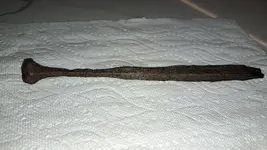
We have a parcel of land on Bloody Bay in Little Cayman and found several spikes that are most likely cribbing spikes. Photo Attached. But I have not found anything on line that looks like them. Definitely appear to be hand wrought with 4 tapered sides on the shank coming down to a chisel point. But the the neck is very narrow and widens out to the tip. Not sure why. Any ideas out there?
 

Attachments

  • 20250918_160447.webp
    20250918_160447.webp
    1.2 MB · Views: 138
We have a parcel of land on Bloody Bay in Little Cayman and found several spikes that are most likely cribbing spikes. Photo Attached. But I have not found anything on line that looks like them. Definitely appear to be hand wrought with 4 tapered sides on the shank coming down to a chisel point. But the the neck is very narrow and widens out to the tip. Not sure why. Any ideas out there?
Perhaps a part of the spike might have been an oak beam, thus protecting or accelerating the deterioration.
 
Perhaps a part of the spike might have been an oak beam, thus protecting or accelerating the deterioration.
Don't think so. This one and several like it were found in the sand and not in wood. plus the upper thinner part of the shank also appears to be flat, like it was fabricated that way.
 
Don't think so. This one and several like it were found in the sand and not in wood. plus the upper thinner part of the shank also appears to be flat, like it was fabricated that way.
All 4 sides are fairly flat. Deterioration from rusting would not have been that consistent.
 
Pepper is correct....a ship spike would never be forged in that fashion, for you could not drive it due to the thinned shank. To me, it's clearly a very old rose head ship spike that has been altered from its long corrosive cycle where it was subject to being partially embedded in a timber as it rotted. The fact that it appears to still have a squared shank at the narrow spot is inconsequential, as I have found many forged spikes with similar irregularities from corrosion. Nice spike though.
 
Pepper is correct....a ship spike would never be forged in that fashion, for you could not drive it due to the thinned shank. To me, it's clearly a very old rose head ship spike that has been altered from its long corrosive cycle where it was subject to being partially embedded in a timber as it rotted. The fact that it appears to still have a squared shank at the narrow spot is inconsequential, as I have found many forged spikes with similar irregularities from corrosion. Nice spike though.
Thanks. I appreciate the input. I understand and agree with the potential for an exposed area closer to the head to be more degraded. But the consistent and even increase in diameter from mid-point of the shank to the tip (ostensibly the portion within the wood) still puzzles me. That appears to designed. Is it possible that this is some type of small chisel, and not a spike? However, I would not expect a rose head on a chisel. So still puzzled.
 
All depends on how the blacksmith finished his nails, some were chisel pointed, some were pointed and some were square to the head to the tip....here are a few of mine to show how variations and corrosion can alter one nail from another.
1146.webp
 
All depends on how the blacksmith finished his nails, some were chisel pointed, some were pointed and some were square to the head to the tip....here are a few of mine to show how variations and corrosion can alter one nail from another.View attachment 2225861
Thanks. I appreciate all the help.
 
Thanks. I appreciate all the help.
Any thoughts on age. I am guessing pre-1800 based on the construction of the head and the direction of the grain running in line with the shank. But beyond that, I have no idea how early
 
Hard to say how old...but it is old and hand forged and typical of such a time period s you suggest. Keep in mind they could have come from an old wharf structure and not from a vessel...iron nails were used as fasteners above the waterline in early ship building, as some will erroniously claim that iron was not used as such. My guess would be ship spike from late 1700 to early 1800s I I were to throw my thoughts out there.
 

Users who are viewing this thread

Latest Discussions

Back
Top Bottom