What's new

Please help identify...Black fish rock

highnam

Bronze Member
Joined
Jan 23, 2012
Messages
1,624
Reaction score
1,710
Golden Thread
0
Location
Western Washington
Primary Interest:
All Treasure Hunting
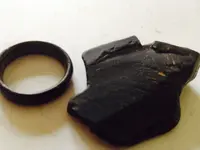
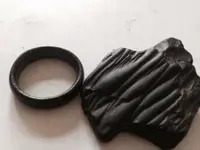
Found this rock in a creek near my house, haven't seen anything like it. The stone is glassy smooth, but have strange cuts that look like fish bodies on one side and pretty smooth on the other...anyone see anything like this before? Thanks!
 

Attachments

  • image.webp
    image.webp
    323.9 KB · Views: 167
  • image.webp
    image.webp
    374.2 KB · Views: 154
Could be a few things. Does it feel heavy or light? Do a streak test and let us know. Possibilities are coal, obsidian, hematite if its natural. Slag or coal waste if not. If your in Washington volcanic origin is pretty high for obsidian.
 
Upvote 0
Could be a few things. Does it feel heavy or light? Do a streak test and let us know. Possibilities are coal, obsidian, hematite if its natural. Slag or coal waste if not. If your in Washington volcanic origin is pretty high for obsidian.
Thanks DDancer-
I have checked the stone and found it to be more heavy than light and extremely dense...I don't know how to scratch test, but I don't see anything that resembles obsidian...I know I described the stone as glassy, but I just meant really smooth. I did rub the stone on paper to see if it would leave a residue and it doesn't.
The stone is flat black and not magnetic.
 
Upvote 0
Streak testing is a matter of just scratching the item on a bit of unglazed porcelain and observing the color and character of the streak. Underside of a white tank lid of a toilet works or a bit of white tile used in flooring. Paper is not going to work unless its graphite your testing ;) Streak test will also give you an initial idea of how hard the mineral is. Minerals much above 7.5 to 8 dont streak well or at all because they are harder than glass. There is a lot on the subject of testing minerals on the net.
 
Upvote 0
Streak testing is a matter of just scratching the item on a bit of unglazed porcelain and observing the color and character of the streak. Underside of a white tank lid of a toilet works or a bit of white tile used in flooring. Paper is not going to work unless its graphite your testing ;) Streak test will also give you an initial idea of how hard the mineral is. Minerals much above 7.5 to 8 dont streak well or at all because they are harder than glass. There is a lot on the subject of testing minerals on the net.
Hey DDancer, thanks for the info...I scratched the unglazed backside of a white wall tile and found the stone didn't leave a streak or any color, but it did scratch the tile, with no damage to the stone at all...the stone must be super dense, the color stays jet black wet or dry...any direction I can go from here?
 
Upvote 0
Is it magnetic, if so weakly or strongly? If you have scales, or know someone who does try a specific gravity test. Pretty hard material seeing as it does not want to streak test. That puts it in the range of silicates.
 
Upvote 0
Just FYI, there is a sample of a simple test on Mindat.org... Scratch, mohs, color ,appearance ect.
 
Upvote 0
Thanks for the info...I checked the site out but ran into dead ends...the stone is not magnetic. This stone is gunna drive me nuts!
 
Upvote 0
I'm back in the opinion of volcanic origin again myself. The top and bottom views have me set on a flow pattern. The hardness and density by weight of feel reported as well as lack of magnetic material support my thoughts. Looking at simular images on the net also lends me to the opinion. Not much else fits unless someone else see's something different I'd say its a bit of flow stone.
 
Upvote 0
I think it does have characteristics of Basalt, I see that Basalt often has parallel lines running through it, so the lines on the stone are probably naturally made?...I have not seen a basalt stone exactly like it, but it seems the most likely to me.
Could the fish body carvings actually be Basalt that has cooled in that State naturally?
 
Upvote 0
Either cooled that way or could be worn by water/sand over time. The backside of the stone shows me that there was some flow to the rock, the u shaped lines, and the pattern looks like an impression from the rock it moved over.
 
Upvote 0

Users who are viewing this thread

Back
Top Bottom