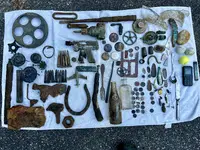
Great finds. The "it sings in the glass" bottle is very cool.
That caught my eye too. It's a local company in our state. I did find this on the internet which explains more...a little lengthy...
Quote:
Here is a very good story. The history of the Warwick Club Ginger Ale Company. I have a lot of info on this company, but we had to condense it down for the newspaper. This story will appear in the Kent County Daily Times newspaper next week.
Brian E. Guiot
Cecilia A. St. Jean
Pawtuxet Valley Preservation and Historical Society
Warwick Club Ginger Ale, “It sings in the glass”
On April 15, 1909, Fred Clarke purchased an interest in the Warwick Bottling Works, a soft drink company founded by James E. Wood in 1902. The company was located in a small building on Pond Street, in the village of Arctic, and produced sodas of all kinds, including sarsaparilla and sassafras, which were big favorites back then. Initially, its product was sold in glass bottles embossed with the company name, but later on were redesigned with a logo featuring the initials W.B.W. and the words Warwick Bottling Works, Arctic, RI, in the center of a circle.
Deliveries made by horse-drawn wagons were followed by the company’s first motorized vehicle – a 1904 Cadillac open-cab truck. For a short time during the transition, both horses and trucks provided transportation. In 1912, an addition was built to garage the delivery wagons and trucks. Three years later, the wagon shed was transformed into a bottling plant and a little storage building was built to replace the original one.
The introduction of Freon in the 1920s expanded the refrigerator market and benefited the beverage industry. The company profited by expanding its market outside of the Valley. In 1928 Fred Clarke bought out James Wood and the business was renamed Warwick Club Ginger Ale Company, Inc. A year later Fred’s his son Luke came to work for his father after graduating from Rhode Island College, earning an Electrical Engineering degree from URI, and working for Westinghouse Electric Co. for five years.
In 1935 Pepsi Cola was added to its brand and the company became identified with the Pepsi Cola Bottling Company of Rhode Island Inc. Fearing that there might be some confusion with Coca-Cola, the Clarkes retained the franchise for the Warwick Club Ginger Ale Company for the entire state of Rhode Island. The company became larger and even more successful under the two names: Warwick Club Ginger Ale Co. Inc. and the Pepsi – Cola Bottling Company of Rhode Island.
In 1936 the 108 Pond Street bottling works expanded again with an addition to the plant. In the spring of 1937 the Miller Soaker and the “728 filler”, the first automatic soda production machines, were installed. This automation process led the company to become Rhode Island’s largest bottling works at that time. As production continued to increase, yet another addition was built to the plant.
By November 1938, the building housing the bottling works was twice the size from when it was purchased by Fred Clarke in 1909. During the same year the company acquired new automatic forty-spout machines and added a new bottling room.
Things were going well. They were making all kinds of sodas. Orange, grape, lemon lime and other flavors, and of course ginger ale. The company catchphrase for its most popular drink was, “Warwick Club Ginger Ale, pale dry or golden, ‘It sings in the glass’”.
Speedball was another favorite thirst quencher for people in the Valley; and its disappearance from the market is an interesting story going back to 1927 when Frederick Gadoury was hired as a “tonic mixer”. Fred worked his way up to “chemist” and concocted a tangy beverage he named “Speedball”. It was orange in color and contained bits of orange pulp. He guarded his recipe closely, memorizing it, never recording it on paper. The label on the bottle was also his own. As he was a big Red Sox fan, the design featured a baseball with the word “Speedball” written across it.
The company produced Speedball for a number of years and one day Luke asked Fred for the recipe. Fred, thinking ahead to his retirement, tried to negotiate a price but that didn’t go anywhere. He continued working at the plant until his retirement sometime around 1964, having advanced from tonic mixer, to chemist, to plant manager. Frederick Gadoury died on October 30, 1970, and his recipe for Speedball went to the grave with him.
Fast forward to 1953, the 25th anniversary of Warwick Club Ginger Ale co., Inc. There was an Open House at the plant. Ads read: “You’re familiar with Warwick Club Grade “A” beverage. Come and inspect the modern hygienic plant where they are made and bottled. See how we protect the quality at every stage of manufacture from laboratory to bottling machine. Learn about the extra care and skill, and the extra quality ingredients that have given Warwick Club its wide reputation and made it worthy of the exclusive privilege of bearing the registered seal “GRADE A.” Please visit us and enjoy yourself during Old Homes Week and our Silver Anniversary.”
In the 1960s they branched out even more, besides selling Warwick Club & Pepsi products, they also sold Schweppes products, Fanta sodas and Moxie. In 1968, Luke Clarke called it quits and the famous Warwick Club Ginger Ale Company and Pepsi Cola Company was sold. It was a good run from when his dad purchased the Warwick Bottling Works in 1909 until 1968 when the big garage doors on 108 Pond Street closed.
Luke Clarke died on July 30,1987.


 .
.  lots of what's its!