What's new

Possible Fossil (What is it?)

fieldsjoe89

Jr. Member
Joined
Dec 27, 2014
Messages
84
Reaction score
183
Golden Thread
0
Location
Alabama
Detector(s) used
Garrett GTI 1500,White's VX3, Tesoro Stingray
Primary Interest:
All Treasure Hunting
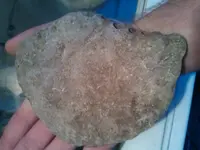
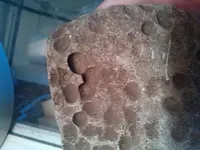
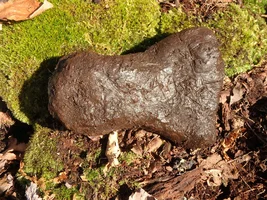
I've had this rock for almost 15 years, but I really don't know what it is. This is the only picture I have currently since it is in storage. I found it in SWVA, which is the extreme western half of Virginia in the Appalachian Mountains. Anyone have any idea what it is?
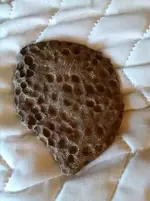

fossil.webp
 
Deleted by author.
 
Last edited:
I'm going for coral fossil also.
 
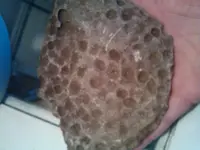
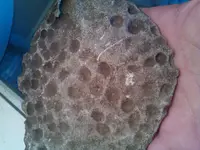
I don't think it's coral. The chambers are too irregularly-spaced, some overlapping, with no central structures in the chambers apparent.

We should have more images and dimensions.

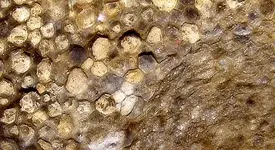
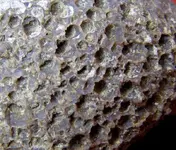
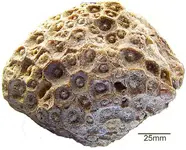
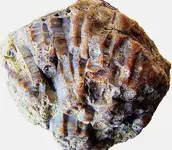
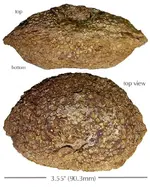
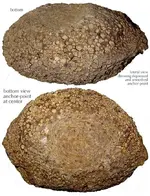
Maybe it's a dasyclad such as this Cyclocrinites sp, Silurian of Eastern Indiana.:
algae_dasyclad_pseudomorph.webp algae_dasyclad_pseudomorph (2).webp algae_dasyclad_pseudomorph (3).webp algae_dasyclad_pseudomorph (5).webp
​
Here's what FOSSILS OF OHIO (1996) says:
Order Dasycladales (calcareous green algae)[dasyclads]
Family Dasycladaceae (extinct and recent)
Family Receptaculitaceae (extinct)
Tribe Receptaculiteae [receptaculitids]
Tribe Cyclocriniteae [cyclocrinitids]
Genus Cyclocrinites

"Fossils of this order [dasyclads] are only rarely recognized by collectors.". . .

"Fossil dasyclads are globose to cylindrical or club shaped in outline. They grew on the sea floor to several centimenters in height.

"Internally, a central, noncalcareous structure, the stem or stipe, was surrounded by worled branches or protuberances (rays). . . . They are generally visible only in cracked or broken specimens.

"The primary branches or rays of some dasyclads are rounded at the tip; some have bristlelike or spinelike appendages; others have cuplike or prismlike tips that may be fused as an outer covering of small polygons.

"In cyclocrinitids, the end of each branch is expanded or branched to form a terminal rhomboidal plate. Each plate is one facet in a fused network of terminal plates of other lateral branches so that the surface of the whole body appears as a reticulate shell of calcareous prisms. . . .

"Cyclocrinities is generally a somewhat flattened sphere that has an indentation there the stem (pedicel) was attached. The main central axis was short; lateral branches were very slender, almost rodlike, and arranged in whorls around the central axis. The distal ends of the branches were swollen, and adjacent swollen branch tips coalesced to form the heads, which were polygonal (generally six-sided) in outline at the surface of the spherical body. These polygonal facets were calcified." . . .
 
Last edited:
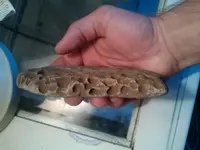
Judging by those images and what I remember of the specimen, I'm not quite sure that is it either. The daisyclads you posted look more crystalline in their material, where as the item I have is more similar to limestone. It was a little less than an inch thick and may be 5 inches in length.
 
Deleted by author.
 
Last edited:
Thanks for the map. Judging by the map, it would either be Cambrian or ORDOVICIAN-SILURIAN, with a slight chance it is DEVONIAN-MISSISSIPPIAN. I'm from Russell County originally, and that is where I found most of my fossils. The only other location I would have found it in would be in Washington County which is would also be grouped in the three I mentioned. It's very interesting to find out it may be coral. I've also found fossilized sea shells in this general location, as well as fossils with with raised indention's that resemble roots. The fossils that resemble roots spread all over the rock and often have perpendicular lines running across them.
 
Judging by those images and what I remember of the specimen, I'm not quite sure that is it either. The daisyclads you posted look more crystalline in their material, where as the item I have is more similar to limestone. It was a little less than an inch thick and may be 5 inches in length.

Preservation is a local accident. Different environment, different preservation. Don't expect your dasyclad to be identically preserved unless they both come from the same geological setting.
 
IMG_20150814_143941.webpIMG_20150814_143947.webpIMG_20150814_143955.webpIMG_20150814_144001.webp

I just got it out of storage, pictures aren't the best because of my phone, but they should give a better idea of the size.
 
Deleted by author.
 
Last edited:
I agree, this is a mystery. If it were a dasyclad or a coral, you should detect structure on the reverse side as well as the face. Burrows, solution pits . . . who knows!
 
I have one last photo to add. In the corner of the rock there is a flower shaped pattern of circles. I thought that was interesting since its the only one. Thanks for the info btw.

IMG_20150814_143934.webp
 

Users who are viewing this thread

Back
Top Bottom