What's new

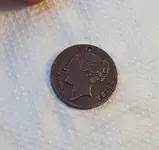
Rare 1837 UK Token

Mytoys

Sr. Member
Joined
Dec 19, 2024
Messages
305
Reaction score
1,172
Golden Thread
0
Not Coinstar but such a unique rare dug find wanted to share.
1837 Victoria Regina dug 3" in front of a 1730s home.
 

Attachments

  • Screenshot_20250731_134346_Google.webp
    Screenshot_20250731_134346_Google.webp
    112.6 KB · Views: 134
  • 20250731_135542.webp
    20250731_135542.webp
    64.7 KB · Views: 108
  • 20250731_135044.webp
    20250731_135044.webp
    101.4 KB · Views: 107
Upvote 18
Great find. Your AI-generated result doesn’t have it completely right. The token doesn’t really satirise Queen Victoria’s inability to inherit the Hanover titles after ascending the British throne. It more satirically mocks the unpopular Duke of Cumberland (dubbed Cumberland Jack) when the majority of the British public gleefully celebrated him returning to Germany after his inability to take the British throne instead of Victoria. The history is this:

Queen Anne died in 1714 without leaving an heir to the British throne. Although she had more than fifty blood relatives who had a legitimate claim, they were all Catholic, and the 1701 “Act of Settlement” prohibited Catholics from inheriting the throne. Her closest living Protestant relative was George Ludwig, then ruler of the Duchy and Electorate of Brunswick-Lüneburg (Hanover) in Germany and he was crowned King in Britain as George I. The Catholic community were disgusted and (as a German) he wasn’t all that popular with many other Brits either.

George’s Hanoverian titles passed through George II, III, IV, and William IV but, when Victoria came to the throne in 1837, Salic Law did not permit the titles to pass to a woman. They passed to the next male heir - Ernest Augustus, Duke of Cumberland – who then became King of Hanover. He was also disliked in Britain, having opposed the much-loved Victoria’s accession to the throne (to which he felt he was entitled) as well as being opposed to Parliamentary reform and Catholic emancipation. He also had unsightly facial scars incurred (he claimed) when an intruder with a sword attacked him in his bedroom in 1811 and one of his valets was subsequently discovered partly undressed with his throat slit. Rumours about homosexuality, his role in the servant’s death and other unsavoury aspects of his personal life dogged him for years.

There was widespread public pleasure when the Duke (who had earned the nickname “Cumberland Jack”) departed to Germany in 1837 to take up his duties in Hanover, resulting in the production of these mocking tokens. They were produced in both copper and brass at least until the 1860s with unchanging dates of either 1837 or 1838 on the reverse (I’ve seen one with the impossible date of 1830) but occasionally with the real date on the obverse under the queen’s head. There are dozens of variations of which the “monkey face” types are the most common. The reverse design is a parody of the “St George & Dragon” design used on sovereigns and the dragon sometimes has two heads to represent the dual kingship of Britain and Hanover that ended with Victoria’s accession. I’ve seen one example that depicts him on a rocking horse. The legend is either “To Hanover” or “Off to Hanover”.

These pieces never circulated as tokens in a monetary sense as far as I know, and I’ve never seen one advertising a merchant’s name, but were produced for use as counters in parlour card games such as whist. The “sovereign-look” brass ones also became popular with turf accountants (bookmakers taking bets at horse-racing tracks, which was the only legal form of gambling in Britain from 1845). They would put a few stacks of them on their tables “heads-up” as an enticing reassurance to gamblers that they had enough money to pay out a big win, while also not risking loss of the real thing by thieves.
 
Great find. Your AI-generated result doesn’t have it completely right. The token doesn’t really satirise Queen Victoria’s inability to inherit the Hanover titles after ascending the British throne. It more satirically mocks the unpopular Duke of Cumberland (dubbed Cumberland Jack) when the majority of the British public gleefully celebrated him returning to Germany after his inability to take the British throne instead of Victoria. The history is this:

Queen Anne died in 1714 without leaving an heir to the British throne. Although she had more than fifty blood relatives who had a legitimate claim, they were all Catholic, and the 1701 “Act of Settlement” prohibited Catholics from inheriting the throne. Her closest living Protestant relative was George Ludwig, then ruler of the Duchy and Electorate of Brunswick-Lüneburg (Hanover) in Germany and he was crowned King in Britain as George I. The Catholic community were disgusted and (as a German) he wasn’t all that popular with many other Brits either.

George’s Hanoverian titles passed through George II, III, IV, and William IV but, when Victoria came to the throne in 1837, Salic Law did not permit the titles to pass to a woman. They passed to the next male heir - Ernest Augustus, Duke of Cumberland – who then became King of Hanover. He was also disliked in Britain, having opposed the much-loved Victoria’s accession to the throne (to which he felt he was entitled) as well as being opposed to Parliamentary reform and Catholic emancipation. He also had unsightly facial scars incurred (he claimed) when an intruder with a sword attacked him in his bedroom in 1811 and one of his valets was subsequently discovered partly undressed with his throat slit. Rumours about homosexuality, his role in the servant’s death and other unsavoury aspects of his personal life dogged him for years.

There was widespread public pleasure when the Duke (who had earned the nickname “Cumberland Jack”) departed to Germany in 1837 to take up his duties in Hanover, resulting in the production of these mocking tokens. They were produced in both copper and brass at least until the 1860s with unchanging dates of either 1837 or 1838 on the reverse (I’ve seen one with the impossible date of 1830) but occasionally with the real date on the obverse under the queen’s head. There are dozens of variations of which the “monkey face” types are the most common. The reverse design is a parody of the “St George & Dragon” design used on sovereigns and the dragon sometimes has two heads to represent the dual kingship of Britain and Hanover that ended with Victoria’s accession. I’ve seen one example that depicts him on a rocking horse. The legend is either “To Hanover” or “Off to Hanover”.

These pieces never circulated as tokens in a monetary sense as far as I know, and I’ve never seen one advertising a merchant’s name, but were produced for use as counters in parlour card games such as whist. The “sovereign-look” brass ones also became popular with turf accountants (bookmakers taking bets at horse-racing tracks, which was the only legal form of gambling in Britain from 1845). They would put a few stacks of them on their tables “heads-up” as an enticing reassurance to gamblers that they had enough money to pay out a big win, while also not risking loss of the real thing by thieves.
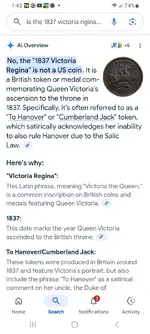
Yup absolutely
 
AMAZING find :_)
 
That token is in great shape. Congrats on a terrific find!

 
Interesting background on that find Red-Coat. Thanks for sharing your information and knowledge with us all! Oh, and Congratulations on the find Mytoys!
 
Not Coinstar but such a unique rare dug find wanted to share.
1837 Victoria Regina dug 3" in front of a 1730s home.
Very Cool!!! Congrats!!!
 

Users who are viewing this thread

Back
Top Bottom