What's new

1783 George Washington Token

Fullstock

Bronze Member
Joined
Oct 14, 2012
Messages
1,215
Reaction score
3,805
Golden Thread
0
Primary Interest:
All Treasure Hunting
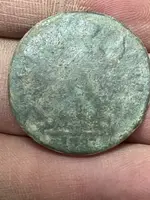
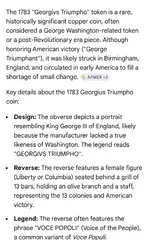
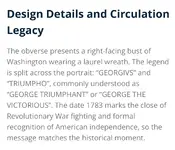
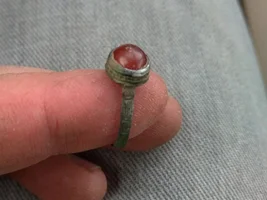
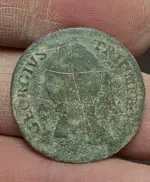
Today I went back to the heavily hunted spot were I found my 1794 large cent recently. I didn’t expect much but eventually I got a scratchy high tone and dug an early intact spoon about 8 inches deep, cool. As I was about to cover the hole, I ran my coil over it again and I got a beautiful high tone in the 90’s! I thought, no way, but when I checked the hole again I found a coin that I thought was a colonial copper. Later as I started wiping the dirt away I realized that this wasn’t an ordinary coin, it was different than any coin I had ever found. It had a right facing bust with the lettering “Georgivs Triumpho” on it. I could also make out the date 1783 on the reverse. A quick search of the internet when I got home revealed that it was a George Washington victory token that was made in Birmingham England after the war commemorating George Washington’s victory. It was also used as coinage as well as a token. I also read that it’s a very rare coin, to say I’m stoked is an understatement!!
 

Attachments
  • IMG_5162.webp
    IMG_5162.webp
    356.9 KB · Views: 302
  • IMG_5159.webp
    IMG_5159.webp
    1.2 MB · Views: 232
  • IMG_5160.webp
    IMG_5160.webp
    216.8 KB · Views: 219
  • IMG_5164.webp
    IMG_5164.webp
    96.4 KB · Views: 223
Upvote 56
Very interesting coin! I guess he was respected in England?
It’s strange that Birmingham England would strike a coin to commemorate Washington’s victory right at the end of the war and send them to America. I guess it was anything for a buck, even back then.
 
Great find! I've collected colonial and early US coins for decades and have always liked the Georgius Triumpho tokens. Like most other coins of the period precise information on them doesn't really exist. Birmingham England was a center of token manufacturing and most of the period are attributed to this area. It's generally accepted that the coin honors George Washington, but ironically the bust on the coin is sort of a generic in stock rendition of most likely George III! These tokens are considered a rarity 3, which translates to 201 to 500 estimated surviving. Nice piece of history!
 
Great find! I've collected colonial and early US coins for decades and have always liked the Georgius Triumpho tokens. Like most other coins of the period precise information on them doesn't really exist. Birmingham England was a center of token manufacturing and most of the period are attributed to this area. It's generally accepted that the coin honors George Washington, but ironically the bust on the coin is sort of a generic in stock rendition of most likely George III! These tokens are considered a rarity 3, which translates to 201 to 500 estimated surviving. Nice piece of history!
Thank you for the information, this is the first one I’ve ever seen or dug in 50 years of relic hunting so it was a real surprise for me. I’ve never found a GW button, so this will probably come as close to finding something GW related as I will get.
 
Fantastic find.

Although it isn’t known who produced the 1783 ‘Georgivus Triumpho’ tokens, there are stylistic similarities including the date numerals which suggest the dies were engraved by the same person who created the dies for the 1783 ‘Nova Constellatio’ coppers. The latter were imported from Birmingham and believed to have been commissioned by the New York City mercantile partnership of Constable, Rucker & Co. (William Constable, John Rucker, Robert Morris and Gouverneur Morris) in 1785, but with a 1783 date. Rucker was based in London, but with business connections to Birmingham, and it’s believed he arranged for a private mint owned by the later-to-become-famous Wyon family in Birmingham to produce them.

Gouverneur Morris had unsuccessfully tried to establish the first US mint in the disused Middle Dutch Church in New York City, enlisting the help of the British die engraver and skilled metallurgist Benjamin Dudley, who was living in Boston, Massachusetts at the time. Dudley was paid $72 on 5th May 1783 for “sinking, case hardening, &c. four Pair of Dies for Public Mint” but, despite intense efforts, the project never materialised and the only pieces from Dudley’s dies were 1783 silver patterns produced in Philadelphia bearing a denomination of 1,000 units (mark) and later as 500 units (quint), 100 units (bit), and 5 units (in copper). Robert Morris, assisted by Gouverneur Morris, (they weren’t related) had envisioned an elaborate new currency system based on a unit of value called, simply, the ‘unit’ (1/1440th of a silver Spanish dollar) but it never gained traction. The copper ‘Nova Constellatio’ and ‘Georgivus Triumpho’ imports from Birmingham are unconnected to Dudley.
 
Fantastic find.

Although it isn’t known who produced the 1783 ‘Georgivus Triumpho’ tokens, there are stylistic similarities including the date numerals which suggest the dies were engraved by the same person who created the dies for the 1783 ‘Nova Constellatio’ coppers. The latter were imported from Birmingham and believed to have been commissioned by the New York City mercantile partnership of Constable, Rucker & Co. (William Constable, John Rucker, Robert Morris and Gouverneur Morris) in 1785, but with a 1783 date. Rucker was based in London, but with business connections to Birmingham, and it’s believed he arranged for a private mint owned by the later-to-become-famous Wyon family in Birmingham to produce them.

Gouverneur Morris had unsuccessfully tried to establish the first US mint in the disused Middle Dutch Church in New York City, enlisting the help of the British die engraver and skilled metallurgist Benjamin Dudley, who was living in Boston, Massachusetts at the time. Dudley was paid $72 on 5th May 1783 for “sinking, case hardening, &c. four Pair of Dies for Public Mint” but, despite intense efforts, the project never materialised and the only pieces from Dudley’s dies were 1783 silver patterns produced in Philadelphia bearing a denomination of 1,000 units (mark) and later as 500 units (quint), 100 units (bit), and 5 units (in copper). Robert Morris, assisted by Gouverneur Morris, (they weren’t related) had envisioned an elaborate new currency system based on a unit of value called, simply, the ‘unit’ (1/1440th of a silver Spanish dollar) but it never gained traction. The copper ‘Nova Constellatio’ and ‘Georgivus Triumpho’ imports from Birmingham are unconnected to Dudley.
Thank you for this great information!
 

Users who are viewing this thread

Back
Top Bottom