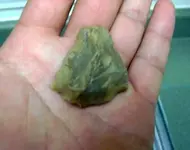
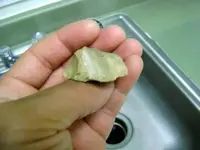
What you want to look at when you're determining whether something was a scraper or not is the angle of the bit relative to the plane of the base. From around 45 degrees up to maybe 75 or so, and you're in the ballpark. Especially if it shows edge re-sharpening and/or edge dulling from use. Much lower than 45, and the edge is too thin to stand up in use (fragile), which puts it into the (probable) knife category.
(I'm aware that many people lump everything with edge work into the "scraper category," and others who evade it by lumping everything like it into "flakes with worked edges." It's an archaeologist argument).
The second thing you'll look for is a fairly uniform working edge. A working edge with jagged projections would cut a hide rather than dress it. On a harder material, it may not have mattered much, and edge irregularities may even have been the result of using it hard enough to take chips out of it. But if so, there'll likely be enough evidence of use on it to support that assumption.
It's possible also that it's a preform somebody started shaping into an endscraper, decided it would be too thick to work well and pitched. Or just "something that looks like an endscraper." Not everything that turns up was a project carried all the way through to completion.
For whatever it may be worth (assuming anything)