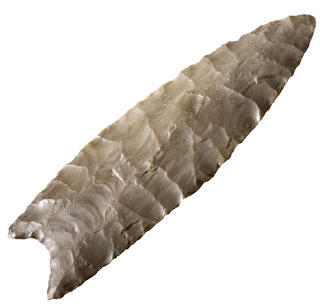
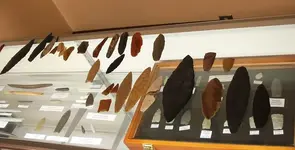
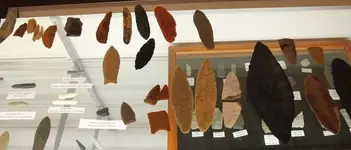
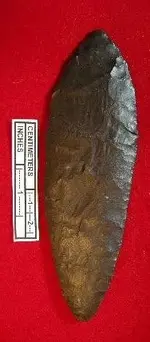
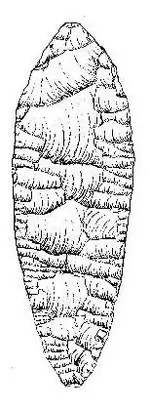
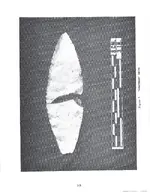
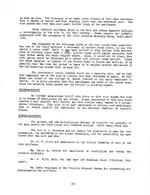
The Virginia biface the article references was found at the Browning Farm Site (44CC8) in Charles City County, along the James River during an excavation of an early colonial house. It was found in "Feature 4", described as "the lower portion of a clay chimney base with evidence of corner posts used to support a superstructure of catted clay and straw wattles." Various European early colonial artifacts of metal, glass, porcelain, earthen wear and gunflints were found in association. The only other Native American artifacts found in that feature were pottery sherds.
The biface is described as, "two halves of a restorable laurel leaf blade made from honey colored (French?) flint. This blade is identical to those typical of the Solutrean Culture of around 20,000 BC in France and Spain. The blade is 10.54 cm long and 3.5 cm wide, with a thickness of 7.5 mm. Its outer surface is patinated with a thick layer of corrosion products. It had been broken before burial, since two small wedge shaped slivers of the stone are missing, and the two larger pieces were physically separated about 2 feet when found."
I was unaware it was tested and determined to be of French flint. If any one has a reference for that, I would be interested in seeing it. Sorry no picture, all I have is a poor copy of a black and white photo, but I imagine with some looking someone smarter than me can find it online.