What's new

The Treasure of Isle D'Croix

Cryptid1990

Sr. Member
🥇 Charter Member
Joined
Jun 3, 2025
Messages
479
Reaction score
411
Golden Thread
0
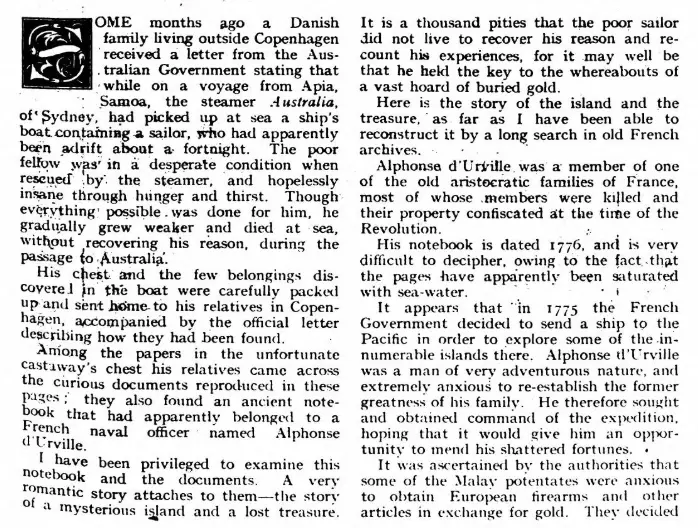
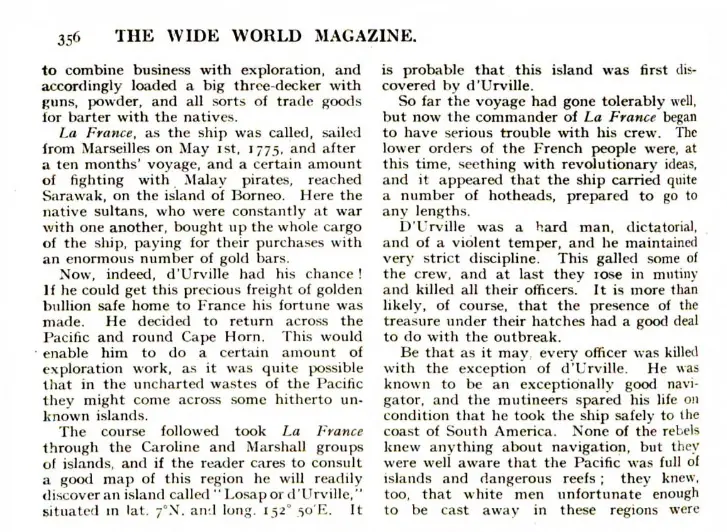
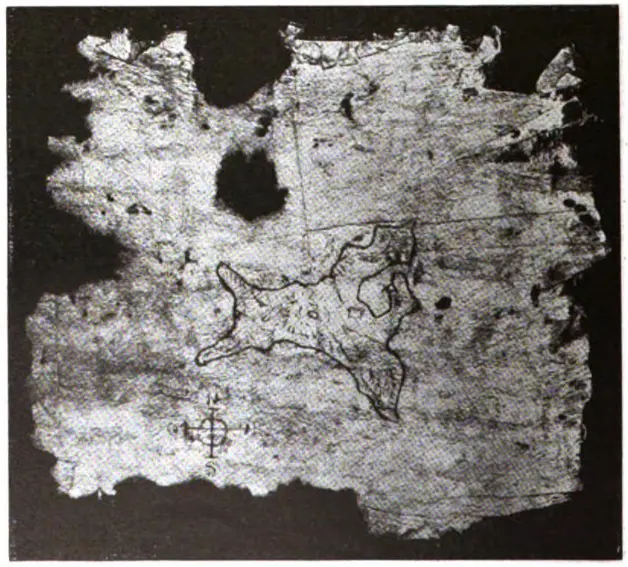
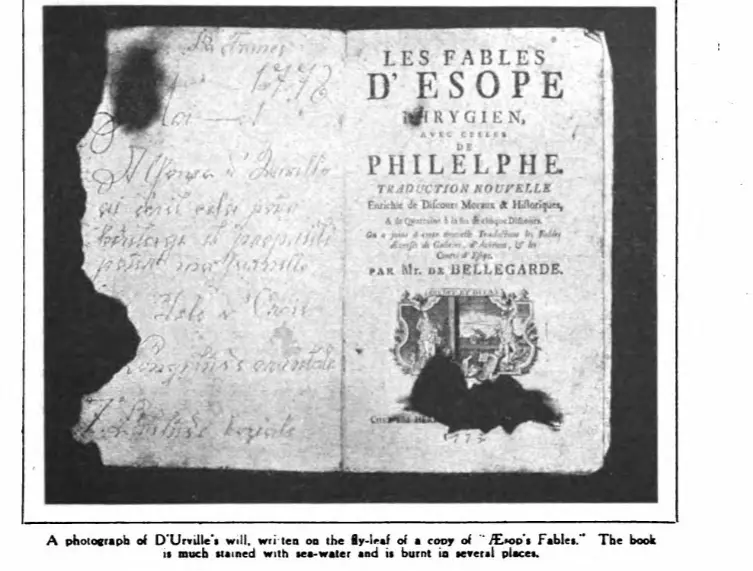
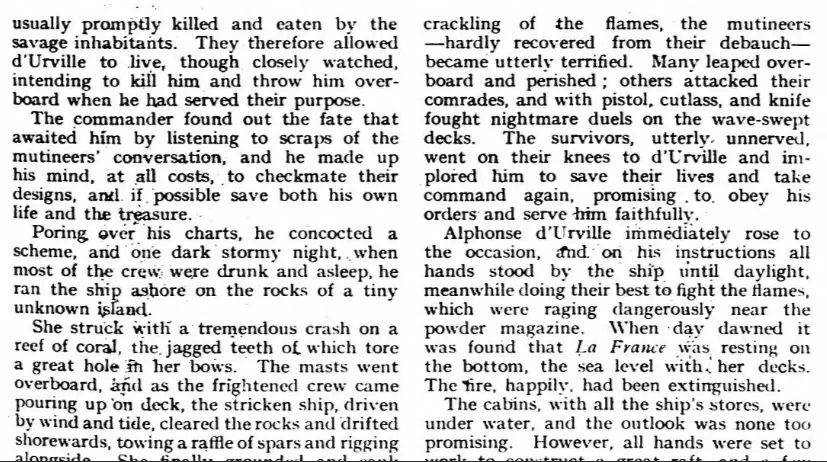
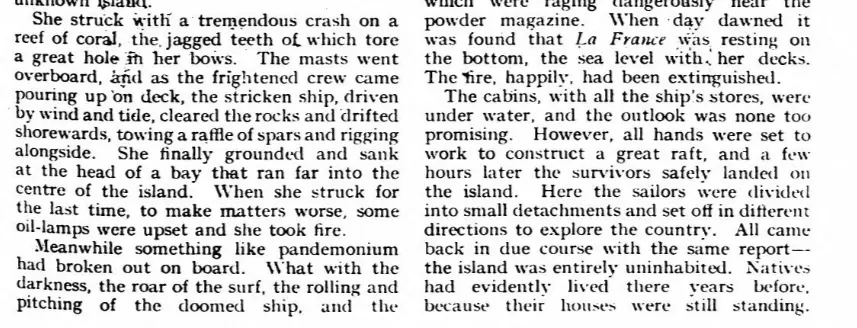
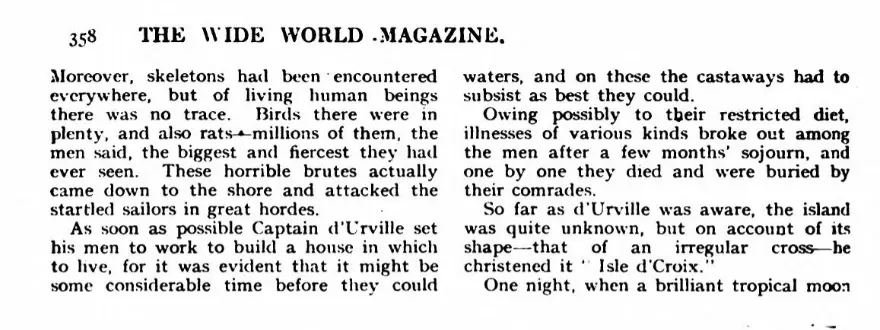
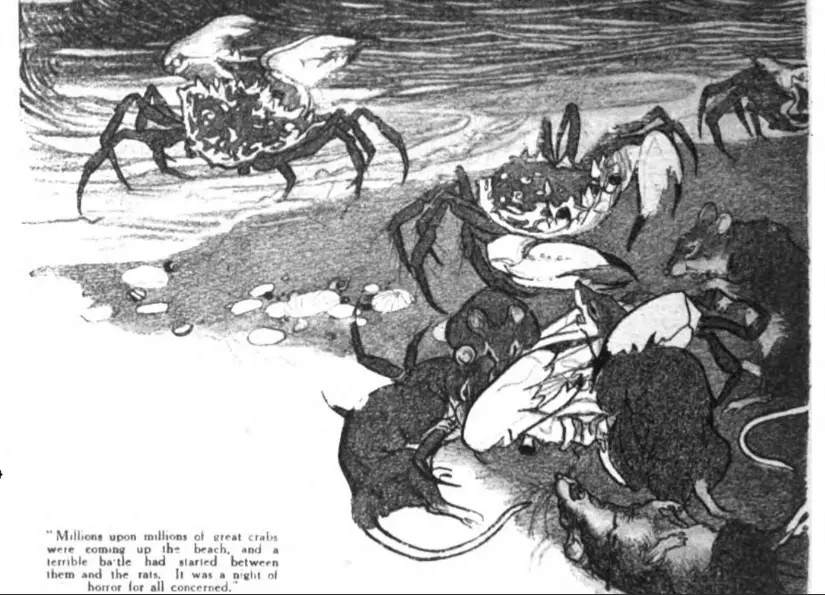
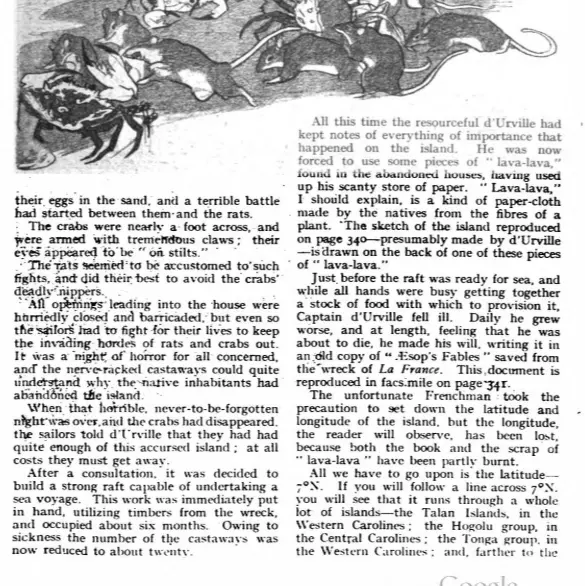
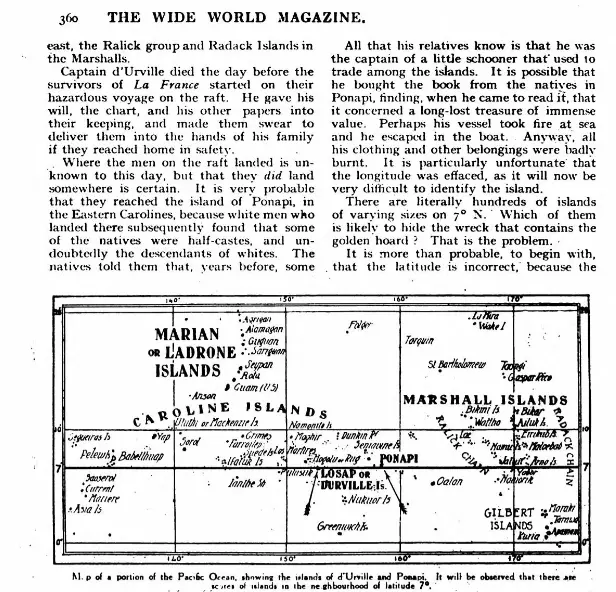
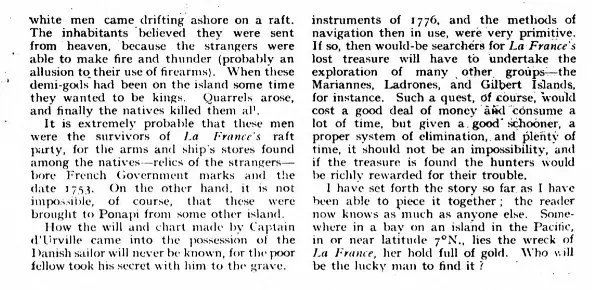
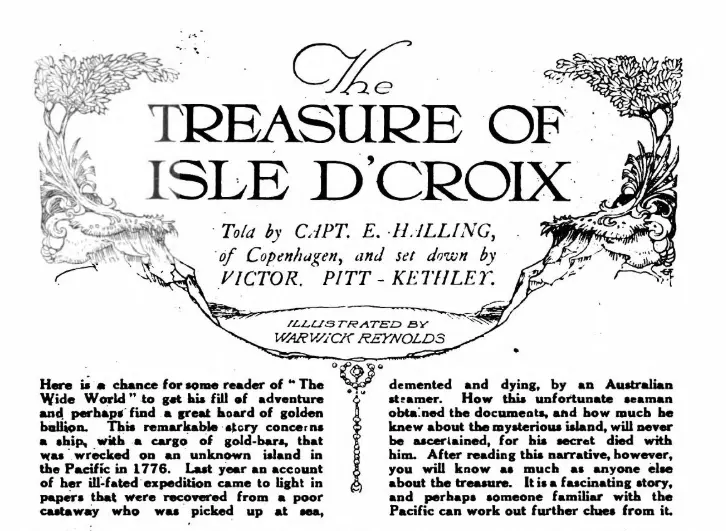
The story goes that documents and a damaged notebook (dated 1776) belonging to a French naval officer named Alphonse d'Urville ended up in the possession of an early 20th century Danish sailor who died aboard the steamer Australia in the Pacific Ocean; his belongings were sent to his family in Copenhagen by the Australian government in 1920. The notebook stated that d'Urville was in charge of an exploratory expedition to the Pacific and South China Sea in 1775 (as captain of a ship named La France). D'Urville acquired a large number of gold bars after trading with the Sultanate of Brunei and then decided to return to France with the bullion. During his return journey, there was mutiny on the ship and all the officers were killed except the captain d'Urville, whose life was spared. The ship later crashed into coral reefs; the ship sank with the bullion and D'Urville and other survivors landed on a nearby island. The shape of the island was an irregular cross (d'Urville gave it the name 'Isle D'Croix') and it had many crabs and rats living on the beach. These crabs and rats were often killing each other. D'rville lived on the island for several months but became ill and died in 1776. Before he died he wrote down what happened as well as made a map. He also wrote a will on the flyleaf of his copy of Aesop's Fables. Other survivors managed to escape the island and took d'Urville's items with them. These were later found on the Danish sailor but it is not explained how he came to own them over a hundred years later.

The main source is an article "The Treasure of 'Isle D'Croix" published in The Wide World Magazine (vol. 45, May 1920), pp. 355-360.

1765828897509.webp

1765829036531.webp


1765829074312.webp

1765829104277.webp

1765829125930.webp


1765829158401.webp

1765829199405.webp

1765829213384.webp


1765829230672.webp

1765829253258.webp

1765829275465.webp

1765829301163.webp

1765829318129.webp

1765829331730.webp


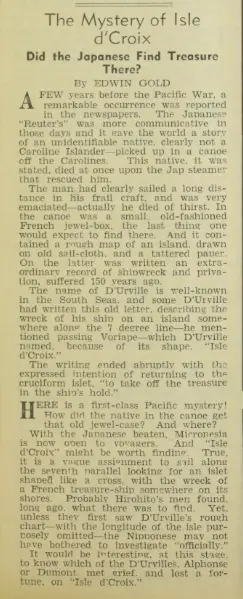
26 years later another article mentioned the same island and treasure.

"The Mystery of Isle d'Croix", Pacific Islands Monthly vol. 16, no. 6 (18 January 1946), p. 51:
1765840214907.webp


I cannot find any other sources aside from the book Pageant of the Pacific: Being the Maritime History of Australasia (1937) by F. C. Rhodes.

Page 91

1765840913704.webp


My thoughts:

Most, if not all of the story reads as fiction and the treasure is almost certainly a hoax. Historically, the name "d'Urville" was associated with the renowned French explorer and naval officer Jules Dumont d'Urville. This cannot be Alphonse d'Urville since the latter supposedly died in 1776 while Jules Dumont was born in 1790. I cannot find any evidence Alphonse d'Urville existed. Furthermore, I cannot find any evidence the ship La France (1775-1776) was real. That said, I would be interested if anyone has more information.
 
Last edited:
A fictional story posing as real story. A classic paper filler tabloid journalism of the era.

Newspapers have their uses. They can state what was being said publicly at given date and time. No research can solely be relied upon what newspapers say. However researchers can work off the comments of the day to find the fact checking from other sources.

Newspapers went through metamorphic changes. Originally before the 1850s reporting was fairly accurate. but as time progressed and the more newspapers came to be due to competition to meet the growing demand of a ever growing population able to read became more tabloid. With more exaggerated stories told to sell newspaper. Some editors created stories to satisfy the ever growing hunger for such stories to sell newspapers. Other smaller stories was fillers stories. treasure stories and strange stories became ever popular and factual news became blended with fictional stories right through the early 20th century. The 1930s was particularly bad because in the great depression treasure stories was exciting and dared people to dream. Truth did not get in the way of good story.

Crow
 
There was a ship steamer called the Australia 1920 -1939. Source
Museums Victoria Collections https://collections.museumsvictoria.com.au/items/1767202
Accessed 16 December 2025

View attachment 2237413

But this by no means support the claims as per story of proof the event happened.

Crow
It also appears the author of the article (Captain E. Halling) from Copenhagen was using their real name and not a nom de plume.

1766024565557.webp


SPECTATOR (Copenhagen). Weekly paper. An organ of German propaganda, controlled by Louis von Kohl, Director of German propaganda in Denmark. Editor (since November 1917): Oluf Bang [...] Contributors: Capt E. Halling.
 
You notice the treasure story is centered around the German possessions in the Pacific. The Caroline Islands became part of the German Empire in 1899 when Spain sold them to Germany, making them part of German New Guinea until Japan occupied them in 1914 during World War I. Germany administered them as a colonial territory, integrating them with their other Pacific holdings like the Marshall Islands and Northern Marianas after purchasing them from Spain.

ship La France (1775-1776) was not real. I suspect the story was propaganda to some how add value to Germany Pacific possessions under pretext there might be treasure there. By the 1917 article the islands had been occupied over three years by Japan. The alleged ship Australia was not built until 1920 that picked up this alleged Danish man.

Captain E. Halling bellow recorded in 1916 aged 41. in the 1916 Denmark Census.

Screenshot 2025-12-18 211803.webp


Denmark was not part of Germany in 1917; it was a neutral country during World War I, though it had lost significant territory (Schleswig-Holstein) to Prussia in 1864, which later became part of the German Empire, creating a Danish minority within Germany that hoped for reunification after the war. Denmark maintained neutrality but had complex relations with Germany due to trade and the unresolved border issue in Schleswig, leading to plebiscites after WWI that returned Northern Schleswig to Denmark.

Captain E. Halling was pro German writing for the Spectator.

Crow
 
You notice the treasure story is centered around the German possessions in the Pacific. The Caroline Islands became part of the German Empire in 1899 when Spain sold them to Germany, making them part of German New Guinea until Japan occupied them in 1914 during World War I. Germany administered them as a colonial territory, integrating them with their other Pacific holdings like the Marshall Islands and Northern Marianas after purchasing them from Spain.

ship La France (1775-1776) was not real. I suspect the story was propaganda to some how add value to Germany Pacific possessions under pretext there might be treasure there. By the 1917 article the islands had been occupied over three years by Japan. The alleged ship Australia was not built until 1920 that picked up this alleged Danish man.

Captain E. Halling bellow recorded in 1916 aged 41. in the 1916 Denmark Census.

View attachment 2237675


Denmark was not part of Germany in 1917; it was a neutral country during World War I, though it had lost significant territory (Schleswig-Holstein) to Prussia in 1864, which later became part of the German Empire, creating a Danish minority within Germany that hoped for reunification after the war. Denmark maintained neutrality but had complex relations with Germany due to trade and the unresolved border issue in Schleswig, leading to plebiscites after WWI that returned Northern Schleswig to Denmark.

Captain E. Halling was pro German writing for the Spectator.

Crow
:weee:
 
Captain E. Hallings fictional propaganda story is based around a real island that was explored around 1826 -1829 I know the island well that made is being referred to. And the French connection. Not in 1775 but in 1826 -1829 Kosrae. I have a good friend that lives there. The island is like micro nation in itself. Kosrae, a state in the Federated States of Micronesia, has a small population, estimated around 6,700 to 7,700 residents.

Screenshot 2025-12-19 100305.webp


Virtually no tourists and fairly low crime rate.

Screenshot 2025-12-19 100040.webp


Its local history is recorded in small museum.

Screenshot 2025-12-19 101423.webp


French explorer Jules Dumont d'Urville visited Kosrae (then known as Ualan or Strong's Island) during his first major Pacific voyage (1826-1829) aboard the ship Astrolabe, documenting the island, its people, and the ancient ruins, providing one of the first detailed Western accounts and establishing a key contact in the island's early European history alongside Duperrey and Lesson. His explorations also coined terms like "Micronesia" and "Melanesia" and significantly mapped Oceania

The Voyage (1826-1829): Dumont d'Urville's expedition, including the Astrolabe, sailed through the Pacific, charting islands and interacting with local populations.He, along with botanist René Primevère Lesson, documented Kosrae, an important event as it marked early significant Western encounters with the island's complex society and impressive ruins. His work produced extensive scientific reports, botanical samples, and linguistic notes on Pacific languages, influencing future understanding of the region. His accounts, along with those of his colleagues, are crucial historical records of Kosrae's unique culture and history from the early 19th century, noted for its stratified society and archaeological sites. In essence, Dumont d'Urville's voyage was a pivotal moment for Kosrae, bringing it to broader European attention through detailed observations and mapping.

You can see the bay inland below.

Screenshot 2025-12-19 104433.webp


The island capital is might metropolis of Lelu

Screenshot 2025-12-19 103828.webp


There are ancient ruins on the island.

Screenshot 2025-12-19 110237.webp


Screenshot 2025-12-19 110338.webp


Screenshot 2025-12-19 110449.webp


And of course this island had a treasure story predated the 1917 Captain E. Hallings propaganda story.

In the lagoon Leonora (or Lenore): This American trading schooner, captained by the notorious "Bully" Hayes, was shipwrecked in Utwe harbor during a typhoon on March 15, 1874. Not much of the wooden structure remains today, but the wreck site can be dived, and it is a central part of the local lore, including myths about buried treasure. An unnamed wooden whaler: The remnants of another 1800s sailing ship rest in Lelu Harbor in about 70 feet of water. Divers can find artifacts related to the whaling trade at the site.

Crow
 
Captain E. Hallings fictional propaganda story is based around a real island that was explored around 1826 -1829 I know the island well that made is being referred to. And the French connection. Not in 1775 but in 1826 -1829 Kosrae. I have a good friend that lives there. The island is like micro nation in itself. Kosrae, a state in the Federated States of Micronesia, has a small population, estimated around 6,700 to 7,700 residents.

View attachment 2237763

Virtually no tourists and fairly low crime rate.

View attachment 2237764

Its local history is recorded in small museum.

View attachment 2237765

French explorer Jules Dumont d'Urville visited Kosrae (then known as Ualan or Strong's Island) during his first major Pacific voyage (1826-1829) aboard the ship Astrolabe, documenting the island, its people, and the ancient ruins, providing one of the first detailed Western accounts and establishing a key contact in the island's early European history alongside Duperrey and Lesson. His explorations also coined terms like "Micronesia" and "Melanesia" and significantly mapped Oceania

The Voyage (1826-1829): Dumont d'Urville's expedition, including the Astrolabe, sailed through the Pacific, charting islands and interacting with local populations.He, along with botanist René Primevère Lesson, documented Kosrae, an important event as it marked early significant Western encounters with the island's complex society and impressive ruins. His work produced extensive scientific reports, botanical samples, and linguistic notes on Pacific languages, influencing future understanding of the region. His accounts, along with those of his colleagues, are crucial historical records of Kosrae's unique culture and history from the early 19th century, noted for its stratified society and archaeological sites. In essence, Dumont d'Urville's voyage was a pivotal moment for Kosrae, bringing it to broader European attention through detailed observations and mapping.

You can see the bay inland below.

View attachment 2237766

The island capital is might metropolis of Lelu

View attachment 2237767

There are ancient ruins on the island.

View attachment 2237769

View attachment 2237771

View attachment 2237772

And of course this island had a treasure story predated the 1917 Captain E. Hallings propaganda story.

In the lagoon Leonora (or Lenore): This American trading schooner, captained by the notorious "Bully" Hayes, was shipwrecked in Utwe harbor during a typhoon on March 15, 1874. Not much of the wooden structure remains today, but the wreck site can be dived, and it is a central part of the local lore, including myths about buried treasure. An unnamed wooden whaler: The remnants of another 1800s sailing ship rest in Lelu Harbor in about 70 feet of water. Divers can find artifacts related to the whaling trade at the site.

Crow
Hi Crow,

About Bully Hayes, they his money is still buried on Kosrae? One of the island stories of the treasure tells of the sighting of a big crab emerging from a hole carrying a large gold piece in his claw, but all excavations near the spot had empty yields. It was also reported that prior to the Second World War, the employees of a Japanese-run sawmill hit a metal box while digging on a small islet in Okat harbor, and that soon after the sawmill closed down, and everyone returned to Japan. It was later reported that the sawmill’s owner had become a wealthy man, but there was no accounting either way for his prosperity.

Tadao Waguk, Kosraean storyteller and culturalist, said that Hayes reputedly had three treasure chests, and that only one was recovered through the Japanese sawmill crew, leaving two still at large.

These sound like folkloric yarns to me but wondering about it since you must be familiar with them.
 
Old Crow forgets so much these days. There are so many stories. Some rooted in fact. Much of what it is is folk yarns. Bully Hayes got accused of many things.

Screenshot 2026-03-24 095225.webp


William Henry (Bully) Hayes (1829?-1877), adventurer, swindler and blackbirder, best known as 'BULLY', is said to have been born in Cleveland, Ohio, United States of America, son of Henry Hayes, innkeeper, to have gained some knowledge of seafaring on the Great Lakes and to have roamed the Pacific engaging in the many trades that ocean offered in ways often not short of piracy. Although he is stated to have made a voyage to Melbourne and Sydney in the American barque Canton in 1853 his first recorded arrival in Australia was at Fremantle in January 1857 as master of the C. W. Bradley which he had acquired at Singapore by devious means. For three years he engaged in several audacious maritime frauds ranging from Fremantle to San Francisco. On 25 August 1857 at Penwortham, South Australia, he married, probably bigamously, Amelia Littleton.

In January 1860 Hayes reappeared in Sydney after his stolen Ellentia foundered, and was charged with indecent assault on a young girl in that ship. The case was dismissed but the Empire printed a scathing account of his character and past activities which was rebutted by forged letters to the Sydney Morning Herald. For debt he was imprisoned in Darlinghurst gaol but released when declared insolvent. After some time in the Hunter Valley with the Glogski and Buckingham minstrel troupe he sailed for New Zealand as a passenger in the Cincinnati with his theatrical companions. There he reputedly 'married' Rosa Buckingham who, with her child, brother and a young nursemaid, were drowned near Nelson in August 1864; Hayes alone escaped. For some years he sailed New Zealand waters in various craft which he obtained by fraud and deception until in May 1866 he bought the Rona and with a wife and children on board became a South Sea trader and blackbirder. The Rona was lost off Manihiki, Cook Islands, and in Samoa he joined the American blackbirder, Ben Pease, in the Pioneer which later returned to Samoa as the Leonora with Hayes in command. In January 1874 Louis Becke, later famous for his South Sea tales, joined the Leonora at Milli in the Marshall Islands and for several months cruised with Hayes.

Screenshot 2026-03-24 102040.webp


On 15 March 1874, while lying at Kusaie in the Caroline Islands, the Leonora was totally lost on a reef but her company escaped. Supported by a few of his scallawag crew and comforted by five native wives, Hayes set up a trading station and terrorized the natives. When H.M.S. Rosario arrived in September complaints against Hayes's violent behaviour were made by missionaries, some of his crew and the native king. To avoid arrest Hayes made off in a small boat with one companion, was picked up at sea by the American whaler Arctic and landed at Guam in February 1875. After various episodes in the Philippines he reappeared at San Francisco, where he sailed on his last voyage in the yacht Lotus in October 1876 accompanied by a woman, said to be the wife of the owner, and a crew of two. The many versions of Hayes's death all agree on the main facts. In April 1877 the Lotus was cruising near Jaluit in the Marshall Islands. After repeated quarrels between Hayes and a sailor, Hayes was killed by a blow from an iron fitting and his body cast overboard. The death was reported when the yacht reached Jaluit but his murderer was never brought to justice.

Notorious in every Pacific port, Hayes became a legendary figure, first in Rolf Boldrewood's A Modern Buccaneer (1894), based on a Louis Becke manuscript, and later as a principal character in many of Becke's own tales of the South Seas. Although uneducated Hayes had infinite resource, great plausibility and was undoubtedly a rogue in the grand manner. He was survived by a wife and twin daughters in Samoa.

Louis Becke wrote below about him.

Screenshot 2026-03-24 095623.webp


His book popularized the image of Bully Hayes we have today.

Screenshot 2026-03-24 095543.webp


Kosrae today still celebrates Bully Hayes ' time at Kosrae. Over time, growing stories with each retelling inevitably entwined with treasure stories connected to him.

Personally, any buried treasure in connection to Hayes; it's just romantic folklore.


Crow
 

Users who are viewing this thread

Back
Top Bottom