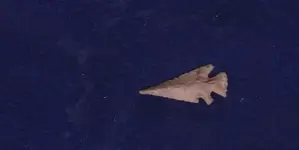
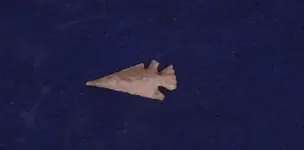
I believe that piece is much later than Charcos. From what I can see, it appears more of a smaller arrow point than a dart. Charcos are typically a dart sized point that are very comparable to Shumla.
It's not uncommon to find stemmed points with an extra notch in them, especially in the southwest. Charcos, Temporal, Dry Prong and others are very common and similar points occur all the way up into western Canada. Many of the Kamloops side-notched points in B.C. (as well as others) have the extra notch. Bob Davidson in B.C. calls the extra-notched ones "clan" points, postulating that it could be for group identification. Who knows. I'm sure much of it could also be for trying different methods of securing it to the haft, or maybe even serve a separate function altogether.
It's possible that the piece could be from the Chaco cluster of points, but it sure doesn't fit the classic form for the named ones. Justice attributes the Temporal to the Chaco cluster of points and one of the identifiers is the "extra" notch on the side. However, most of the Chaco type points are more side or corner notched, the Temporal itself greatly resembling a Keota. I have personally examined a large group of Chaco Cluster points ( Bonito, Chaco, Pueblo, etc) from a well-known collection that had a point or two with the exact same form as your point.
From what I have seen, the random side notching does occur in many later arrow points. Believe it or not, you will also find it occur sporadically even in Wa
--deleted--a / Huffaker variants. Come to think of it, I have one of the best ones I have ever seen here in my collection somewhere! I may have to find that and take a picture of it for you..lol.
Hey, take a real good look at the notching area of that piece when you get a chance. I would be curious to know if the notches have a recurved appearance, or take an upward turn. Look at where the ding is on the base and see if you can tell from that. It looks like the side of the base that is dinged would have come out much further than the other side, which would greatly reinforce it being related to Chaco or Puebloan piece.
Good talking to you today Chong!