What's new

Wall inside a cave?

Ed144

Full Member
🥇 Charter Member
Joined
Apr 27, 2015
Messages
214
Reaction score
564
Golden Thread
0
Location
Saddlebrooke, Pinal County, Az.
Detector(s) used
Garrett Axiom, XP Deus 2, XP Xtrem
Primary Interest:
Metal Detecting
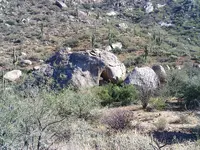
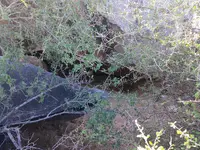
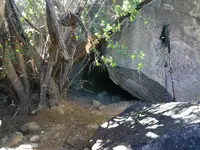
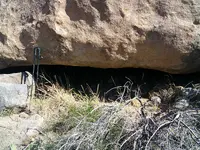
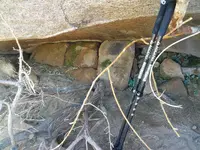
Santa Catalina Mtns Arizona. Sutherland wash archaeological district north of Tucson. I followed an ancient trail to a large boulder complex that had multiple shelters beneath it. This wall feature within one of the caves that seems man-made. Any ideas?
 

Attachments
  • C2_Wall.webp
    C2_Wall.webp
    743.3 KB · Views: 193
  • C2V.webp
    C2V.webp
    1.4 MB · Views: 160
Upvote 0

Maybe, or perhaps a rodent-proof food alcove. I'm not going to disturb it since it is an archaeological resource. There are many ancient Hohokam trails, shelters, petroglyphs and rock markers on the west side of the Santa Catalina Mtns near Tucson. It is most interesting to follow the ancient markers and trails.
 
I'd find the Equipment & Way to Feed a Camera Behind it.
Make sure it's Not a Cave/mine !
 
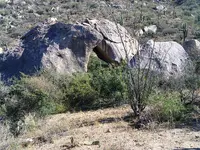
Jeff, that is a good idea. I'm finding a lot of rock shelters that are difficult to access. Some small camera on an extendable stalk would be able to see into small spaces. The site is a large rock shelter with multiple alcoves/caves around it. Just about every rock shelter that enable one to get one out of a storm or the sun seems to have a trail to it and was used. I think the shelters are ancient Hohokam from perhaps 1400-800 years ago. They may have been used by later first people.
 

Attachments

  • C2C.webp
    C2C.webp
    921.1 KB · Views: 67
  • C2H.webp
    C2H.webp
    932.7 KB · Views: 48
  • C2T.webp
    C2T.webp
    1.4 MB · Views: 60
this is a really cool find.... gets you out of the Hot desert sun when needed.... I'd look around from that point at other landmarks
 
Surf Pirate, you are exactly right. About 100 yards away from the shelter there is another single rock marker. About 100 yards beyond that is another rock shelter with a very nice roof. It has pottary shards in it. There is an ancient trail continuing further up the hill which I have yet to follow.
 

Attachments

  • C3C.webp
    C3C.webp
    1.2 MB · Views: 60
There is a guy on YouTube called The Desert Drifter and he has dozens of videos about caves and shelters he locates and shares. Sadly he passed in a bad car accident several months back. All his videos are still up.
 
Oh man sucks to hear that about desert drifter, was wondering why I hadn't seen any new videos lately
 
Surf Pirate, you are exactly right. About 100 yards away from the shelter there is another single rock marker. About 100 yards beyond that is another rock shelter with a very nice roof. It has pottary shards in it. There is an ancient trail continuing further up the hill which I have yet to follow.
Interesting..... I'd keep coming back to that area. Make yourself comfortable with it. Try to google map your area if you don't have access to a drone. See if you can find unusual imprints in the ground like foundations or impressions. Hieroglyphs or carvings on any rocks would be cool. Look good on the rocks, might be faint but with water you might find something...
 
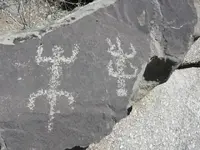
There are thousands of petroglyphs in the area. Most are near the main wash and nearby camp/village sites. Petroglyphs usually have meanings like the hot tea kettle icon on your auto instrument cluster. The kettle means: "Your engine is overheating." This petroglyph is at the beginning of the main trail that goes up to a higher stepped bench where the camp sites are. Although I don't understand all the details in the petroglyph, I think it can be interpreted to: "We (Lizard Clan?) live straight ahead up this trail and are dangerous. You should turn back because it is dangerous to you. If you do not stop you will receive broken arms, broken legs, broken head and death."
 

Attachments

  • Trail_Mkr_1.webp
    Trail_Mkr_1.webp
    53.2 KB · Views: 54
Key Arizona Laws & Regulations:
  • Archaeological Protection: Arizona law protects historic/prehistoric resources, including those in caves, making it illegal to disturb burial grounds, fossils, or artifacts.
  • Cave Vandalism: Damaging cave formations (speleothems) or disturbing cave life (plants/animals) is a misdemeanor, with penalties for such acts.
  • Permits for Exploration: Activities like exploring caves on state land often require permits from the Arizona State Museum or relevant authorities for scientific purposes.
  • Blue Stake (811): Even for minor digging, you must call 811 (or use E-Stake online) to locate buried utilities, a requirement for any excavation.
What You Cannot Do:
  • Dig or Excavate: You cannot dig, remove soil, or excavate in caves to find things.
  • Damage Formations: Don't break, mar, or remove stalactites, stalagmites, or other formations; they are fragile and protected.
  • Disturb Life: Harming or removing bats, insects, or plants within a cave is illegal.
  • Vandalize: Writing on walls, breaking locks, or leaving trash are all misdemeanors.
What You Might Be Able to Do (with Permission):
  • Scientific Permits: Institutions or qualified individuals can get permits for research, but excavation is highly restricted and only for specific, approved purposes.
In Summary: If you're not a qualified researcher with permits, do not dig in Arizona caves. Focus on preservation, respect the environment, and contact the right authorities (like the Arizona State Museum or local land managers) for any legitimate exploration or research.
 
Correct. Ancient native American sites are protected by 16 USC Chapter 1.B, The Archaeological Resources Act of 1979, amended in 1988. Ancient graves are protected by the Native American Graves Protection and Repatriation Act of 1990. The National Historic Preservation Act of 1966 may also apply. My interest is only in following the ancient trails, markers and petroglyphs, to see if I can, and to discover where they may lead. I also greatly enjoy hiking into remote places.
 

Users who are viewing this thread

Latest Discussions

Back
Top Bottom