What's new

What’s with Large thin flakes

Older The Better

Silver Member
Joined
Apr 24, 2017
Messages
3,833
Reaction score
8,098
Golden Thread
0
Location
south east kansas
Detector(s) used
Whites Eagle Spectrum
Primary Interest:
All Treasure Hunting
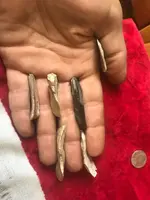
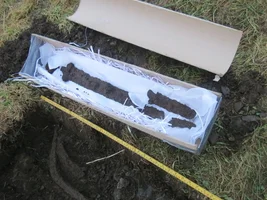
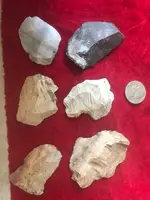
I’ve found a bunch of these over the years including one today. As I learn more about tool manufacturing these seem curious. Why would they remove such a large amount of material in one pop? Is this normal? Were they meant to be flaked into tools but for what ever reason they weren’t good enough? Are they quick and dirty tools used as is and tossed? It just seems like they were better nappers than to waste such a large amount of good material when making tools.
ImageUploadedByTreasureNet.com1566156162.632790.webp
ImageUploadedByTreasureNet.com1566156190.716765.webp
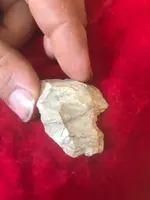
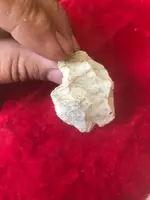
The one I found today I’m thinking maybe it was made into a hafted scraper. It’s kinda got that shape and it looks like a channel flake was struck on the opposite side as the scraper edge.

ImageUploadedByTreasureNet.com1566156247.057518.webp
ImageUploadedByTreasureNet.com1566156262.492598.webp
ImageUploadedByTreasureNet.com1566156276.111990.webp
 
Upvote 0
Those flakes are from early in the biface knapping process when the knapper is driving large flakes across the face of the stone to rapidly thin it. They are usually found at the biface production sites which are generally within a few hundred yards of the stone source (quarry). When found away from the stone source they may indicate someone was carrying them around to use as is for tools or as blanks to make small tools (small points, scrapers, flake knives, etc.). I don't see anything in the pictures indicating use, but that kind of thing can be hard to see in pictures.
 
Makes sense then that most of them are local materials. I don’t know about 100yds in the case of the last flake but I’m going to assume that’s not a hard fast rule there is some flint nodules within a 5 minute walk. I guess my first instinct was right that they were early flakes, I’ve been trying to get better at identifying flake tools and other less easily identifiable objects and thought maybe the large ones were something besides flakes. they are def far more rare than the little ones or the large chunky pieces.
 
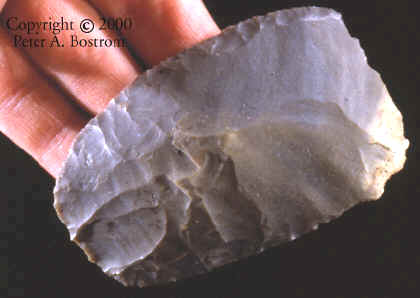
A lot depends on who (when). In the paleo era, large, thin flakes would be late removals from platter bifacial cores, and used, as-is or modified, as Keith pointed out, as small tool blanks.

Here's one such from Sheridan Cave in Ohio :

sheridenscraperhandsmall.jpg


CONTINUED FROM PAGE 1 SHERIDEN CAVE
 

Users who are viewing this thread

Back
Top Bottom