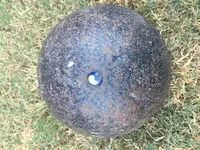
Hi Coreymainit. I see you are a new member, so first let me say, welcome to TreasureNet. I co-wrote a very detailed educational article on how to tell with certainty whether a ball is an artillery ball or a civilian-usage ball.
http://www.pochefamily.org/books/SolidShotEssentialsMod.html
As the article says, for certainty in identifying the ball, we cannonball collectors must weigh it very precisely (typical household bathroom scales aren't precise enough), and measure it's very-exact diameter, using either a caliper or a diameter-tape. Your approximately-48-pound ball is too big for most calipers, so you'll need to borrow or buy a diameter-tape (also called a "Pi tape").
In artillery use, a ball MUST NOT fit either too loosely or too tightly into the cannon's bore (the tunnel in the barrel). So, generally, the ball was about .09 to .12-inch smaller than the cannon's bore. Due to the very-important need that the ball fit just right, the Ordnance Department created very-exact diameter and weight specification rules, which all cannonball manufacturers had to obey. An army or navy Ordnance Inspector carefully measured every cannonball, and any which failed the very-precise measuring test were rejected. The size-&-weight specifications, called the "Shot Tables," were published in the US Ordnance Manual of 1861. (The Confederates used he same specifications.) We cannonball-collectors use the Shot Tables very-precise weight and diameter-size charts to tell with certainty whether the ball is an artillery ball or not.
http://www.civilwarartillery.com/shottables.htm
As the Shot Tables charts at the link above show, there is only one actual cannonball which your 48.8-pound ball is even slightly close to matching up with.
An 8-inch caliber hollow explosive cannonball was 7.88-inches in diameter and weighed 49.75 pounds. Your ball is .95-pound lighter than that. But because I've very-precisely weighed many-many "definite" cannonballs, I can testify that being about 2% lighter than the official Shot Tables weight-specification doesn't automatically exclude a ball from being a cannonball. That's because large cast-iron objects made before the 20th century often contained airbubbles which were accidentally trapped inside the molten metal during the casting process.
So, the next step in identifying your ball is to do some super-precise measuring of its diameter. As mentioned above, the Shot Tables say an 8-inch caliber cannonball was 7.88-inches in diameter. If your ball measures between 7.85 and 7.88-inches (rusting could have removed a few hundredths-of-an-inch from its surface), it's a cannonball. Otherwise, it is not a cannonball.
Because you said you aren't sure whether or not it has gunpowder in it... let me also mention, if it is an 8-inch caliber cannonball, its 48.8-pound weight strongly indicates it no longer contains its 2-pound gunpowder bursting-charge. You can use a hammer and screwdriver to bust the glass marble out of the hole.
Speaking of the hole... I should mention that in your photos it looks like an unusually small hole to be a cannonball's fuze-hole. That brings up another possible ID for your ball. It might be a solid (not hollow) ball with a small hole for mounting it on a monument, or some other "Ornamental" purpose. The final chart on the Shot Tables webpage says a 49-pound SOLID iron ball is 7.145-inches in diameter. So if your ball turns out to measure approximately that size, it is a solid one, and would be an Ornamental Ironwork ball, not a cannonball.