What's new

A medieval mace?

Maximus Blade

Greenie
Joined
Mar 29, 2014
Messages
16
Reaction score
19
Golden Thread
0
Primary Interest:
All Treasure Hunting
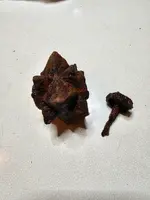
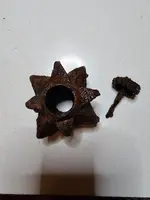
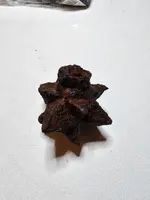
Dear colleagues, after a rather long break, I'm back "in the club" again. I need a help with this interesting artifact. I think it's a Byzantine, Bulgarian or Turkish mace but I'm not sure. I am asking colleagues who have experience and hunt for such things for help. The shape of the mace is: 12 pyramids (4 smaller, 4 larger and again 4 smaller). The height is about 6 cm, the diagonal length is about 8 cm, the opening for the handle and the cap is about 3 cm. On the pyramids, traces of silver (decoration in the form of a net) are visible under the corrosion. Any help with identification is appreciated...Cheers!
 

Attachments
  • Photo 1.webp
    Photo 1.webp
    648.1 KB · Views: 159
  • Photo 2.webp
    Photo 2.webp
    911.4 KB · Views: 114
  • Photo 3.webp
    Photo 3.webp
    722.6 KB · Views: 108
Last edited:

Dear colleagues, after a rather long break, I'm back "in the club" again. I need a help with this interesting artifact. I think it's a Byzantine, Bulgarian or Turkish mace but I'm not sure. I am asking colleagues who have experience and hunt for such things for help. The shape of the mace is: 12 pyramids (4 smaller, 4 larger and again 4 smaller). The height is about 6 cm, the diagonal length is about 8 cm, the opening for the handle and the cap is about 3 cm. On the pyramids, traces of silver (decoration in the form of a net) are visible under the corrosion. Any help with identification is appreciated...Cheers!
it does resemble medieval maces in that area.
but my issue is the rusting and deterioration that appears.
You may want to take it your local museum for Authentication.
 
too tiny
 
Dear colleagues, after a rather long break, I'm back "in the club" again. I need a help with this interesting artifact. I think it's a Byzantine, Bulgarian or Turkish mace but I'm not sure. I am asking colleagues who have experience and hunt for such things for help. The shape of the mace is: 12 pyramids (4 smaller, 4 larger and again 4 smaller). The height is about 6 cm, the diagonal length is about 8 cm, the opening for the handle and the cap is about 3 cm. On the pyramids, traces of silver (decoration in the form of a net) are visible under the corrosion. Any help with identification is appreciated...Cheers!
Meat tenderizer.
 
It sure looks like a mace head to me, and it’s certainly not “too tiny”.

This English one from the PAS database measures only 4.6cm long by 4.8cm diameter and weighs a mere 110g. You don’t need much size or weight at the end of a pole or shaft for a knopped mace to do serious damage because of the centripetal velocity achieved when you swing it in a wide arc. They’re rare finds in England, with only a few examples known.

Knopped Mace Head.webp

https://finds.org.uk/database/images/image/id/120455/recordtype/artefacts

Terrific find in my opinion @Maximus Blade.
 
Last edited:

it seems minuscule, do you have an example in restored condition? It looks like a hobbit mace to me!
 
it seems minuscule, do you have an example in restored condition? It looks like a hobbit mace to me!

No, as I said, they're rare in Britain although less so in other parts of Europe (mainly Eastern Europe) and beyond. I don't think I've seen a 'restored' one, but there's a not very sharp picture of one mounted on its (replacement) shaft at the link below (if that's what you mean by 'restored') together with a number of other examples showing variations in type. Note that they're all small (dimensions given for many, but not all, of them):


There's also a slide-show of a repro being made here:


Try it for yourself by taping something weighing around 100g to 200g to the end of a stick around 18 inches long. It immediately gives some heft to it when you swing it in an arc. The 'knops' are usually pointed or angular so the the pressure from an impact is concentrated on a small area and easily enough to shatter a skull or break a limb.
 
Last edited:

No, as I said, they're rare in Britain although less so in other parts of Europe (mainly Eastern Europe) and beyond. I don't think I've seen a 'restored' one, but there's a not very sharp picture of one mounted on its (replacement) shaft at the link below (if that's what you mean by 'restored') together with a number of other examples showing variations in type. Note that they're all small (dimensions given for many, but not all, of them):


There's also a slide-show of a repro being made here:


Try it for yourself by taping something weighing around 100g to 200g to the end of a stick around 18 inches long. It immediately gives some heft to it when you swing it in an arc. The 'knops' are usually pointed or angular so the the pressure from an impact is concentrated on a small area and easily enough to shatter a skull or break a limb.

And remember, that wasn’t too terribly long removed from when people were just using sticks…..the iron head addition was a big step forward in lethality.
 
To support red coats statement about a bit of extra weight on the end of a stick….i know several people who trap (or used to). They carried a half hoe or shovel handle to dispatch their catch. They drilled out a 1/2 to 3/4” dia hole on the end of the handle and added lead. Amazing what an extra few ounces at the end of a 24” stick will do.
 
Here is link to Pdf file on maces.

Mace

I agree with comments here. If your hit with a mace you stay down. if not permanently. It was a lethal weapon. First disable the attackers legs as soon as they buckle over bang over the head good night. It is a close quarter fighting weapon.

Crow
 
Last edited:

Here is link to Pdf file on maces.

Mace

I agree with comments here. If your hit with mace you stay down if not permanently. It was lethal weapon. first disable the attackers legs as they buckle over bang over the head good night. it a close quarter fighting weapon.

Crow
That's a really good document you posted Mr. Crow
I'm keeping that on my hard drive.
 
Dear colleagues, thank you very much for all the details and help. Special thanks to Crow and Red-Coat. In the meantime, I received confirmation that it is a mace (Bulgarian or Byzantine). The weight of the head is 330 grams, which was quite enough to break the skull and kill the enemy on the battlefield.
 

Users who are viewing this thread

Back
Top Bottom