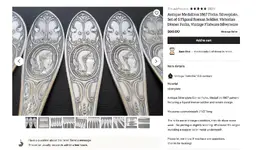
The reverse would usually have a name or initials of the intended owner.
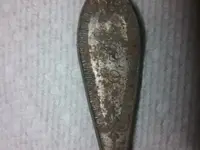
If it's sterling, you may wish to clean off the crud for better images of both side.
Don......
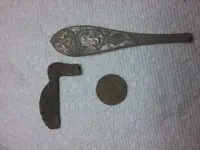
This kind of Neo Classical imagery was not uncommon throughout the Victorian era . Note the similarity of the bust on your utensil handle , to those so often depicted on cameo brooches of the same era .
Your utensil handle looks to be made of pewter with a silver wash.
My gut tells me that it's got some serious age to it... I'm thinking 1810 - 30.
"Pewter, essentially an alloy of the same metals as bronze (copper and tin), was likely discovered during the Bronze Age. From the early 17th century until the mid-19th century, pewter was a favorite metal for domestic flatware (spoons, forks) and small serving, pouring, eating and drinking vessels. Since pewter is a soft metal, objects in daily use had a short lifespan, estimated at 5 years. "
Thank you go everyone for all of your knowledge. I was really stumped. He found this in a old road in middle if woods. Absolutley amazing. It defintely seens like pewter with the wash finish. Tried to clean it by damping with wet qtip.