I'd love to see more pictures of it. How thick and long is it?
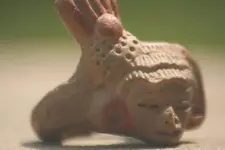
Style wise I think you are close with Veracruz. Personally, I'd suggest the face is more of the Teotihuacan style. Veracruz heads usually have almond shaped eyes and a more expressive mouth (smiles, smirks, tongues, lips, etc.) Teotihuacan faces are are usually dead or expressionless (strait-line hollow eyes & empty open mouth.)
What is it?...
I haven't seen any ancient pottery rings from Mexico (or from the US.) Tempered pottery wouldn't be a great material for a ring. I have seen lots of pottery earspools but those typically have some ridges or thickness that support the structure, and still would be subjected to a lot less pressure and force than a finger ring. Metal and obsidian rings from Mexico are rare, but they do exist. From burial contexts, they were probably worn higher on the finger than we typically think of. (Not on the first finger bone, but in the middle or tip of the finger.) I've also seen a lot of flutes and whistles from Teotihuacan that have a face decoration like that, might be a repaired end to a flute but then it would have some repair marks.
My best guess is that it's a tourist piece. In the 50's, 60's and 70's there was a lot of interest in jewelry that combines old and new (both fashionable Mexican women and international tourists.) Google Taxco Jade and you can see some of the silver works done initially with old pieces of jade, and then later with onyx copies of old pieces. I've seen the same done with pottery faces for necklaces and pins. It's not the Taxco style with silver, but given that people were interested in them someone might have made rings and things like that. It might be built around a metal ring and then covered with something, if you have a metal detector see if it beeps.
How it got there?...
Outside of some copper bells and trade items found in Arizona or New Mexico and the occasional obsidian arrowhead found in Texas, there isn't much evidence for relics coming up from Central or Southern Mexico. The best example is an obsidian flake that was found in the fill of Spiro mound that was traced to the Teotihuacan area. It might have made it up over generations of trade or it might have been a rare example of direct contact. It wasn't found with any of the burials, but was still found in one of the largest ceremonial sites in the US.
If it came from a big site, then maybe your friends have found a rare piece. An x-ray to see the structure and then a TL test would pretty clearly suggest how old it is. (The x-ray wouldn't give an age, but it's often done to see if pottery items are repaired or bonded together in non ancient ways.)
If it was just an isolated find without evidence of a pretty significant burial or deposit, unfortunately the best and least satisfying scenario that I see is a tourist item that someone lost. A buddy of mine found a relatively rare Nazi officer's pin while metal detecting a school playground. It had been there for a while, and a logical explanation is that some kid took dad or grandpas war souvenir to school and it fell out of his pocket. I don't think Nazis penetrated that far into a poor farming community in Indiana during the war.
The Poverty Point culture was the big trading force in that part of Louisiana, they were dead 800 to 1000 years before this style of artifact was happening in Mexico. I think you had Marksville Hopewell during the Woodland and Baytown Mississippian culture in that area, I don't think they were known as big trading entities (they probably exported items, but aren't know for drawing importing artifacts into their area.) If they did trade with Mexico, I think Obsidan, jade and feathers would have been the likely commodities.


 The mounds in this area are well known for their pyramid look, large dirt cones built on top of them.


 That sure is a most interesting and unique find. It may be a trade item or the artistic aspect was integrated into that region.