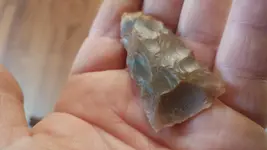
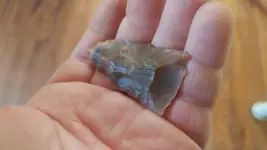
It is one of the natural break patterns found in most types of knappable stone. Causes vary by stone type, but in general it is a spot in the stone where during the formation process, two layers came together but didn't entirely bond. This basically causes a tiny "fault line" in the stone such that when the piece is being knapped, the bending stress of the flake removals opens up and expands the fault, causing the stone to shear apart. If a knapper wanted to intentionally create a smooth, continuous edge like that with a single flake removal, I'm not sure how it would be done. In any event, there would be no reason to do it since the same effect can be had more easily with a series of flakes, like on the rest of the biface. It looks like a biface that came apart very late in the process. This demonstrates one of the main reasons to bother making a biface to begin with: The stresses applied by the knapping process thoroughly test the material for defects like this such that the piece fails at the stone source instead of away from it.