What's new

ancient bronze statue, egyptian??

jrh4

Greenie
Joined
Jun 26, 2018
Messages
19
Reaction score
25
Golden Thread
0
Primary Interest:
All Treasure Hunting
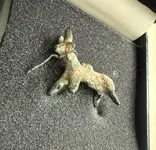
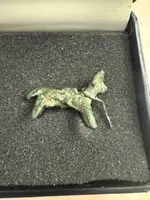
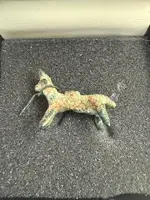
I was hoping someone might be able to help me identify this item. It supposedly came from the collection of Leighton Wilke, who was a rich guy that funded archaeological expeditions in the early 1900s (specifically Egypt). He was also an avid collector and antiquities, and gave this to my father decades ago. I was always told it was an item from the tomb of King Tut. Another person recently told me they thought it might be a West Asian votive from the 2nd millennium BC.
Does anyone else have an opinion? I'm all ears!!
 

Attachments

  • tut 1.webp
    tut 1.webp
    95.2 KB · Views: 106
  • tut 2.webp
    tut 2.webp
    108.1 KB · Views: 73
  • tut 3.webp
    tut 3.webp
    134.7 KB · Views: 72
What’s it made out of? What’s the wire looking thing made out of?
 
I assume you mean Leighton A. Wilkie? It’s a shame you don’t have any documented provenance or provenience which would also add to its value as well as helping to determine where it originated. A number of cultures made zoomorphic items like this, and Egypt is certainly a possibility, although the likelihood of it being from Tutankhamun’s tomb is close to zero.

You didn't give a size for yours, but I'm guessing it's small judging by the storage box it's in... so not exactly a statue.

My guess (and it is only a guess) is that it’s not from Egypt, but from Luristan (now western Iran). The culture is known for these kind of items, frequently found in grave contexts suggesting a ceremonial significance. Typical dates between 1,000 BC and 650 BC. Like this one, measuring around 1 ¾ x 1 ¼ inches:

Luristan.webp
 
Last edited:
It looks like a Brahman bull to me.
Two tall horns, two ears, hump at shoulders.
 
Sidebar: What a coincidence.........I knew Leighton Wilkie (and his wife, Adele, son and daughter) Leighton owed the Willow Brook Farm in Long Grove, Illinois and the Doall Company in Des Plaines. For years (maybe even today), he had a hugh display of machinery in the Museum of Science and Industry in Chicago.
Our homes were about 1/2 mile apart. I would camp with the son, Michael, (RIP) in the woods beteen our homes. Woods and farmland were all around us; today there are only million dollar homes and a country club where my family's home once stood.

Wilkie had a large home just west of the intersection of route 22 and 83. While there house is now gone, on maps there is shown a pond near where their home once stood. In reality, that 'pond' was the largest private (concrete-lined) swimming pool in the county (12 feet deep !!) ; generously shared by the Wilkie's to the kids in the area.
This brings back good memories of the way things used to be; thanks.
Don in SoCal
 
I was hoping someone might be able to help me identify this item. It supposedly came from the collection of Leighton Wilke, who was a rich guy that funded archaeological expeditions in the early 1900s (specifically Egypt). He was also an avid collector and antiquities, and gave this to my father decades ago. I was always told it was an item from the tomb of King Tut. Another person recently told me they thought it might be a West Asian votive from the 2nd millennium BC.
Does anyone else have an opinion? I'm all ears!!
It doesn't look typical Egyptian. That said Tutankhamun (or how he was called originaly Tutankhaton) died young and also after Armana which produced a quite different art then everything before or after it. Figures like yours had a much more natural appearance then the somehow stiffer and ritualized forms that were almost invariant for more that 1000 years.

I think it could be very well authentic. This is of course no final Judgement. I would look through the catalogs and also compare the piece in hand with other exhibits from the Armana to truely evaluate the piece. If it is truly a piece of King Tut's grave then there must be some documentation, fotos etc in some archive. It would also be incredible valuable.
 
Gaining knowledge through the Wilkie family may give you the info you seek.
Michael is survived by his wife, Teri Wilkie; his children: Serena, Grant, Austin, Parker, Constantine, Christian, Alexander, and Victoria; His five grandchildren: Judah, Ajah, Helanie, Alexandra, and Thomas; His sister and brother-in-law, Bonnie and Jon Henricks. While Leighton's son, Michael, has passed away these relatives, especially is sister, Bonnie, may be helpful if located. Leighton also had a home in Montecito, California.

Another idea is to contact the Museum of Science and Industry in Chicago; someone there might give you a lead.
Don in SoCal
 
Sidebar: What a coincidence.........I knew Leighton Wilkie (and his wife, Adele, son and daughter) Leighton owed the Willow Brook Farm in Long Grove, Illinois and the Doall Company in Des Plaines. For years (maybe even today), he had a hugh display of machinery in the Museum of Science and Industry in Chicago.
Our homes were about 1/2 mile apart. I would camp with the son, Michael, (RIP) in the woods beteen our homes. Woods and farmland were all around us; today there are only million dollar homes and a country club where my family's home once stood.

Wilkie had a large home just west of the intersection of route 22 and 83. While there house is now gone, on maps there is shown a pond near where their home once stood. In reality, that 'pond' was the largest private (concrete-lined) swimming pool in the county (12 feet deep !!) ; generously shared by the Wilkie's to the kids in the area.
This brings back good memories of the way things used to be; thanks.
Don in SoCal
That's crazy Don! My dad worked for Leighton at DoAll in DesPlaines, IL for decades. I remember seeing displays of old industrial equipment at his office. Leighton had a HUGE collection of egyptian antiquities, a lot of which were auctioned off some years back (I think by Michael before he passed).
 
I definitely think it's meant to represent a beast of burden or pack animal because it has the square "box" on its back.
 
It doesn't look typical Egyptian. That said Tutankhamun (or how he was called originaly Tutankhaton) died young and also after Armana which produced a quite different art then everything before or after it. Figures like yours had a much more natural appearance then the somehow stiffer and ritualized forms that were almost invariant for more that 1000 years.

I think it could be very well authentic. This is of course no final Judgement. I would look through the catalogs and also compare the piece in hand with other exhibits from the Armana to truely evaluate the piece. If it is truly a piece of King Tut's grave then there must be some documentation, fotos etc in some archive. It would also be incredible valuable.
I appreciate your feedback! The only pics I can find from Tut's tomb are items that have been previously catalogued. Not sure this one ever was, so it's been hard to verify
 

Users who are viewing this thread

Back
Top Bottom