What's new

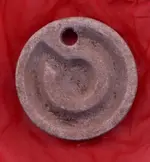
✅ SOLVED Any idea what this Texas find might be?

creskol

Gold Member
Joined
Jan 14, 2007
Messages
13,882
Reaction score
23,351
Golden Thread
2
🥇 Banner finds
2
Primary Interest:
Other
Found this on Friday while digging in North Central Texas. It is exactly the same on both sides, made of stone-like material, and measures exactly 2.25 inches in diameter, and is .75 of an inch thick.
 

Attachments

  • Scan 3.webp
    Scan 3.webp
    45.8 KB · Views: 152
Powder Incense burner ?
 
Last edited:
Upvote 0
I had a powder incense burner that looked just like that but definitely did not have a hole through it
 
Upvote 0
I haven't been able to find anything in the way of an incense burner that looks like this, as all of them I have researched are of spiral design, with the "tracks" only on one side, and none have a hole. But, for lack of any other ideas, I will mark it solved.

Thanks all for your nice comments and suggestions.
 
Upvote 0
Insulator for a rotary potentiometer. Most old car light switches had them for the dash light circuit. I've seen them on variable speed wiper motor switches also, along with other applications. Usually, the automotive applications weren't quite that thick however, so, it might be for some other industrial use.
 
Upvote 0
Insulator for a rotary potentiometer. Most old car light switches had them for the dash light circuit. I've seen them on variable speed wiper motor switches also, along with other applications. Usually, the automotive applications weren't quite that thick however, so, it might be for some other industrial use.

Yes!! I agree. (Nice ID, CudaMark!) :notworthy:
I couldn't quite put my finger on it, but I think CudaMark has nailed it. (I'm an electrical engineer.)

This does indeed look like a ceramic insulator for an embedded coil of some sort.
Automotive applications would include panel light dimmers or air conditioner controls.
It could be either a rheostat or a potentiometer. (My guess is rheostat, which is maybe best explained as a two-wire "potentiometer" - to keep it simple.)
You would need to see the rest of the device (missing) in order to determine the exact circuit.

It might not be automotive, though - as CudaMark suggests.
It could also be part of a heater element. The ceramic would hold the wire coil, which when powered-up, would glow a nice orange color.

A final possibility is it could just be a ceramic form for a high power wirewound resistor.
Same basic principle though: a ceramic form to hold heater wire.
 
Upvote 0
looks like a filament to a small ceramic heater to me...just a wag
 
Upvote 0
Never thought about the insulator possibility, but that makes perfect sense! Thanks a bunch for those suggestions. I'll mark it solved now.
 
Upvote 0

Users who are viewing this thread

Back
Top Bottom