What's new

🔎 UNIDENTIFIED Any ideas??

Buptyler13

Greenie
Joined
Mar 17, 2024
Messages
16
Reaction score
59
Golden Thread
0
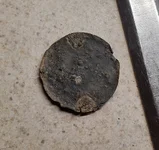
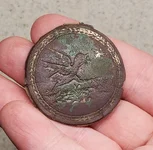
My son found this in our "field of dreams" today. Any ideas?? Alot of colonial stuff was found in there. It's the size of a silver dollar. Appears to be a bird running trying to eat something. Does have some gilting left on it. Not quite sure of the metal. Button or maybe some kind of brooch?
 

Attachments

  • 20260620_105647.webp
    20260620_105647.webp
    122.1 KB · Views: 140
  • 20260620_105713.webp
    20260620_105713.webp
    484.6 KB · Views: 104
Maybe a compact lid?
 
Upvote 0
Sticking to the sporting theme ncsuwolf, looks like the lid to a pistol percussion cap tin.
 
Upvote 0
I asked Gemini AI and this is the result.

1. A 19th-Century Bridle Rosette (Most Likely)​

The forum user creskol hit the nail on the head here.

  • The Clues: Bridle rosettes—decorative brass pieces used on horse harnesses—were incredibly common in the 1800s and early 1900s. They are typically exactly this size (roughly the size of a silver dollar).
  • The Back: The solder mark and broken attachment on the reverse side are highly characteristic of where the lead fill and the iron attachment loop (or bar) would have been secured to fasten it to the leather harness.
  • The Motif: Game birds (like the running pheasant or grouse shown here), hunting dogs, and horses were among the most popular "sporting" designs for equestrian gear during the Victorian era.

2. A Great Coat or Livery "Sportsman" Button (Strong Alternative)​

Another very strong possibility is a large livery or "sportsman" button.

  • The Clues: In the late 18th and 19th centuries, gentlemen wore heavy overcoats, hunting coats, or duster coats featuring large, decorative brass buttons with wildlife scenes.
  • The Catch: While "sportsman" buttons are incredibly common relic finds, one the size of a silver dollar is exceptionally large for clothing. If it is a button, it would have been for a very heavy outer coat.

Material & Age​

  • Composition: The rich green patina indicates a copper-alloy metal (brass or bronze) that has spent a long time underground.
  • Age: The style of the engraving, the remaining gilding, and the "field of dreams" colonial context suggest this likely dates to the mid-to-late 19th century (approx. 1840s–1880s), matching the era when brass sporting rosettes and gilt sportsman buttons peaked in popularity.
 
Upvote 0

Similar threads

Users who are viewing this thread

Back
Top Bottom