No, you did not find the Canister version. As its name implies, the "business" part of a Canister round is shaped like a can.
You found either the HE (High Explosive) or the APC-T (solid-shot) version. The solid-shot has a long cone-shaped
aluminum cap on its front end. Since your find is rusty for its entire length, it might be the High Explosive version. That is why I said I'd need to see a photo of its base to know for sure.
If it is the explosive version, it will have an approximately 1.15"-diameter flat brass disc (which is the fuze) in the center of its base ...or, if the fuze is missing, you'll see a large hole with threading for the fuze to screw into. Check the photo about halfway down the page at the site you linked (
http://www.inert-ord.net/usa03a/usa5/37mm/index.html).
If you found the (Solid) Shot version of the World War 2 US 37mm projectile, the base will have only a 1/2"-wide, 3/4"-deep hole, with no threading in the hole.
If you found the explosive version and it still has its brass fuze in the iron base, you might want to be careful about handling it, because it is a 20th-century artillery projectile. There seems to be no record (such as a newspaper-report) of a civil war shell exploding from merely being dropped during the modern era ...and we relic diggers almost always hit civil war shells pretty hard with our shovel when we dig them up. But unlike 1861-1865 shells, some 20th-century shells can still explode from merely being dropped.


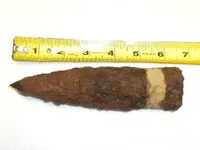
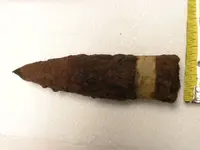
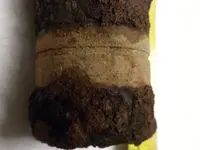


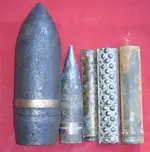
 Now that I know it's the AP variety, how would you guys suggest I clean it up? I don't know if that Aluminum nose cone would survive electrolysis.