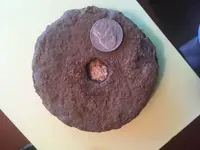
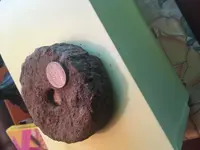
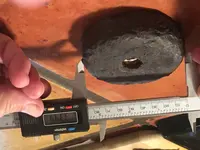
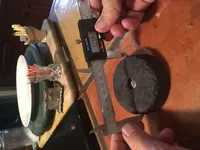
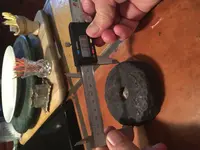
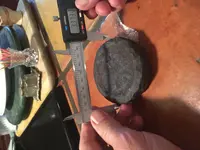
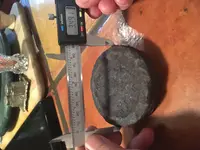
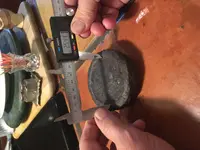
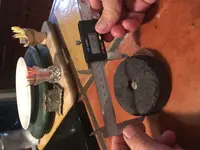
I just now thought of a civil war artillery projectile possibility... the base of a "Flat-Base Hotchkiss," which was an early-war artillery shell used by the yankees, found only at battles along the lower Mississippi River, in that state and Louisiana. That "Flat-base" version of Hotchkiss shell is so extraordinarily rare (fewer than ten have ever been excavated) that I didn't immediately think of it as a possibility. Can you do Electrolysis on it, to remove the rust-encrustation, and give me a super-accurate measurement of its diameter, in hundredths-of-an-inch? You'll need a Digital Caliper for that kind of measuring. (Please measure the diameter in several directions across the flat bottom of the object.)
What put me onto the possibility was (1) your Southern Louisiana location, (2) the presence of a yankee Parrott shell's fuze nearby, and (3) the hole in the flat base appears to be filled with lead. Sometimes when a civil war (or earlier) artillery projectile came out of the ironcasting mold with a casting-flaw hole on its surface, the hole would be patched with lead.
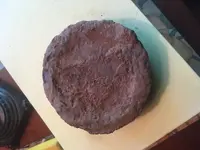
If it is the "base-cup" part of a Flat-Base Hotchkiss, the sidewalls of the cup have been blown/broken off... which is another reason I didn't immediately think of it as an artillery shell's base. There seems to be a broken-off circular rim on the opposite side from where the hole is.
I must add, the possibility that it is the base of an extraordinarily rare Flat-Base Hotchkiss shell is kind of a stretch... but it's worth investigating. Precise measurement of the object's diameter will tell us whether it matches up with the diameter of a Flat-Base Hotchkiss shell, or not.