invent4hir
Bronze Member
- Joined
- Aug 1, 2017
- Messages
- 2,323
- Reaction score
- 3,908
- Golden Thread
- 0
- Detector(s) used
- Whites V3i & DFX
- Primary Interest:
- Other
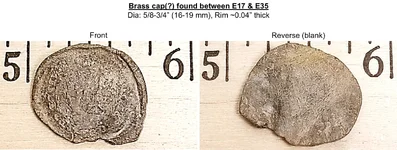
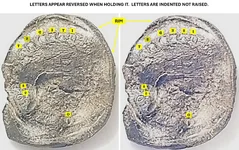
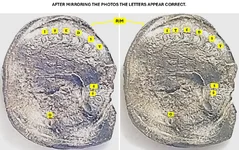
Found this where a cabin was built about 1815 and other artifacts dug nearby, including a 2 Reales and 22 Large Cents, range from the mid-1700s to late-1800s. Initially I thought it was a beat-up coin. Looking through my coin book, I noticed that most if not all the U.S. coins have raised letters. After discovering the letters on the front of the artifact are indented, my theory about it being a U.S. coin seemed unlikely. Also unusual, is that the letters are reversed. There is a picture showing that and another where the artifact is reversed so the letters read left to right. The few strings of letters I’ve been able to make out are “ITED ST”, “08” and “O”, despite trying different magnifications, angles, and filters. I’m hesitant to clean further, because the remaining lime deposits provide some contrast that help make those letters stand out. The back side is void of letters or markings of any kind.
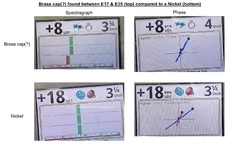
While probably round at one time, it is now more oval with a diameter that varies from 5/8-3/4” (16-19 mm). There is also a partial rim that is about 0.04” thick. By appearance I originally thought it was made of brass or copper. During a bench test, my Whites V3i detector shows it to be a conductor with a VDI of 8. Despite the artifact being disfigured, its phase is solid. A modern nickel is shown as a comparison.
All thoughts welcome. Happy 4th and America 250!
While probably round at one time, it is now more oval with a diameter that varies from 5/8-3/4” (16-19 mm). There is also a partial rim that is about 0.04” thick. By appearance I originally thought it was made of brass or copper. During a bench test, my Whites V3i detector shows it to be a conductor with a VDI of 8. Despite the artifact being disfigured, its phase is solid. A modern nickel is shown as a comparison.
All thoughts welcome. Happy 4th and America 250!