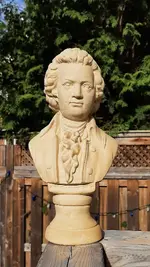
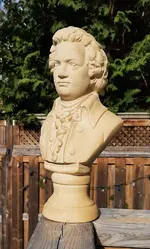
Before you proceed, you need to determine whether or not the surface is bare plaster, or has been sealed and, if so whether the sealant is water-sensitive. Plaster busts were sometimes finished with an unobtrusive durable waterproof coating or a less durable wax/resin water-sensitive coating to simulate a patina.
If it’s bare plaster, or you aren’t sure, confine yourself to ‘dry-cleaning’. Bare plaster is very porous and will readily absorb water, taking any water-soluble dirt below the surface where it is then almost impossible to remove. It may also create ‘tide-marks’ as the plaster dries out again, worsening the appearance rather than improving it. Any stubborn dirt or marks that can’t be removed by brushing or wiping with a dry cloth (and a cotton bud for difficult to reach areas) can usually be removed with an artist’s eraser. These are available as ‘kneadable’, which can be moulded like putty into shapes to help reach the tricky areas. Work slowly and carefully when using an eraser because they can be so effective that the cleaned areas come up a startling white compared to the areas that you don’t need to clean or need only light cleaning.
It it’s finished plaster and you’re sure the coating is not water-sensitive, in addition to the methods above, you are usually safe to use ‘wet-cleaning’ but do not immerse it or put it under a running tap. Use cotton wool balls and/or cotton buds moistened (not dripping wet) with distilled or filter-purified water containing a small amount of washing-up liquid. Rub gently, rotating the cotton as you go so that you actually remove the dirt rather than just spread it around.
After cleaning (and a day or two or drying in a warm place if necessary) you could give it some future protection with a couple of coats of waterproof artist’s acrylic spray, available in aerosol cans, but make sure to get one with a matte finish to avoid an unnatural appearance.
If you’re unsure about whether it’s coated or bare or can’t ascertain the nature of the coating, try some test swabbing on the underside of the base. That should give you some idea. Since these kinds of busts were mass-produced and can be picked up for under $50, unless there are any markings which suggest it’s a superior-crafted item you won’t be losing much value even if you paint it. But I would suggest that just slapping some white household paint on it without any preparation or priming isn’t likely to give you a very satisfactory finish. Especially not if you brush it on rather than spray it on.