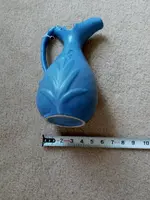
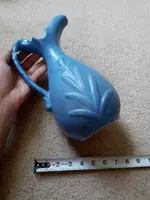
What became known as “Niloak” pottery started life as a cottage industry in the 1860s in Benton, Arkansas using local kaolin clay. By 1906 Charles Hyten had established the “Eagle Pottery”, producing on a commercial scale along with his competitor “Ouachita Pottery”. By 1910 both companies were producing pottery with a distinctive multicoloured marbled pattern from partial mixing of clays with different colours, known as “Mission Swirl”. Capitalising on its success, a new company was incorporated by community leaders to promote it. They called the company “Niloak” (“kaolin” spelled backwards) in a deal with Hyten whereby his Eagle Pottery was the contracted producer.
The Niloak Pottery Company dissolved in 1918, and the rights to the name passed to Hyten. He became aware of other companies imitating the swirled design and took legal action, securing the Niloak trademark in 1925 and a patent protecting the swirl design in 1928. The Eagle Pottery also produced conventional castware pottery and, as demand for the swirl ware declined, Hyten borrowed heavily to fund expansion of the castware side of the business and particularly to launch a new line of glazed wares under the “Hywood Pottery” brand in 1931,
It was a disastrous move in the face of the Great Depression and the company was in receivership by 1934. It was bought out by a group of Little Rock businessmen, managed less than 4 weeks of production in 1935 and attempted a revival in 1938 with a new large kiln to reduce costs. Swirl ware sales fizzled out by about 1940, castware couldn’t support continuing operations and the company finally went under in 1946.
So, it’s “Eagle Pottery” and from the late 1930s to early 1940s as PNP says but not “Niloak” in the traditional sense of swirl ware, except that Eagle owned the Niloak brand. It’s a jug for whatever purpose you cared to use it and that pattern wasn’t sold with a lid as far as I’m aware.