What's new

Brass finials or bells?

johnnyi

Bronze Member
Joined
Jul 4, 2009
Messages
1,887
Reaction score
146
Golden Thread
0
Location
new jersey
Detector(s) used
minelab, white's xlt, deus xp, fisher aquanaut, white's twin box
Primary Interest:
Relic Hunting
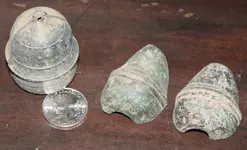
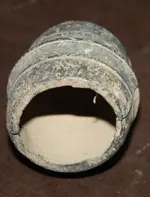
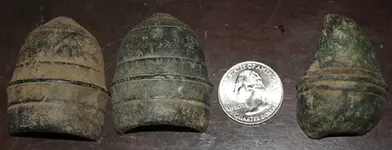
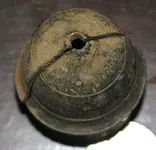
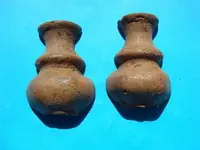
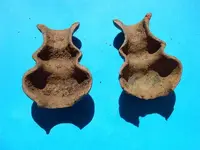
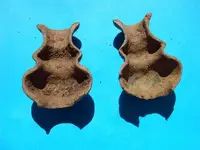
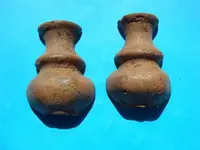
I found these four objects over a period of years in one field where most finds dated between mid 1600's to 1820's. They seem to have been half castings which were originally brazed or soldered together. Although the smal hole in the top picture appears to be threaded, it is not; it is perfectly smooth on its interior. The large holes on the bottom of both conplete objects are crude and show no means of attachement to anything. The hole on the top of the smaller of the two objects is crude also without any threads. The smaller of the two objects resembles a little bit a hames finial, but it is too large (as both are) and they are both hollow.

Are these a type of early bell that some of the British detectorists might recognise? (Crusader, have you found many of these of this size and shape?) Thanks
 

Attachments

  • brass objects1.webp
    brass objects1.webp
    155.9 KB · Views: 327
  • brass object 2.webp
    brass object 2.webp
    58.6 KB · Views: 324
  • brass objects4.webp
    brass objects4.webp
    167.8 KB · Views: 324
  • brass objects 3.webp
    brass objects 3.webp
    51.3 KB · Views: 326
Tag. No idea but nice finds :icon_thumright: I would guess bells.
 
Upvote 0
Montana Jim said:
Not sure - reminds me of fence post toppers, or finials.

This is my first impression also, decorative fence post topper/finial.
 
Upvote 0
Jim, it's raining here now so I've time to tell you about the field if you want. As it's now completely developed I don't have a problem with revealing its location. I worked it for years at least oncer a week, beginning almost 35 years ago until it was closed to detecting some ten or fifteen years ago.

It was below the Bowman's tower on a parcel of land supposedly once owned by John Bowman who was believed to be Kidd's doctor on an early voyage. (I believe that is more of a legend, and that actually it was possibly owned by "Beau Mont", but most likely Pidcock who the creek was named after and who was a friend of Dr. Bowman's).

Every find in that field with very few exceptions dated before the 1820's (the date a nearby mill was abandoned). Finds included pewter cask taps, pewter syringes, a few pieces of gold braid, a Rev war chin scale, pewter spoons, etc. The most common relics were the musket balls and lead sprue left by the soldiers who had camped there before the crossing on Christmas eve, as well as many buckles, and coin ranging from unidentified through to William's through to 1820's large cents. It was also for centuries an indian villiage with many arrow heads, scrapers, drills, etc. showing up in the plowed field after a rain.

Incidently the button in my moniker I found directly across the river road from this field on land that is also now developed also and off limits to detecting. (I have surmised it was possibly left by Monroe (some records indicate this style may have been worn by Monroe or Adams who both crossed the river that night). As both men were along this stretch of river on Christmas Eve; and as Monroe in particular was well acquainted with the area and actually stayed nearby after being wounded, he may have been visiting the old crossing on his way to or from the inauguration.)

I'm just mentioning the finds from this particular location so someone doesn't go in the wrong direction on a possible i.d., as such things as Victorian artifacts or relics associated with more urban sites were completely absent on this old farm. In addition, the style and patina compared to similar objects of the same composition which can be dated from this field show these to be very old.

*Before someone asks, I made attempts to have this field saved as a landmark, but "money talks" louder than history. At the time the excuses made were that "the objects were all found in disturbed ground", and thus had no provenance. We all know by now that this old "chestnut" taught in archeology classes has been pretty well debunked by modern detectorists who've proved that simply the number of related finds coming from one particular location IS pertinent and forceful information that tells a story.
 
Upvote 0
Interesting background story on location of finds :icon_thumright: The more I look at them the less the look like bells. Finial of sorts, but for what? An old tea keetle lid :dontknow:
 
Upvote 0
Some sort of finial, but to what I'm not sure. Bells (as far as I'm aware) need to be cast in one for the sound to resonate properly.
 
Upvote 0
"The more I look at them the less the look like bells. Finial of sorts, but for what? An old tea keetle lid"

Dunno Spike. What bothers me about my finial idea is the inturned base and its shape. I've been kicking around google and did find something, but it gives no information at all as to age or where it might have come from. As well, it's larger and the handle doesn't look original to me suggesting it might have been a bell of another sort altogether.
http://images.google.com/imgres?img...=brass+bell&ndsp=21&hl=en&sa=N&start=189&um=1
 
Upvote 0
Just saw your post Crusader. I was hoping you'd found a few of these over there :D. Yes, the way it was cast in two parts does seem important, but like you, I just don't know.
 
Upvote 0
p.s., since your post Crusader, I just read that your early crotal bells were cast in two halves and then joined.
 
Upvote 0
johnnyi said:
p.s., since your post Crusader, I just read that your early crotal bells were cast in two halves and then joined.

yeah, so as to get the pea in. But they are a completely different shape to this type. Or they were & not so bothered about the sound.
 
Upvote 0
"What type of metal are they composed from? "

Sorry, I'd meant to mention that in my first post. They are made of brass or a brass alloy.
 
Upvote 0
"yeah, so as to get the pea in. But they are a completely different shape to this type. Or they were & not so bothered about the sound."

Yes, thanks, I understand that. I guess what remains a mystery (to me) is why such an object, whether it be a bell or a finial, would be cast in two halves? :dontknow:
 
Upvote 0
johnnyi said:
"yeah, so as to get the pea in. But they are a completely different shape to this type. Or they were & not so bothered about the sound."

Yes, thanks, I understand that. I guess what remains a mystery (to me) is why such an object, whether it be a bell or a finial, would be cast in two halves? :dontknow:

Look at my most recent post. There is half a finial (dug today), I have had many just not quite like yours. (Shaun7 has had one as well) - cheaper, less metal I guess
 
Upvote 0
Thanks for your help Crusader. I see your half finial, yet I'm still at a loss as to why such things would be half castings which were joined, as I would have thought it would be the same amount of metal used either way it was done (but with more energy consumed brazing two halves together afterwards :dontknow:). Anyway, I'll continue trying to find material on early casting techniques, the "whys and hows" and see where that leads. Thanks again.
 
Upvote 0
CRUSADER said:
johnnyi said:
"yeah, so as to get the pea in. But they are a completely different shape to this type. Or they were & not so bothered about the sound."

Yes, thanks, I understand that. I guess what remains a mystery (to me) is why such an object, whether it be a bell or a finial, would be cast in two halves? :dontknow:

Look at my most recent post. There is half a finial (dug today), I have had many just not quite like yours. (Shaun7 has had one as well) - cheaper, less metal I guess


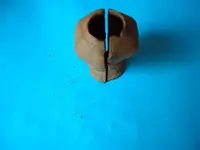
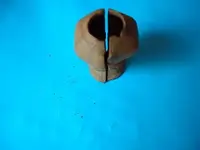
Here's mine, both found in the same hole!
 

Attachments

  • whatsit 003-1.webp
    whatsit 003-1.webp
    11.9 KB · Views: 263
  • whatsit 002-1.webp
    whatsit 002-1.webp
    13.7 KB · Views: 266
  • whatsit 001-1.webp
    whatsit 001-1.webp
    5.6 KB · Views: 253
  • whatsit 001-1.webp
    whatsit 001-1.webp
    5.6 KB · Views: 258
  • whatsit 002-1.webp
    whatsit 002-1.webp
    13.7 KB · Views: 251
  • whatsit 003-1.webp
    whatsit 003-1.webp
    11.9 KB · Views: 262
Upvote 0
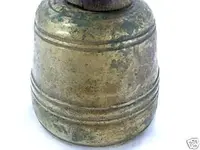
Nice finial shaun. You found your two halves a whole lot faster than I found mine! ;D I wish I'd gotten my hands on the bell I posted in the link farther up so as to determine if that might have been half cast also. I can't imagine tone would have been much of a consideration if (repeat "if") this had been a cheap "ringer" rather than a finial (of which use, unlike your's and Crusader's, I still can't quite picture considering it's shape and size :dontknow:).
 
Upvote 0
I remember Shaun7's thread. It's a good clue that these pieces actually were soldered together. Did other metal part go in finial?

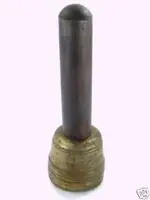
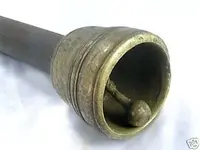
Posting the eBay bell pics, which appear to be all one piece bell.
 

Attachments

  • 21ca_35.webp
    21ca_35.webp
    9 KB · Views: 232
  • 2185_35.webp
    2185_35.webp
    1.9 KB · Views: 218
  • 2216_35.webp
    2216_35.webp
    6 KB · Views: 239
Upvote 0
Could it have been some kind of link for a chain of sorts?
 
Upvote 0

Users who are viewing this thread

Latest Discussions

Back
Top Bottom