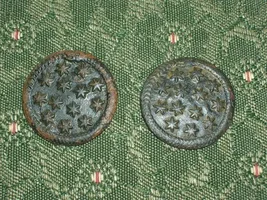
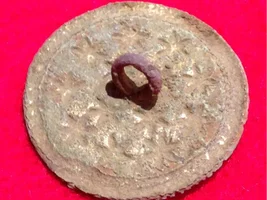
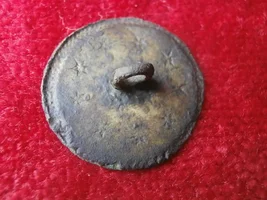
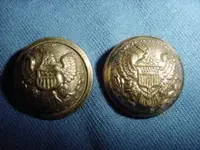
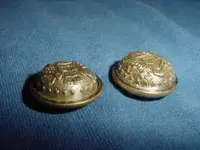
In my opinion, for what seems to be several rock-solid reasons, your two "self-shank" buttons are the Civilian "Fashion" usage "Army Officer" button equivalent of the Civilian-copy US Navy buttons which have been discussed in this forum recently.
Here are the reasons. The first two are Army Regulations reasons. The third is a "practicality" reason.
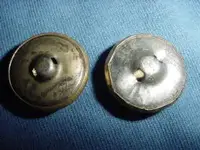
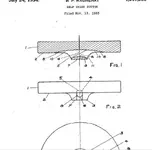
By official US Army Regulations, the Great Seal button officially replaced this type of 3-piece button for US Army officers in the year 1902. The very simply-made, cheaply-produced "self-shank" back seen in your photo does not seem to have come into use until well after 1902.
By official US Army Regulations, buttons for Officers were to be gilted/plated, and buttons for Enlisted men were not to be gilted/plated. Your photos of your two self-shank "US Army officer" buttons (and Buddyb's "US Army officer" self-shank button) are clearly not gilted/plated.
The reason almost all Military buttons have a long-ish shank is to provide enough clearance (or "room") for thick wool military-uniform cloth to fit underneath the button when the uniform is "buttoned up." The self-shank buttons fit much too closely to the cloth for use on a thick-cloth coat or jacket.
I know of a good reason for small-ish numbers of these buttons to be produced in the early 20th-century. Civil War veterans and 1898 Spanish-American War veterans liked to wear their uniforms to Reunions/Conventions. But if a officer veteran lost an Original (Military) button from his old uniform after 1901, and he wanted to buy a replacement, he would be unable to get another Original, because none of those were being manufactured for the US Army after 1901. So, by their now-civilian customers' "special order," a button-making company manufactured some non-Regulation copies for the veterans who needed replacement buttons.



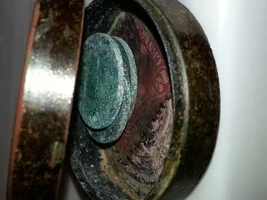
 This button was found by another member reminded me.