What's new

Can anyone translate Chinese?

reapp

Jr. Member
Joined
Nov 1, 2005
Messages
76
Reaction score
44
Golden Thread
0
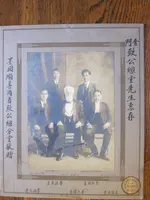
I recently acquired this old photograph, and was hoping someone could translate the text in the side margins. It is circa 1890's or so and was taken in Mexico. Someone in this f forum was helpful with a similar translation a few years ago. Thank you in advance!
 

Attachments

  • IMG_8602.webp
    IMG_8602.webp
    520.4 KB · Views: 130
I recently acquired this old photograph, and was hoping someone could translate the text in the side margins. It is circa 1890's or so and was taken in Mexico. Someone in this f forum was helpful with a similar translation a few years ago. Thank you in advance!
I did an image search/translation of the text and this is what I got, not sure if it's correct or not.

"To Mr. Xingzhi Gongzongtang"
"Presented by the Shunshan Zhigong General Branch of Mexico"

Edit: The translations aren't very correct because I just did the same search again and got slightly different results, hopefully someone who can actually read it will help!
 
Last edited:
I did an image search/translation of the text and this is what I got, not sure if it's correct or not.

"To Mr. Xingzhi Gongzongtang"
"Presented by the Shunshan Zhigong General Branch of Mexico"

Edit: The translations aren't very correct because I just did the same search again and got slightly different results, hopefully someone who can actually read it will help!
Thank you for the information! I have since discovered that Major John B. Jeffrey was a mason in San Francisco who was instrumental in improving conditions for Chinese detainees at Angel Island Immigration Station. He was granted awards from the Chinese government for his efforts. I could tell from the image that he was important!
 
Interesting picture. If esteemed member @Yang Hao sees this, he will undoubtedly provide something useful.

My AI translated the text to the left as “Two zodiac signs of Shunshan from the Kingdom of Mo are presented as a gift from the Zhigong Branch Hall.

My guess is that “Zhigong Branch Hall” relates to an outside-China fraternal organisation originally of a secretive folk nature known as the “Hung Society Zhigong Hall” founded in the early Qing dynasty. Later, in 1925, it spawned the “China Zhi Gong Party” in San Francisco, advocating for federalism and multi-party democracy in the Chinese Republic. Members of the original society were Ming Loyalists who later supported Sun Yat-sen’s revolutionary efforts to overthrow the Qing dynasty, which lasted until the Xinhai Revolution of October 1911, China then formally becoming a republic in January 1912, and the last emperor abdicating in February 1912.

I guess “Kingdom of Mo” is an abbreviation or mistranslation for “Kingdom of Mexico”. Mexico was briefly a kingdom twice in its history: from 1821 to 1823, and then again from 1864 to 1867, so maybe the picture was taken in that latter period?
 
How do we know which language or dialect it is?

I got a bit of help from someone who is Chinese and he gave me the characters at the right as 門金致公總堂先生惠存 and those at the left as 墨國順兩省致公總公堂敬贈

Google Translate identifies them as ‘Chinese (Traditional)’, the most common standard written form of the many Chinese spoken languages until the middle of the 20th Century, used also in most overseas Chinese communities outside of Southeast Asia. They translate as:

To Mr. Menjin Zhigong General Hall” and “Presented by the Zhigong General Hall of Mexico, Guoshun and other provinces”.

The names at the bottom have some uncertainties since they appear to be ‘equivalent’ transliterations of the English and Anglicised names into Chinese characters for which direct translations aren’t really valid. For example, if you transliterate my name (Roger) into Traditional Chinese, you get 羅傑 (Luó jié) as the 'equivalent'.
 
I got a bit of help from someone who is Chinese and he gave me the characters at the right as 門金致公總堂先生惠存 and those at the left as 墨國順兩省致公總公堂敬贈

Google Translate identifies them as ‘Chinese (Traditional)’, the most common standard written form of the many Chinese spoken languages until the middle of the 20th Century, used also in most overseas Chinese communities outside of Southeast Asia. They translate as:

To Mr. Menjin Zhigong General Hall” and “Presented by the Zhigong General Hall of Mexico, Guoshun and other provinces”.

The names at the bottom have some uncertainties since they appear to be ‘equivalent’ transliterations of the English and Anglicised names into Chinese characters for which direct translations aren’t really valid. For example, if you transliterate my name (Roger) into Traditional Chinese, you get 羅傑 (Luó jié) as the 'equivalent'.

Roger that !
 
I got a bit of help from someone who is Chinese and he gave me the characters at the right as 門金致公總堂先生惠存 and those at the left as 墨國順兩省致公總公堂敬贈

Google Translate identifies them as ‘Chinese (Traditional)’, the most common standard written form of the many Chinese spoken languages until the middle of the 20th Century, used also in most overseas Chinese communities outside of Southeast Asia. They translate as:

To Mr. Menjin Zhigong General Hall” and “Presented by the Zhigong General Hall of Mexico, Guoshun and other provinces”.

The names at the bottom have some uncertainties since they appear to be ‘equivalent’ transliterations of the English and Anglicised names into Chinese characters for which direct translations aren’t really valid. For example, if you transliterate my name (Roger) into Traditional Chinese, you get 羅傑 (Luó jié) as the 'equivalent'.
下面的名字是:
廖波光、吴邦植、李焕元、者户李、王卓孙。除了“者户李”——正中这个人的名字可能叫杰夫·李?其他四个人的中文名字是明确的、固定的!
The names listed below are:
Liao Boguang, Wu Bangzhi, Li Huanyuan, Zhehu Li (likely Jeff Lee), and Wang Zhuosun(廖波光、吴邦植、李焕元、者户李、王卓孙). Apart from 'Zhehu Li' — where the person's actual name is probably Jeff Li — the other four Chinese names are clear and established without ambiguity.
 
Interesting picture. If esteemed member @Yang Hao sees this, he will undoubtedly provide something useful.

My AI translated the text to the left as “Two zodiac signs of Shunshan from the Kingdom of Mo are presented as a gift from the Zhigong Branch Hall.

My guess is that “Zhigong Branch Hall” relates to an outside-China fraternal organisation originally of a secretive folk nature known as the “Hung Society Zhigong Hall” founded in the early Qing dynasty. Later, in 1925, it spawned the “China Zhi Gong Party” in San Francisco, advocating for federalism and multi-party democracy in the Chinese Republic. Members of the original society were Ming Loyalists who later supported Sun Yat-sen’s revolutionary efforts to overthrow the Qing dynasty, which lasted until the Xinhai Revolution of October 1911, China then formally becoming a republic in January 1912, and the last emperor abdicating in February 1912.

I guess “Kingdom of Mo” is an abbreviation or mistranslation for “Kingdom of Mexico”. Mexico was briefly a kingdom twice in its history: from 1821 to 1823, and then again from 1864 to 1867, so maybe the picture was taken in that latter period?
Your understanding in the previous part is correct!
The expression ‘Kingdom of Mo’ is incorrect!
In Chinese, ‘國’ means ‘country’; ‘kingdom’ would be ‘王國’.
‘墨國’ refers to Mexico.
 

Users who are viewing this thread

Back
Top Bottom