Here are the major differences between civil war era Canister and Case-Shot ammunition:
Canister takes its name from the fact that its contents were contained in what was basically a "tin can" (made of thin iron sheetmetal). The can contained a certain number of iron or lead balls, packed in sawdust. The number of balls in the Canister varied according to the caliber of the ammunition. (For example, 6-pounder caliber Canister contained 27 balls which were 1.16-inches in diameter, and for 24-pounder caliber Canister the balls were 2.62 inches in diameter.) The precise size of the balls in every caliber of Canister ammo for the Army was listed in a chart in the 1861 Ordnance Manual, which can be viewed for free on the Internet at
www.civilwarartillery.com/shottables.htm . IMPORTANT NOTE: Unlike artillery shells, civil war Canister did not contain an explosive powder charge. The blast of the cannon's propellant powder-charge shredded the thin "tin can," releasing the balls.
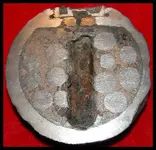
Case-Shot was a type of civil war cannon-shell which contained an explosive powder charge and a large number of "antipersonnel" balls (or slugs or wedges). Because the Case-Shot balls had to fit inside a heavy iron projectile body, the balls were much smaller (usually between .44" to .69") than Canister balls. The Ordnance Manual specified that Case-Shot ammo was to be used with a Time-fuze (never an Impact-fuze), so that it would explode in the air over enemy troops. Here is a photo of a sawed-in-half ("halfsectioned") Bormann-fuzed 12-pounder caliber Case-Shot cannonball. As you see, its explosive powder-charge was contained in a "well" in the middle of the projectile's cavity (NOT mixed among the antipersonnel balls). Canister ammo contained no powder-charge.
Regards,
TheCannonballGuy