First... the "pounder" designation of cannon calibers is based on the weight of the Solid-Shot (not hollow) cannonball fired by that caliber of cannon. For example, a "6-Pounder" cannon's Solid-Shot cannonball weighed within one ounce of 6.0 pounds.
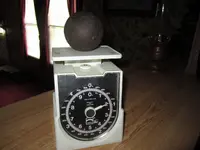
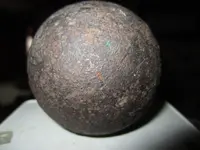
The non-electronic scale in the photos shows this ball weighs a teeny bit less than 2 pounds. There was a 2-Pounder caliber cannon in the Colonial era. So, this ball MIGHT be a 2-Pounder cannonball.
But to confirm with 100% certainty whether it is or is not actually a 2-Pounder cannonball, we need super-precise measurement of it weight AND its diameter. To do that, you'll need to weigh it on an electronic Postal Shipping scale. You'll also need to chip the rust-encrustation off of four spots on opposite sides of the ball, so its "naked" iron surface can be accurately measured with a Digital Caliper, in hundredths-of-an-inch.
Super-precise measurements of the ball's weight and diameter are needed for two reasons:
1- The very-exact diameter measurement will tell us whether or not this ball is the precisely-correct diameter to "properly" fit into a 2-Pounder cannon's bore.
2- In combination with the diameter measurement, the very-exact weight measurement will tell us whether this ball is made of steel or of iron. The reason the metal-type matters is that no STEEL cannonballs are known to have been used in North America. If this ball is made of steel, it is not a cannonball.
The 1861 US Ordnance Manual says a cast-IRON ball which weighs precisely 2.00 pounds will always be 2.46-inches in diameter. Steel is about 10% heavier than simple iron... so a 2.00-pound steel ball will be less somewhat smaller than a cat-iron ball. Therefore, the precisely-measured weight and diameter of a solid (not hollow) ball tells us whether it is made of steel or of iron.