Harry Pristis
Bronze Member
- Joined
- Feb 5, 2009
- Messages
- 2,366
- Reaction score
- 1,315
- Golden Thread
- 0
- Location
- Northcentral Florida
- #1
Thread Owner
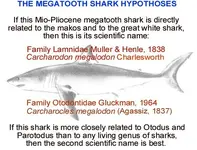
This is interesting. This paper assigns Cosmopolitodus (Isurus) hastalis to the genus Carcharodon and erects a new species (from Peru), Carcharodon hubbelli, as an sister taxon with some intermediate tooth features. So, now we have these three related sharks in a clade:
Carcharodon hastalis (broad-tooth mako)
Carcharodon hubbelli (from Peru)
Carcharodon carcharias (great white)
Carcharocles megalodon is not part of this clade. I don't have the full paper yet, but it seems we may have to make some new labels for our collections.
Origin of the white shark Carcharodon (Lamniformes: Lamnidae) based on recalibration of the Upper Neogene Pisco Formation of Peru
DANA J. EHRET1,*,
BRUCE J. MACFADDEN2,
DOUGLAS S. JONES2,
THOMAS J. DEVRIES3,
DAVID A. FOSTER4,
RODOLFO SALAS-GISMONDI5
Article first published online: 14 NOV 2012
DOI: 10.1111/j.1475-4983.2012.01201.x
© The Palaeontological Association
Palaeontology
Volume 55, Issue 6, pages 1139–1153, November 2012
Keywords:
Carcharocles;
Cosmopolitodus;
geochronology;
Miocene;
Isurus;
strontium
Abstract: The taxonomic origin of the white shark, Carcharodon, is a highly debated subject. New fossil evidence presented in this study suggests that the genus is derived from the broad-toothed ‘mako’, Carcharodon (Cosmopolitodus) hastalis, and includes the new species C. hubbelli sp. nov. – a taxon that demonstrates a transition between C. hastalis and Carcharodon carcharias. Specimens from the Pisco Formation clearly demonstrate an evolutionary mosaic of characters of both recent C. carcharias and fossil C. hastalis. Characters diagnostic to C. carcharias include the presence tooth serrations and a symmetrical first upper anterior tooth that is the largest in the tooth row, while those indicative of C. hastalis include a mesially slanted third anterior (intermediate) tooth. We also provide a recalibration of critical fossil horizons within the Pisco Formation, Peru using zircon U-Pb dating and strontium-ratio isotopic analysis. The recalibration of the absolute dates suggests that Carcharodon hubbelli sp. nov. is Late Miocene (6–8 Ma) in age. This research revises and elucidates lamnid shark evolution based on the calibration of the Neogene Pisco Formation.
Carcharodon hastalis (broad-tooth mako)
Carcharodon hubbelli (from Peru)
Carcharodon carcharias (great white)
Carcharocles megalodon is not part of this clade. I don't have the full paper yet, but it seems we may have to make some new labels for our collections.
Origin of the white shark Carcharodon (Lamniformes: Lamnidae) based on recalibration of the Upper Neogene Pisco Formation of Peru
DANA J. EHRET1,*,
BRUCE J. MACFADDEN2,
DOUGLAS S. JONES2,
THOMAS J. DEVRIES3,
DAVID A. FOSTER4,
RODOLFO SALAS-GISMONDI5
Article first published online: 14 NOV 2012
DOI: 10.1111/j.1475-4983.2012.01201.x
© The Palaeontological Association
Palaeontology
Volume 55, Issue 6, pages 1139–1153, November 2012
Keywords:
Carcharocles;
Cosmopolitodus;
geochronology;
Miocene;
Isurus;
strontium
Abstract: The taxonomic origin of the white shark, Carcharodon, is a highly debated subject. New fossil evidence presented in this study suggests that the genus is derived from the broad-toothed ‘mako’, Carcharodon (Cosmopolitodus) hastalis, and includes the new species C. hubbelli sp. nov. – a taxon that demonstrates a transition between C. hastalis and Carcharodon carcharias. Specimens from the Pisco Formation clearly demonstrate an evolutionary mosaic of characters of both recent C. carcharias and fossil C. hastalis. Characters diagnostic to C. carcharias include the presence tooth serrations and a symmetrical first upper anterior tooth that is the largest in the tooth row, while those indicative of C. hastalis include a mesially slanted third anterior (intermediate) tooth. We also provide a recalibration of critical fossil horizons within the Pisco Formation, Peru using zircon U-Pb dating and strontium-ratio isotopic analysis. The recalibration of the absolute dates suggests that Carcharodon hubbelli sp. nov. is Late Miocene (6–8 Ma) in age. This research revises and elucidates lamnid shark evolution based on the calibration of the Neogene Pisco Formation.
Last edited:


 Harry...very interesting, thank you for finding & sharing!