What's new

✅ SOLVED Civil War era "Whatsit"

creskol

Gold Member
Joined
Jan 14, 2007
Messages
13,882
Reaction score
23,351
Golden Thread
2
🥇 Banner finds
2
Primary Interest:
Other
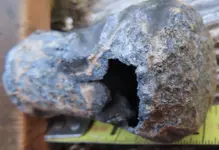
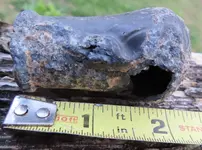
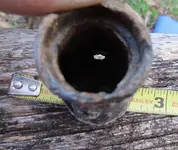
Today I was supervising the restoration of a old stone wall around a cemetery that dates from the 1700s to the Civil War era. The rocks were all dry stacked and the wall had been neglected for many years. Some of the wall had toppled over and much had been pushed out of alignment by trees and privet that were allowed to grow by the wall. While the crew was carefully removing the rocks, this item rolled out. I believe it is pewter and it has an eagle on it. It is also quite heavy. Any idea what this is? Seems to be overkill for a cane tip or umbrella. Strange piece indeed.
 

Attachments

  • Screenshot 2026-04-06 at 6.58.07 PM.webp
    Screenshot 2026-04-06 at 6.58.07 PM.webp
    477 KB · Views: 132
  • Screenshot 2026-04-06 at 6.58.23 PM.webp
    Screenshot 2026-04-06 at 6.58.23 PM.webp
    427.5 KB · Views: 107
  • Screenshot 2026-04-06 at 7.07.53 PM.webp
    Screenshot 2026-04-06 at 7.07.53 PM.webp
    177.7 KB · Views: 106
Today I was supervising the restoration of a old stone wall around a cemetery that dates from the 1700s to the Civil War era. The rocks were all dry stacked and the wall had been neglected for many years. Some of the wall had toppled over and much had been pushed out of alignment by trees and privet that were allowed to grow by the wall. While the crew was carefully removing the rocks, this item rolled out. I believe it is pewter and it has an eagle on it. It is also quite heavy. Any idea what this is? Seems to be overkill for a cane tip or umbrella. Strange piece indeed.
Is that lead maybe?
 
Upvote 0
It is heavy like lead, but it is deteriorated like pewter.
Could it be possible that in the making of it, they had some % Tungsten within the preliminary ores or molten mix and they just fired the ovens much higher than usual?? They didn't know of course....but it happened.

Because Tungsten is very heavy , same as pure gold, and may give such dark bluish hue to the material.
 
Upvote 0
Could it be possible that in the making of it, they had some % Tungsten within the preliminary ores or molten mix and they just fired the ovens much higher than usual?? They didn't know of course....but it happened.

Because Tungsten is very heavy , same as pure gold, and may give such dark bluish hue to the material.
Tungsten has a melting point of 6192°F. The highest of any pure metal. I don’t think they could melt it back then.
 
Upvote 0
Tungsten has a melting point of 6192°F. The highest of any pure metal. I don’t think they could melt it back then.
That's the big question.
Back then nobody knows.
But even before the patent on Tungsten in USA was it around 1857 or 1867, I forgot exactly BUT Tungsten can be found as an integral part of finished stuff in the 1820s. Even in the 1700s. At least impurities of it....
Maybe better insulation of the furnaces??
Certainly the craftsman Didn't know it as an element TO INCLUDE it purposely! They didn't do it purposely.
But they might have by LOCAL tradition known where to extract ores from that " for some exceptional reason " makes things stronger.

Well our colleague can take it to a Place to test the composition of this piece. Then we will know for sure.

Maybe Cobalt it contains. Only 1495 Celsius, Iron is 1538 Celsius.

For sure it Contains something interesting.

One other thing, The stone wall may have been repaired/ rearranged again in the 1800s without being known.
 
Last edited:
Upvote 0
That's the big question.
Back then nobody knows.
But even before the patent on Tungsten in USA was it around 1857 or 1867, I forgot exactly BUT Tungsten can be found as an integral part of finished stuff in the 1820s. Even in the 1700s. At least impurities of it....
Maybe better insulation of the furnaces??
Certainly the craftsman Didn't know it as an element TO INCLUDE it purposely! They didn't do it purposely.
But they might have by LOCAL tradition known where to extract ores from that " for some exceptional reason " makes things stronger.

Well our colleague can take it to a Place to test the composition of this piece. Then we will know for sure.

Maybe Cobalt it contains. Only 1495 Celsius, Iron is 1538 Celsius.

For sure it Contains something interesting.

One other thing, The stone wall may have been repaired/ rearranged again in the 1800s without being known.
Also Bismuth. Melting temperature only 271 Celsius often becomes integral part of cast iron in old times, Is a LITTLE heavier than Iron.
Iron is about 7.87 grams per cubic cm while Bismuth is 9.78 grams.
If the thing has unusually high amount of Bismuth, it might feel heavy to the hand. But not as heavy as Lead.
Screenshot_20260407_095021_Chrome.webp
 
Upvote 0
"Your recovered eagle fragment is best understood as a hollow-cast finial from a 19th-century ceremonial baton or staff, likely associated with a bandmaster or drum major. The deep socketed weighted base, thin cast walls, and absence of mounting lugs indicate it was designed to fit over a wooden shaft rather than serve as fixed hardware. This construction is consistent with mid-19th-century baton finials, which were often decorated with patriotic motifs such as spread-wing eagles. The interior wear suggests it was once mounted and used, rather than being a purely ornamental casting. Given its form, material, and context of recovery, the piece is reasonably attributable to a Civil War–era ceremonial band implement."


Its presence at the site also raises the possibility of a connection to funeral or memorial observances. Military and community bands were commonly present at 19th-century funerals, particularly for veterans, where music played an important ceremonial role. While no direct evidence links this finial to a specific event, it is entirely plausible that a band once participated in services at this cemetery, lending a quiet but meaningful dimension to the site’s history and the lives commemorated there.


Screenshot 2026-04-11 at 7.46.53 PM.webp
 
Upvote 0

Users who are viewing this thread

Back
Top Bottom