What's new

🔎 UNIDENTIFIED Colonial 8 Reals Coin cut to 4 Silver over Copper

JamesJr

Jr. Member
Joined
May 4, 2025
Messages
50
Reaction score
152
Golden Thread
0
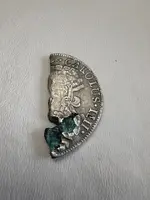
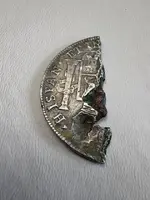
I have this 8 real Spanish coin that was cut in half revealing that it was silver over a copper core. Was it counterfeit or did Spain issue debased coins like we do zinc pennies. If so what is its value to a collector?
 

Attachments

  • 8 Real 2.webp
    8 Real 2.webp
    97.6 KB · Views: 107
  • 8 Real cut .webp
    8 Real cut .webp
    100 KB · Views: 87
I have this 8 real Spanish coin that was cut in half revealing that it was silver over a copper core. Was it counterfeit or did Spain issue debased coins like we do zinc pennies. If so what is its value to a collector?
tn_link.gif
Until a member(s) pipes in - I searched Google and found mention of silver and copper. May not be your particular coin but at least it does mention silver/copper.


"...Alexander Hamilton took a few Spanish pieces of eight. He got an average of 24.1 grams of silver & 2.9 grams of copper..."
 
Upvote 0
The value if any would depend if it's a modern fake or a true period counterfeit, if a modern fake not worth anything, if period counterfeit it would be worth some money BUT a lot more if you hadn't of broke it in half!
 
Upvote 0
I found it just like this - broken in half. Obviously done on purpose not a clean cut like they did when making change. What I heard is that merchants back then had scales where they weighed the coins to see if they were within weight, as many coins were cut into pieces. This coin looks like it would not have made the weight check. Hence the hammer to break it open. You can see a hammer dent on one side.
 
Upvote 0
I found it just like this - broken in half. Obviously done on purpose not a clean cut like they did when making change. What I heard is that merchants back then had scales where they weighed the coins to see if they were within weight, as many coins were cut into pieces. This coin looks like it would not have made the weight check. Hence the hammer to break it open. You can see a hammer dent on one side.
From doing a bit of research most all of the "period" counterfeits I saw were coins made under weight but still out of silver, the goal of the counterfeiters was to make a small amount off each coin, I couldn't a single period counterfeit that had a solid copper core, I did however see some "modern" fakes that did but they aren't worth anything.
 
Upvote 0
This coin was dug deep in a 1600's to 1800's colonial site in Virginia. You can see the patina on the copper meaning it was long underground. I keep looking on line and I did come across a reference that said that in the late 1700's the Spanish crown issued a series of debased copper covered coins in the far east as trade dollars. Have not been able to back that up. Takes someone with deep knowledge of Colonial Spanish coinage.
 
Upvote 0
It's a counterfeit for sure. Spain was very serious about the quality of silver in their coinage. The reason for having a mintmark and assayers initials on these early coins was to know who to blame if coins were found to be lightweight or debased, and the penalty was severe for anyone found guilty.
 
Upvote 0
Makes you wonder what happened to the guy who tried to pass this one off.
 
Upvote 0
What you have is likely a Charles IV "Sheffield Plate" counterfeit, most likely from Birmingham. Birmingham was a center for counterfeiting, continuing into the 20th century, with many operators. Counterfeiting Spanish Colonial coins went on all over the world, especially in China, England and Mexico...often with a debased silver content but just as common to silver plate over another metal. There is a large collector base for such coins, some selling for more than their legitimate counterparts. Fakes are still being made today. This is a very deep well to fall into...
 
Upvote 0
What you have is likely a Charles IV "Sheffield Plate" counterfeit, most likely from Birmingham. Birmingham was a center for counterfeiting, continuing into the 20th century, with many operators. Counterfeiting Spanish Colonial coins went on all over the world, especially in China, England and Mexico...often with a debased silver content but just as common to silver plate over another metal. There is a large collector base for such coins, some selling for more than their legitimate counterparts. Fakes are still being made today. This is a very deep well to fall into...
Thanks for your replies. I posted it on Ebay and it sold within 5 minutes, so there must be some interest in it. I called it a conversation piece Spanish Colonial coin.
 
Upvote 0
Thanks for your replies. I posted it on Ebay and it sold within 5 minutes, so there must be some interest in it. I called it a conversation piece Spanish Colonial coin.
Do you mind saying what it sold for, it will be good info if someone else finds one?
 
Upvote 0
Ten dollars. I just wanted to get rid of it. Did not know if it had any value except as a conversation piece. I used to drag it out on occasion with my metal detector buds and ask them what you think happened to the guy who tried to use this one.
 
Upvote 0

Users who are viewing this thread

Back
Top Bottom