What's new

Colonial Silver Spoon. Need help with the hallmark and actual date

Stef45

Hero Member
Joined
Jan 7, 2016
Messages
781
Reaction score
1,228
Golden Thread
0
Location
SC
Detector(s) used
Minelab Safari
Primary Interest:
All Treasure Hunting
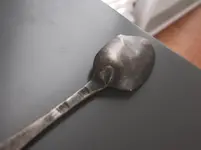
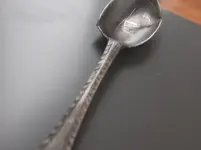
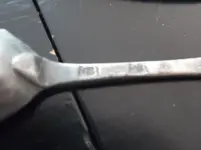
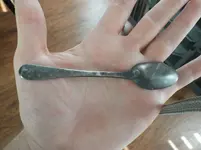
Found this silver spoon today. There are two back marks and they are the same. I S or S I with a dot in between them. This was found on a colonial site in the back yard of the original house. Any help would be great. It definitely looks old to me. Sorry for the blurryness on the first pic I'm terrible with this camera but you can still make out the I S or S I
DSCF0347.webpDSCF0349.webpDSCF0350.webpDSCF0351.webp
 
Looks like a variety of the "rat tail" spoons. That one is probably mid 1700s.
 
Upvote 0
Thats a Killer spoon man! I've never been very successful finding those marks out. I think I remember Cru saying once that they would leave some of the hallmarks off so avoid tax... so it seems that IDing this stuff is a whole other art. Here is some info from some sites I've look at in the past.

This site has a forum and a TON of great info British Sterling - English Hallmarks, Irish Hallmarks & Scottish Hallmarks It actually says at the bottom to join the forum if you have a mark you need identified. I'd guess its a bunch of people over there who are as into collecting and researching silver as we are into digging up dirty relics. ha

Here are some IS marks: English silver hallmarks: British maker's marks identification IM-IZ

IS under an asterisk (James Smith I [ L ]) entered 1720
IS (Isaac Solomon or John Seymour [ D ] ) 19th c./1st half
IS (not identified) Birmingham 1936
IS (John Shaw [ B ] ) 19th c./1st half
IS into a rectangle (James Scott [ D ] ) 19th c./1st half
I.S (John Stoyte [ D ] ) end 18th c.
I.S into a rectangle (James Scott [ D ] ) 19th c./1st half
I.S (John Settle & William Hatfield [ S ] ) 19th c./1st half
 
Upvote 0
Looks like a variety of the "rat tail" spoons. That one is probably mid 1700s.

Agreed circa mid-late 18th C!

I.S in that period the I is a J.

Only having the makers-mark with no other part of the British (Probably) hallmark will make it a tough one to track down without a silverware expert.
 
Upvote 0
The design does looks like other examples of colonial spoons I have seen.
 
Upvote 0
Agreed circa mid-late 18th C!

I.S in that period the I is a J.

Only having the makers-mark with no other part of the British (Probably) hallmark will make it a tough one to track down without a silverware expert.

Thanks Cru! Wondering how one reads the mark (with bowl to the right or bowl to the left) There was a Joseph Smith from boston with I (Dot) S as a back mark accd. to this 1917 American Silversmith book. The spoon has the same initials as the person who owned the house back in the late 1700s. Also its interesting that there is two identical marks about a half cm apart.
 
Upvote 0
Thanks Cru! Wondering how one reads the mark (with bowl to the right or bowl to the left) There was a Joseph Smith from boston with I (Dot) S as a back mark accd. to this 1917 American Silversmith book. The spoon has the same initials as the person who owned the house back in the late 1700s. Also its interesting that there is two identical marks about a half cm apart.
There is no rule about which way up they went, you see all sorts.
This Makers Mark needs to be indentical to the original including the shape of the stamp & position of the dot etc.... You are right its very odd to repeat a Maker Mark twice on the same object, not seen that before, but then I don't study them that hard either. What I am sure of is that its a 18th C example.
 
Upvote 0

Users who are viewing this thread

Back
Top Bottom