What's new

Concreation Fossil Ohio

jhenry

Jr. Member
Joined
Apr 19, 2009
Messages
59
Reaction score
9
Golden Thread
0
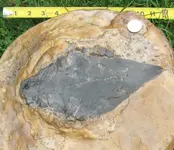
Found this in the Huron River, Ohio. Devonian age fossil, any idea what it is?
Thanks for your help!
 

Attachments

  • Concreation Fossil.webp
    Concreation Fossil.webp
    204.7 KB · Views: 1,576
Welcome to Tnet jhenry :hello:

That's a big fossil. Maybe some more pics would help (the whole fossil/different views etc.). Also the Fossils forum here on Tnet may be able to help. Interesting fossil with the two different colors :icon_thumright:
 
Upvote 0
Thanks for posting. You might try to make your photos much smaller so we can can a better idea and might be able to help you. Try sending the photo email..the computer always reduces the size prior to sending..you then can save the same pic by just changing the file 'name'. This way it will all 'fit' on the screen. Then again I could be wrong.

Good Luck

just realized there is a photo tutorial in this thread! use it.
Good Luck.
 
Upvote 0
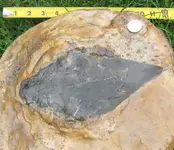
Hope the size reduction helps, but I have no idea what it is:
 

Attachments

  • Concreation Fossil.webp
    Concreation Fossil.webp
    97.9 KB · Views: 2,110
Upvote 0
Henry, it is a fascinating specimen what ever it is. I assume this is adhering to limestone? Some things are curious about it, one being the lack of any trace of bone structure. The formation of the limestone, as well as the visible edge of another gray layer several inches beneath this one seem to suggest this might be mineral rather than animal?
 
Upvote 0
I see a Flounder or a Fluke .
Perhaps a Stegasauras radiator fin.

Two ghost towns come to mind here. "Sinclair", Tennessee, and, "Prestone", Tennessee.
 
Upvote 0
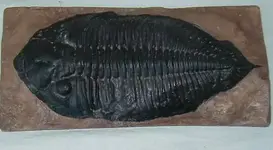
think maybe its a complete trilobyte if so a complete one(to my knowledge) has never been found. they come in all sizes. dont disturb the layers and contact a university state level if possible
 
Upvote 0
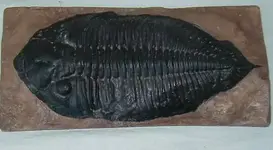
I agree with Goldie; here's a pic of a repro. Breezie
 

Attachments

  • Trilobite_Dalminites_Perdue_LowerDevonian_Tennessee_Large.webp
    Trilobite_Dalminites_Perdue_LowerDevonian_Tennessee_Large.webp
    13.9 KB · Views: 999
  • Trilobite_Dalminites_Perdue_LowerDevonian_Tennessee_Large.webp
    Trilobite_Dalminites_Perdue_LowerDevonian_Tennessee_Large.webp
    13.9 KB · Views: 760
Upvote 0
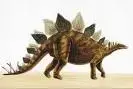
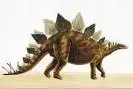
Looks like a plate off of a Stegosaurus, towards the tail would be smaller. Not sure if they were in that area or not though?

Brian
 

Attachments

  • images.webp
    images.webp
    2 KB · Views: 820
  • images.webp
    images.webp
    2 KB · Views: 824
Upvote 0
Dang, this is like the Rochart test in psychology! Everyone sees someting different. Some of us must be crazy! M :tongue3: nty
 
Upvote 0
"Concretions are commonly misunderstood geologic structures. Often mistaken for fossil eggs, turtle shells, or bones, they are actually not fossils at all but a very common geologic phenomenon in all types of sedimentary rock; including sandstone which is made up of compacted sand grains, shale which is made up of compacted mud, siltstone which is made up of a fine grained silt, and limestone which is made up of calcium carbonate precipitated by many marine invertebrates." http://images.google.com/imgres?img...?q=how+are+concretions+formed&hl=en&sa=N&um=1

This definition seems to fit your example, which appears to be a non-fossil secretion. If you look carefully at what at first appears to be a fossil you'll see that similar deposits of black mineral exist throughout this entire formation which happen not to be exposed. As well, carefully looking at the left hand side of the apparent fossil shows a spreading of black mineralization, rather than an original shape which was preserved within the surrounding rock.
 
Upvote 0
Hi TNETTERS I took the concreation to the Cleveland Museum of Natural History. This is what the man in charge of fossil restoration said.....It's a piece of the skull and thoracic shield of dunkleorsteus terrelli. This ferious arthrodire fish was a preditor in the Devonian Seas of Ohio. The skull of this fish is nearly 1.4 meters long. This is a plate or part of the thoracic shield, approximately 360 million years old. The museum wants me to donate this and several other pieces of the skull. This skull is pictured on the front cover of 'Fossils of Ohio'. Thanks for the input!
 
Upvote 0

Similar threads

Users who are viewing this thread

Back
Top Bottom