Some good research definitely wort further investigation.
A novel approach using a dog. They will be great company in searches and wish you the best. But I would not rely on search to its entirety to just using a dog. Gold is odourless. Gold itself does not have a distinct smell.
Due to its sulfur content, pyrite may emit a faint sulfuric or 'bad egg' smell when struck or scratched. However, pyrite, which is often mistaken for gold, can have a faint sulfuric or "rotten egg" smell, especially when scratched or struck. This is because pyrite is an iron sulfide mineral, meaning it contains sulfur.
However some Gold deposits that contain both real gold and pyrite (fool's gold) are not uncommon, and the two minerals can be found associated with each other in various geological settings. Pyrite, while often a "fool's gold" mimic, can sometimes also contain traces of real gold, and the presence of one can often be an indicator of the other.
Carlin-type gold deposits are a unique type of gold deposit characterized by disseminated gold within sedimentary rocks, particularly in the form of invisible, microscopic particles. These deposits are commonly found in sedimentary basins and are associated with specific geological features like thrust faults and permeable, reactive rocks. The gold is often locked within pyrite and arsenopyrite, making it difficult to detect without specialized analysis. In essence, while pyrite itself isn't gold, its presence can be a valuable clue for finding real gold and can also contain some gold itself. The two minerals are often linked in the geological processes that form gold deposits.
However In Georgia a region known for high-purity gold (near 24 karat) like the one found below. found in eroded rock and quartz veins, gold deposits are primarily of two types: lode deposits and placer deposits. Lode deposits consist of quartz veins within solid rock, while placer deposits are gold-bearing sands and gravels in stream valleys, derived from the erosion of lode deposits. Quartz Veins: Gold is found within quartz veins that cut through the rock or placer deposits. Stream Valleys: Gold is found in the form of gold-bearing sands and gravels that have been transported by streams. Placer deposits are formed by the weathering and erosion of lode deposits. You might get lucky like finder below.
View attachment 2210457
I would be looking for quartz to see if there is an traces of gold. And be search for tell tale mine shafts like the one below.
View attachment 2210452
Old house foundation of original plantation house. old fence lines post hole caches. cellar holes. Any more detailed maps of plantation house might help also to narrow down search areas. Many gold coinage from the day may have been hoarded and buried with in sight of the plantations houses masters bedroom. Hidden from both Armies and never recovered. And pre-civil war maps you can get your hands on might be of help also. Foundations may be very meager but certain detecting in vicinity like the foundations below of a former plantation house.
View attachment 2210456
Hopefully the weather will dry out and you will have fun.
Cheers Crow
You are very correct sir.
A dog can't smell the gold or silver.
At least that we know of.
What they are scent detecting is the gold sulfide and silver sulfide.
Dogs have the ability to distinguish between the metal sulfides.
How? To tell you the truth, researchers are still wondering.
But it's not just the sulfide scent they detect; it is the actual metal itself plus the sulfide.
So Chance has been trained to discriminate between the different metal sulfides.
Chalcocite (Copper sulfide), Pyrite (Iron Sulfide), Galena (Lead Sulfide) Arsenopyrite, and several others.
Plus, countless of other distraction odors. Deer poop, chocolate, squirrel bones, etc.
Silver Sulfide (Tarnish) was quite easy for him to distinguish. With-in a day he could easily pick out silver compared to other scents.
Gold Sulfide took a few weeks. It must have a much fainter scent to dogs.
Here is an old video from about 7 months ago.
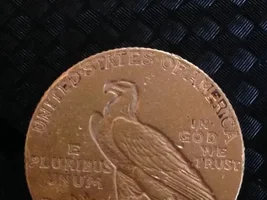
Chance is picking out a scent container with a gold coin compared with other containers that had distraction scents in them, Iron, Zinc, etc.
Since that time 7 months ago. Chance has been homing his skills.
Winter and work restricted us from traveling to sites to explore.
And lately the rain has been stopping our searches.
But last week we came across an old mine site that wasn't listed.
Unfortunately, Chance was exhausted by the time we got to it.
So, I had planned to revisit the site the next.
Then a massive thunderstorm came through during the night, so we had to bail out of the tent and get out of the woods before I got stuck in the mud.
But the site is full of quartz deposits that is in several piles throughout the woods in the area one of those plantation owners owned.
later I found a sketched map of the area we were exploring that shows it was a mine locate
A location that isn't listed by the USGS. So, I assume it hasn't been explored much.
All those mines were owned by one plantation owner. I also have the approximate location of his house. So Chance will be able to search the old plantation grounds. The house or any remnants of it aren't there.
But chance is quick in his scent detection and can scan a large area a heck of a lot quicker than I can.
Here he is in the training exercise locating some gold in the scent container I show above.
Chance isn't perfect. He will sometimes trigger on zinc. Not sure why yet.
And sometimes he just gets lazy and wants a treat, so he'll trigger on a non-gold or silver object.
maybe once out of every twenty or thirty times.
He's an experiment in the works.
I'm using "Prospecting Dog" training developed by Finland by their government to find Iron Ore.
Also, a Swedish geologist did quite a bit of work with a "Prospecting Dog" named Rex.
But the goal is for Chance to tell me where a bunch of these are.
😁
Hopefully!