Villagenut said:
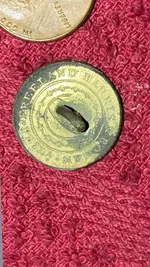
> Weird how the makers mark doesn't come up in any of my searches.... curious minds want to know.
Friendly advice for anybody here who doesn't already know:
The backmark on a button does not always tell the name of its maker. Many, (in fact most,) of these brass 1-piece flatbuttons had what at that time wwas called a "Custom" backmark... meaning, the Customer chose what the mark would say of show. Often, it is a simple "quality declaration" such as Superfine or Rich Orange. Sometimes, the Customer chose to have his own company's name be the backmark (as a way of advertising his business or store) -- not the Manufacturer's name (Such as Scovill or Waterbury Button.
In this case:
Like Villagenut, my research did not turn up a backmark saying "Freeland Harris & Bowen Phila." But I did find that a person named Freeland Harris invented and patented something in 1965. Yes, that is a long way from this flatbutton's time... but it cautions us that sometimes the first name in a backmark is simply a person's actual first name. Thus somebody here might find a record of an 1820's Philadelphia company named Harris & Bowen.
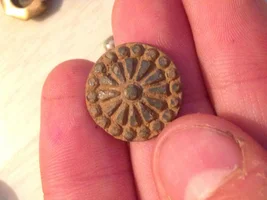
About LostinGeorgia's flatbutton:
The presence of indented (not raised) letters in a brass flatbutton's backmark seems to first start appearing around 1810... and continued until 1-piece flatbutton's fell out of favor with the public around 1840. The War-of-1812 interrupted the supply of British-made buttons from 1812 throuh the end of the patriotic boycott of British goods in the early-1820s. The absence of British "competition" gave a majpr boost to the fledging American button-making industry during that time... so I agree with The Rebel's supposition that this one was made sometime in the 1820s... or perhaps the early-1830s.