What's new

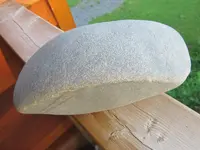
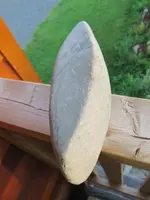
Double-bladed Woodland(?) unusual ground stone ax

Almy

Bronze Member
Joined
Mar 18, 2011
Messages
2,006
Reaction score
3,962
Golden Thread
0
Location
Maritime Provinces
Detector(s) used
Tesoro Cibola
Primary Interest:
Other
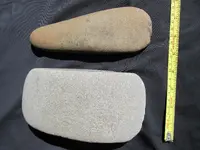
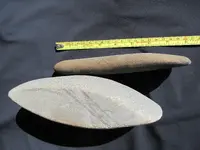
I was walking along the beach of a river island and noticed this unusually-shaped object which had apparently been washed out of bank this spring. I wonder whether anyone else has found something similar and what age/people type it may have been made by. It is 8" long, 4" wide, 2" thick at the centre (thickest point) and weighs about 2.5 lbs. Since there is no haft groove and it would be difficult to embed one of the blades in a socket, I wonder how it was used and what for. The two blade edges show signs of considerable use.
 

Attachments
  • IMG_5383.webp
    IMG_5383.webp
    383.9 KB · Views: 152
  • IMG_5387.webp
    IMG_5387.webp
    771.9 KB · Views: 146
Upvote 0

Looks like unfinished Axe.
 
Looks almost natural to me. Might have been something started but then never finished. Has a great shape to it.
 
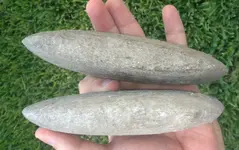
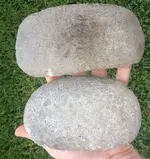
You might be in the wrong area, but if I found it, I'd call it a mano. I've seen lots of them get that ax shape after years of use. Here are a couple I have. Depending on the type of metate (base of the grinding stone), they get squared off on the sides and that axe bit shape from rocking as it is pushed up and down against the metate to grind corn.

These have also been used into modern times by many groups in Mexico and Southwest.

Could be an axe preform, there are some double bit axes out there, but normally the grove was pecked in long before they put the bit on them.

Mano1.webpMano2.webp

Mano3.webp
 
Last edited:
Thank you for the replies and speculation. Some more recent information:

I took it to our provincial archaeology department and 2 archaeologists looked at it. The senior one has excavated many early sites containing stone artifacts and the other is just finishing a Master's on stone tools. Both immediately recognized it as man-made and showed me the chipping on each blade edge indicating extensive use as a cutting/chopping device. Neither had seen anything like it in our province but the senior one remembered seeing a couple of similar ones in southern Maine. I also found a hammerstone and a stone used for grinding other stones in the locality (both of which I thought were unusual natural cobbles but the archaeologists showed me otherwise, to my surprise and pleasure. I had taken the other 2 along just to be sure they were cobbles).

I am very new to stone artifacts, so am no expert for sure. But from a mechanical point of view, the rough surface on a fine-grained rock, the blade edge use and the fairly sharp edge where the convex sides meet the flat ends are suggestive features. The rough surface suggests pecking, the blade edge use suggests its use as mentioned above, and the sharp edge suggests that it was not river action that finally shaped it.
 
So lets see the other 2 pieces you found.
 
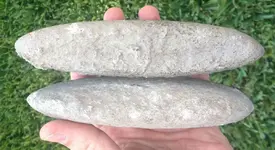
Other axe

Thank you all for the comments and encouragement. This is the single-bladed axe with the double-bladed one. Note chipped wear on the blade end of the single one.
 

Attachments

  • IMG_5416.webp
    IMG_5416.webp
    1.2 MB · Views: 93
  • IMG_5415.webp
    IMG_5415.webp
    878.5 KB · Views: 101
Last edited:

Users who are viewing this thread

Back
Top Bottom