BobinSouthVA wrote:
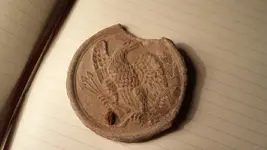
> Is this the solder filling of a eagle breast plate? (it's hard, can't scratch it with my nail)
YWell... if you are absolutely certain that what you are seeing isn't greyish-brownish CONCRETION of the plate's brass front... then yes, definitely it is the solder filling from the plate's back.
For anybody here who doesn't already know... although most relic-diggers and collectors call these a "lead filled" plate, the filling in Originals of these breastplates (and boxplates, and belt-buckles) was indeed solder, not lead. Modern-made Reproductions of them are filled with lead -- which is a softer metal than solder, and that is an important ID-clue for telling a Repro from an Original.
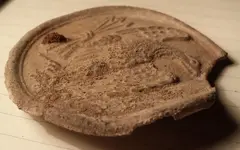
> When they poured the solder into the back of the brass plate did they leave perfect impressions like this?
Yes. The reason is the the plate's thin sheetbrass front was stamped simultaneously with both a positive die and a negative die. That produces an indented "reverse image" on the back of the sheetbrass. So the molten fillermetal takes the shape of the indented back, like when in my childhood my mom would "cast" Jello in a mold.
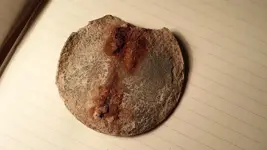
> Can't see any markings on the back. The hooks protrude though the face as you can see, so I don't think it's an earlier variety.
What you are seeing is not the end of the iron wire hooks/loops protruding through the filler-metal's face... it is a "rust-blister" which ruptured through the filler metal. The same thing happened sometimes even when the sheetbrass front is not missing from the plate. The brass front will show rust-blister eruptions through the brass, coming from the iron wire hooks/loops in the plate's back. I've dug quite a few solder-filled eagle breastplates (and US Oval boxplates) with rust-blisters on their brass front here in Virginia.