What's new

🔎 UNIDENTIFIED Early 1800s Sword

Joined
Oct 1, 2018
Messages
442
Reaction score
690
Golden Thread
0
Location
Western PA, Northern NJ
Detector(s) used
Garrett AT Max
Primary Interest:
All Treasure Hunting
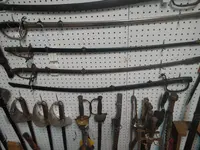
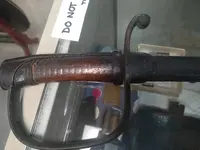
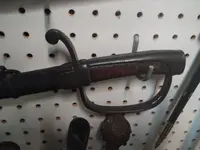
Good morning everybody. Yesterday I was in an antique shop and came across this sword with no markings that looked pretty old. It resembles a number for late 1700s/early 1800s swords, but I can't find any that are exactly like it. It's probably most similar to a Greenleaf contract sword, but it isn't identical. Does anybody recognize it?
 

Attachments

  • IMG_20251123_154757.webp
    IMG_20251123_154757.webp
    834.1 KB · Views: 169
  • IMG_20251123_154753.webp
    IMG_20251123_154753.webp
    1.1 MB · Views: 134
Looks to be a light artillery saber, probably an import. That shop has a great selection!

 
Upvote 0
Looks to be a light artillery saber, probably an import. That shop has a great selection!

The 1840 is close, but there are definitely some differences. For one, this has iron furniture instead of brass. It also has the 'ears' that come off the hand guard over the ricasso. I will say, the 1840 has a much closer hand guard shape that the 1796 light cavalry sword, since it is more rounded and doesn't meet the cross guard at a right angle. And yeah the store has some cool stuff, but most of it is overpriced. Not pictured is the rack of modified trapdoor springfields sold at unmodified prices.
 
Upvote 0
I agree with your estimate of a 1790-1820 period of manufacture. As TheRebel points out, the unbranched knuckle bow is reminiscent of the French 1822 or the US 1840 light artillery sword. However , the blade is much straighter than either of these swords, and is shaped more like a cavalry blade. The rudimentary drag on the end of the scabbard is somewhat similar to those made by Nathan Starr ca 1812. The hilt is similar to the French style, but the langets are of the British style rather than the Hungarian style usually used by French makers. Oftentimes a mixture of different traditional styles in the same specimen is said to indicate American manufacture.
 
Upvote 0
I agree with your estimate of a 1790-1820 period of manufacture. As TheRebel points out, the unbranched knuckle bow is reminiscent of the French 1822 or the US 1840 light artillery sword. However , the blade is much straighter than either of these swords, and is shaped more like a cavalry blade. The rudimentary drag on the end of the scabbard is somewhat similar to those made by Nathan Starr ca 1812. The hilt is similar to the French style, but the langets are of the British style rather than the Hungarian style usually used by French makers. Oftentimes a mixture of different traditional styles in the same specimen is said to indicate American manufacture.
This is really the conclusion I came to also. I'm thinking it has to be an early US sword. Unless I can find markings on the blade somewhere, I think I'll have to start scouring reference books. There may not be many of this kind out there.
 
Upvote 0
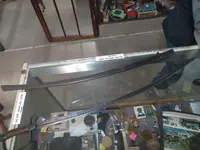
I went to look over the blade for markings and found none, but I took a picture of the blade out of the sheath. I will say, the handguard feels very loose.
 

Attachments

  • IMG_20251206_151946.webp
    IMG_20251206_151946.webp
    1.2 MB · Views: 63
  • IMG_20251206_151939.webp
    IMG_20251206_151939.webp
    1.3 MB · Views: 66
Upvote 0
So did you buy it yet ?
Did you offer them less ?
 
Upvote 0

Users who are viewing this thread

Back
Top Bottom