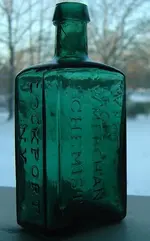
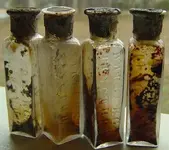
Nobody, and I mean nobody, can glassify a window like Rory! Thanks, once again, for some great photos of some equally great glass, sir.
Are any of the Warburg's pontiled? Four fantastic flares!
"A SAD REVELATION— DR CARUS WARBURG.
It has been the fate of some men to be appreciated too late.
Bread has been asked for during life and refused, but after death
a stone is given, and a statue is raised as recompense for merit.
History furnishes us with many instances of this kind. The sad
narrative of Dr. Maclean in
The Times, September, 1878, in refer-
ence to the position of Dr. Carus Warburg, furnishes us with an
instance of the cruel injustice of the world in bestowing its favors,
and of the fate tluit may await men of the highest talent if they
forget self, in their desire to benefit their fellow men. Professor
Maclean said that Dr. Cams Warburg was "wanting the common
necessaries of life," though he was the discoverer of a remedy
which would have made for him a fortune had he kept it secret, like
other astute owners of recipes. Through the agency of Dr. Mac-
lean, Warburg revealed, to the profession, the composition of his
remedy for malarial intermittent fevers and cholera, in the hope
that government might obtain their supply from him. But if any
promise of the kind was ever held out it was not fulfilled, for we pre-
sume, when the secret of the remedy became public property, it
could be procured at a cheaper price, and government did not seem
to consider itself bound to recompense the discoverer. Dr. War-
burg was wanting in worldly wisdom in not having a bond — signed,
sealed, and delivered — that he should be adequately rewarded for
his prescription, and his position will be attributed by some to his
own fault in neglecting this precaution. We are not informed
whether any inducements were held out by Professor Maclean, but
the facts are that Warburg parted with his secret to him gratuit-
ously, and was absolutely destitute. He possessed a prescription of
his own of a complex nature, more so even than that of chlorodyne, a
remedy of high reputation in India against the malignant malarias
of that country and cholera. Its composition was made known by
Professor Maclean in the columns of a contemporary several years
since, and he gave his unqualified support to all that had been said
in its favor. Dr. Broadbent has, moreover, testified that its efficacy
cannot be disputed..."
A Weekly Journal of Medicine and Medical Affairs.From January to June,1880.
ROMAN GLASS JAR WITH WIDE FLARED LIP, 1st - 3rd CENTURY C.E.
From.