Re: Final changes to 2 1/2" dredge
Ames,
Here is some friendly tips from a dredger who put a 2.5 dredge in the water in the summer of 1980!
and has mined for the last 29 summers!
first the front of the dredge is where the motor is..as the output of the sluice will discharge downstream
next the handle on the nozzle is not needed. The value of a pea shooter dredge (2.5) is
that you cant run volumes of gold bearing gravel but you sure can get in those nooks and crannies
that the big dredges couldnt. So the handle will only block you from getting in to those crevasses!
The reason you see them on bigger dredges is that the suction power on an 8 inch with a big motor
can suck your arm in and put you in a bad way under water, the handle lets you get a sure grip.
What is critical about the nozzle is your must make is slightly smaller than the inside diameter of the
hose or you will clog even 60 seconds and spend more time getting the clogs out than dredging.
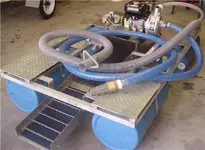
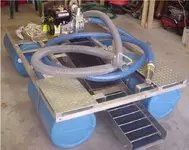
The floats looks good, but I dont think you will be able to sit on it..as you would need to balance the
oppisite end to keep from tilting at a dangerous angle.
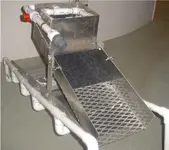
The sluice box looks good too, but I think it is mounted too steep, the rule of thumb is kinda 1 inch drop
for each 3 feet of run.. also depending on how deep the floats sink into the water , the sluice may be
underwater at the tail end.* A good fix for this would to have made the frame dip down at this point and
go under the back end of the sluice,. I did like the way you lowered the sluice to fit just slightly below
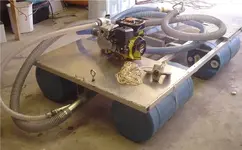
the pontoons, this saves power. However the motor is mounted very high and this will burn hp needed
to lift the column of water from down below.
The pump is what concerns me the most as this is the critical part of the design. This looks like we call
a swimming pool pump to use in case of fighting a fire in an area where the Fire Department can get to
to fast. This type of pump usually does not produce the needed psi for suction dredges. This looks like
a high volume pump and not high pressure, the dredge pumps are high volume and high pressure.
The motor looks like a 5hp, i hope it is cause a 3hp would never work for this application. A good solve
would be to get a 180gp pump from Keen engineering..that would make this a Hot Rod dredge. A pump
of only 60-100gpm will only work for a little while until you keep clogging the hose.
Your foot valve looks very nice, the cheap plastic ones sold everywhere are over priced and junk, and they
dont sink in fast water, your looks good, although you only need about a fourth of the length of hose as,
the foot valve should not touch the bottom where it can suck up sand and wear out the pump.
I cant see the jet and the flare, but from here it looks ok. just be sure there are no restriction of any kind
as it will clog so much you will take out a firearm and put it out of it misery!
Also I cant see what is under the flap..or the riffles. but be sure to get a good "seal" between the carpet,
the riffles and the bottom of the sluice. This is critical. Also I can't see how you mounted the riffle ladder,
but most of them lift up - to do the clean up at the end of the day..the crossover bar of the frame,
might get in your way..cant tell.
At the front of you dredge, by the motor, this part will face upstream. against the current. you will notice all dredges have angled the front part of the pontoons to break and deflect the current, with a bold, flat edge presented to the current, you will find it hard to anchor it safely. Oh and you can leave the Anchor at home to save weight , the streams here a filled with anchors, we call them rocks! lol. Just be sure to have 50 of 1" nylon rope to safely tie
off your dredge at night.
One last thing Ames, the bottom of your floats will take a tremendous amount of wear, because of the dragging
the dredge across those rocks, cobbles and boulders , plus you are usually pulling against the current as well.
Looks like you got a good secure tie down there on the front of the dredge.Just be sure the braces you put
around the floats are super secure, because this is where all the pressure will be when the current tries to take
it downstream and the rope stops that action, the braces have to hold when you are pulling against it.
Most dredges don't have so much metal on the surface be cause of the sun in California is blazing and these surfaces will be red hot! Many have covered these with indoor outdoor carpet, plus that makes them skid proof. as losing things off this surface is common when the vibration of the motor while running and the current action.
Hope this helps you get the bugs out before you truck it cross country and you spend more time learning than dredging. Remember that out of state Dredging Permits are $175 or there abouts, obtainable at the Dept of Fish
& Game on S street, Sacramento. The good news...dredging season for 2009 opens Memorial Day weekend, but
bring a wet suit,(7mm) the water in California a melted snow and glaciers at about 48-52 degrees! Without one
you will turn blue long before your sluice box turns yellow...
I have some suggestions on where you can put your dredge in also, just send a pm message.
rangler
*I dont know if you fired up the motor when you floated it on the pond, but when you fire the motor up the whole balance will change and will dip down quite a bit at the back end, as much as 4-6 inches or more!




 jim
jim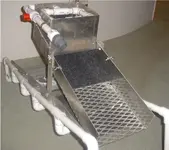















 New Nokta Promotions for the Nokta Simplex Ultra, Nokta Triple Score Pro Pack and Nokta Legend 2!