What's new

Final Platter Removals

uniface

Silver Member
Joined
Jun 4, 2009
Messages
3,224
Reaction score
2,907
Golden Thread
0
Location
Central Pennsylvania
Primary Interest:
Other
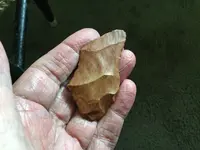
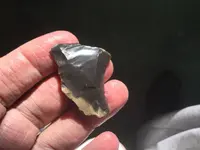
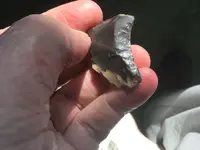
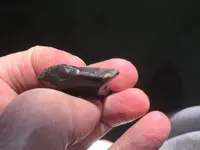
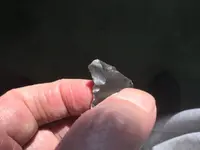
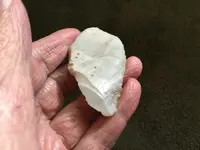
As platter(-like) bifacial cores were reduced, the flakes removed from them became thinner in proportion to the remaining thickness of the core itself. The last ones were thin indeed, only suited for cutting tasks.
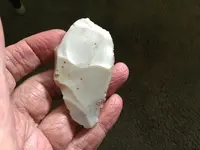
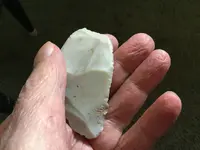
image.webp

image.webp

image.webp

Sorry these came out crappy. No idea why the thumbnail posted. Or how to delete the extras using this tablet. Edit option doesn't show them.
 

Attachments
  • image.webp
    image.webp
    420.2 KB · Views: 56
  • image.webp
    image.webp
    447.1 KB · Views: 62
Last edited:
Upvote 0
Soldiering on with these.

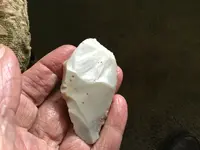
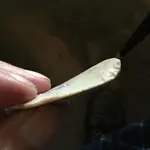
Flakes tend end to widen as they go when not constrained by ridges. This one is an edge-to-edge thinning flake, just barely an overshot. The hooked-over distal portion is turning into an endscraper from being used as one (flaking -- second picture at center -- is use wear).

image.webp

image.webp
 
A similar, but narrower one. Endscraper with edge @ right retouched.

image.webp

image.webp
 
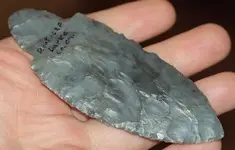
Examples so far stayed intact. Often, even usually, they broke into sections, as this one did. Made of blue Flintridge, which Jon Dickinson says is rare. Probably had a graver spur @ left corner.

image.webp

image.webp

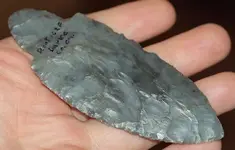
A rare blue flintridge point from Jon Dickinson's site :

adenaroot1.webp
 
Last edited:
Must have been making giant bifaces to generate flakes of that size. Not knowing different, I would have taken them for spalls. Most are big enough to be worked to small points. How can you tell they were peeled off bifaces rather than a cobblestone or block?
All really nice, BTW.
 
Will come back to Out Of Time's question.

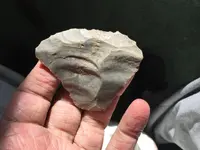
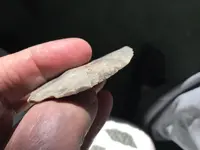
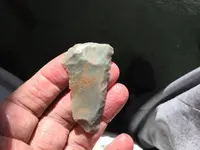
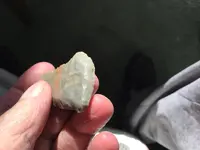
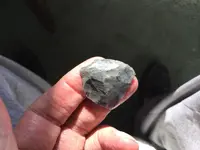
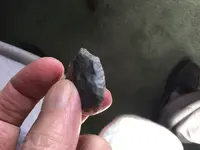
Final one in this series, and a great favorite. Gift from Ryan Leaf I've treasured for many years.

Made of what's called Ridge and Valley chert ; various sources differ widely on where it's found. Almost always, from what I've seen, as used up nubs of points that people obviously valued highly enough that they re-used them until there was no more use left in them.

An overshot thinning flake that was repurposed as an endscraper also, but with a twist : part of the scraping edge is still there, but most of it was removed to make a backed tool -- a bill hook. Probably for splitting sinew and the like. Thin edge retouched as well. Spur may have once been @ left corner.

image.webp

image.webp

image.webp

image.webp
 
Must have been making giant bifaces to generate flakes of that size. Not knowing different, I would have taken them for spalls. Most are big enough to be worked to small points. How can you tell they were peeled off bifaces rather than a cobblestone or block?
All really nice, BTW.

One of the all-time great threads ever posted here :

http://www.treasurenet.com/forums/north-american-indian-artifacts/637820-biface-platters.html

Short answer: because thinning flakes follow (ride on) the shape of the core/nucleus. Look at the removals on these.
 
Last edited:
My bad, I wasn't familiar with the term 'platter' as a name for the huge bifaces that were used for stock. It was in your thread title but I missed it as a qualifier. Of course that explains it clearly but, even clearer, is this reply you made to the linked post.

You wrote:

"....Platter cores were the preferred design for transportation. They started out thicker and got thinner as long, transverse flakes (some of them overshots) were removed. Oval shapes made it fairly easy for removals to reach, or pass, the center line (no stacks wanted).

The ones found (like those) are generally last stage (thinnest) before being split in two (diagonally) for point production (if that's what was intended). At that point, they were cached for later use far from the lithic source.

The thin, spreading flakes removed were excellent tools as-is, and served as tool stock for making purposefully shaped tools like endscrapers.

Actually, near-complete thinning flakes from them are even scarcer than the platters themselves. First picture shows reduction sequence involved. All three are overshots.

Some Paleo Tools for Joshuareem

FWIW
Last edited by uniface; Jul 24, 2020 at 05:49 PM."
 
As mentioned, flakes follow the surface they're removed from. When that twists, the removal from it will also :

image.webp
 

Attachments

  • image.webp
    image.webp
    553.4 KB · Views: 53
Last edited:
double post
 

Attachments

  • adenaroot1.webp
    adenaroot1.webp
    42.7 KB · Views: 61
Last edited:

Users who are viewing this thread

Latest Discussions

Back
Top Bottom