What's new

First colonial silver in a few years

toasted

Silver Member
Joined
Jun 1, 2015
Messages
3,452
Reaction score
14,368
Golden Thread
5
Location
Maryland
🥇 Banner finds
6
Detector(s) used
Minelab Equinox 600 XP Deus
Primary Interest:
Metal Detecting
Finally got out after an unusually long stretch of cold weather. I hunted a field being turned into a residential development. Found a colonial site with a few buttons and coppers and a nice earlier milled Spanish right in the road cut only 1” down
IMG_2716.webp
 
Last edited:
Upvote 47
Finally got out after an usually long stretch of cold weather. I hunted a field being turned into a residential development. Found a colonial site with a few buttons and coppers and a nice earlier milled Spanish right in the road cut only 1” downView attachment 2245167
Wowww

Congrats

Whats in the other side
 
Finally got out after an usually long stretch of cold weather. I hunted a field being turned into a residential development. Found a colonial site with a few buttons and coppers and a nice earlier milled Spanish right in the road cut only 1” downView attachment 2245167
Gotta Love that early silver! Congrats
 
Very nice!! What year?
Looks like 1756 to me. Ive only found around 5 of these pillar and globes type reales. Far more cob coins from earlier and bust style from later. One of the nicest condition colonial coins Ive ever found was this type
IMG_1689.webp
 
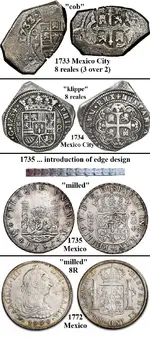
Very nice find (1756 is correct). Mexico City stopped producing hand-struck cobs in 1733.

In 1733, still cutting irregular blanks by hand, Mexico pressed the blanks between a screw press, rather than hand-striking the coins. These are called "klippes", & were struck for 2 years, in 1733 & 1734.

The above design, your coin, (known as "pillar dollars"), was first struck in 1735. Mexico used round, uniformly cut blanks that were struck in a screw press, with a collar around the edge. the collars served to keep the round shape, as well as impressing a design onto the edge. The edge design discouraged the practice of drilling into & removing silver from the coins This design continued at Mexico City until 1772, when it was abandoned for the King's portrait.

The below shows the evolution from (hand-struck) cobs to machine milled coins:
 

Attachments

  • 50538141_1.webp
    50538141_1.webp
    129.5 KB · Views: 50
Finally got out after an unusually long stretch of cold weather. I hunted a field being turned into a residential development. Found a colonial site with a few buttons and coppers and a nice earlier milled Spanish right in the road cut only 1” downView attachment 2245167
Fantastic find!!!! Congrats on sniffing out that old Spanish silver.
 

Users who are viewing this thread

Back
Top Bottom