You are using an out of date browser. It may not display this or other websites correctly.
You should upgrade or use an alternative browser.
You should upgrade or use an alternative browser.
🔎 UNIDENTIFIED Found a Roman Coin
- Thread starter Benclark
- Start date
-
- Tags
- ancient big roman coin


- Joined
- Feb 3, 2009
- Messages
- 52,445
- Reaction score
- 208,111
- Golden Thread
- 1
- Location
- Eastern Ontario Canada
- 🥇 Banner finds
- 1
- Detector(s) used
- Deus, Deus 2, Minelab 3030, E-Trac,
- Primary Interest:
- Relic Hunting
When they produce replicas of anything it's a given the item is going to have weight +/- a tad from the original if any at all. Replicas/fakes/copies of coinage, and other trade items of value have been around since the first items ever produced.The weight of it makes me think it’s not a replica. I found it in a box at my grandparents house that is being demolished.
It's not a Roman as the coinage was quite small as stated.
This Little Piggy Went to Market: Boars, Hogs, Sows and Piglets on Ancient Coins
CoinWeek Ancient Coin Series by Mike Markowitz ..... INTELLIGENT, ADAPTABLE, AND omnivorous, pigs have long been companions to humans. We know from
 coinweek.com
Upvote
0

Red-Coat
Gold Member
- Joined
- Dec 23, 2019
- Messages
- 7,933
- Reaction score
- 25,198
- Golden Thread
- 0
- Location
- Surrey, UK
- Primary Interest:
- All Treasure Hunting
I don’t know what this is, or if it is ancient, but I have some thoughts.
The figure at the left is wearing a Corinthian (Greek) helmet, pushed back over the forehead, like this:

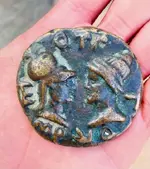
That’s one of the common depictions for Athena on coins and elsewhere, as the Greek goddess of warfare (and wisdom). She was also the protectress of various Greek cities, and especially Athens from which the name likely derives (or vice-versa). I can’t see the facing figure as having a Greek helmet style, nor a Roman one. Also, at the top of the reverse, I can see the letters ‘Ο Γ Γ’ (or possibly ‘O T Γ’), which would be consistent with the ancient Greek alphabet. Likely this will be an abbreviated form for the name of a place, authority or person (including the possibility of a ruler) but it’s not something I have seen before. The ‘E’ at the left would also be within the ancient Greek alphabet and might be a mintmark. The other characters I’m not sure about.
Ancient Greek bronze coins can be commonly found in sizes between 30-40mm and occasionally beyond, so I don’t have a problem with the size and weight. Some of the larger ones are often referred to as ‘medallions’ but in many cases there’s no doubt that they were coins… only doubt about whether they commonly circulated as ordinary currency.
I use the word “Greek” in the sense that it applies to the Greek Empire in general, its related Kingdoms and its Greek-speaking colonial territories which stretched far and wide in ancient times.
The decline of Greek influence began with the Roman victory at the Battle of Corinth in 146 BC but many areas were allowed to retain their Greek heritage under Roman rule for some time. Coins with Greek symbolism or with a combination of Greek and Roman imagery are not uncommon after the Roman victory at Corinth, but I can’t see the figure facing Athena as Roman.
IF this is an authentic ancient coin (or medallion), my guess is that it’s from some far-flung part of the Greek Empire as an obscure local issue and that the figure facing Athena relates to the original heritage of that territory, or a local King under the Greek umbrella. I could see the helmet style as possibly being from the Middle East or Near East. Persia, for example, but there are other possibilities. Until about 1 BC, the Indo-Greek Empire still existed in Afghanistan, parts of Pakistan and NW India, undisturbed by any Roman conquest or interference.
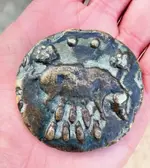
I haven’t seen the ‘sow with piglets’ before, either. It might be symbolism for prosperity or ‘benevolent mothership’ under Greek rule (my guess).
The figure at the left is wearing a Corinthian (Greek) helmet, pushed back over the forehead, like this:
That’s one of the common depictions for Athena on coins and elsewhere, as the Greek goddess of warfare (and wisdom). She was also the protectress of various Greek cities, and especially Athens from which the name likely derives (or vice-versa). I can’t see the facing figure as having a Greek helmet style, nor a Roman one. Also, at the top of the reverse, I can see the letters ‘Ο Γ Γ’ (or possibly ‘O T Γ’), which would be consistent with the ancient Greek alphabet. Likely this will be an abbreviated form for the name of a place, authority or person (including the possibility of a ruler) but it’s not something I have seen before. The ‘E’ at the left would also be within the ancient Greek alphabet and might be a mintmark. The other characters I’m not sure about.
Ancient Greek bronze coins can be commonly found in sizes between 30-40mm and occasionally beyond, so I don’t have a problem with the size and weight. Some of the larger ones are often referred to as ‘medallions’ but in many cases there’s no doubt that they were coins… only doubt about whether they commonly circulated as ordinary currency.
I use the word “Greek” in the sense that it applies to the Greek Empire in general, its related Kingdoms and its Greek-speaking colonial territories which stretched far and wide in ancient times.
The decline of Greek influence began with the Roman victory at the Battle of Corinth in 146 BC but many areas were allowed to retain their Greek heritage under Roman rule for some time. Coins with Greek symbolism or with a combination of Greek and Roman imagery are not uncommon after the Roman victory at Corinth, but I can’t see the figure facing Athena as Roman.
IF this is an authentic ancient coin (or medallion), my guess is that it’s from some far-flung part of the Greek Empire as an obscure local issue and that the figure facing Athena relates to the original heritage of that territory, or a local King under the Greek umbrella. I could see the helmet style as possibly being from the Middle East or Near East. Persia, for example, but there are other possibilities. Until about 1 BC, the Indo-Greek Empire still existed in Afghanistan, parts of Pakistan and NW India, undisturbed by any Roman conquest or interference.
I haven’t seen the ‘sow with piglets’ before, either. It might be symbolism for prosperity or ‘benevolent mothership’ under Greek rule (my guess).
Last edited:
Upvote
2
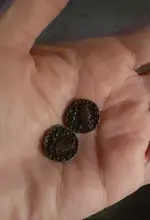
I have 2 of these. Small. marks--AICA. LN, poc. Have no idea what they are.
Attachments
Upvote
0

Red-Coat
Gold Member
- Joined
- Dec 23, 2019
- Messages
- 7,933
- Reaction score
- 25,198
- Golden Thread
- 0
- Location
- Surrey, UK
- Primary Interest:
- All Treasure Hunting
Something odd has happened above in post#7. Share has apparently quoted Benclark from a post I can't find him having made, and I can't quote Share's reply. Nevertheless, welcome to Tnet Share, but it's kinda impolite to piggy-back unrelated items onto an existing thread.
What you have imaged appear to be poor 'copies' (I use the word loosely) of a Judaean coin called a 'prutah':
 coinquest.com
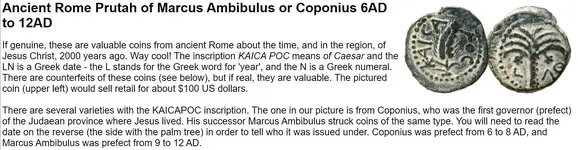
These are commonly produced as 'religious keepsakes' because of their association to the time and region of Jesus (and with various degrees of resemblance to the real thing... all the way through to well-made counterfeits intended to deceive).
What you have imaged appear to be poor 'copies' (I use the word loosely) of a Judaean coin called a 'prutah':
Coin Value: Ancient Rome Prutah of Marcus Ambibulus or Coponius 6AD to 12AD
Coin Value: Ancient Rome Prutah of Marcus Ambibulus or Coponius 6AD to 12AD
These are commonly produced as 'religious keepsakes' because of their association to the time and region of Jesus (and with various degrees of resemblance to the real thing... all the way through to well-made counterfeits intended to deceive).
Last edited:
Upvote
1
Something odd has happened above in post#7. Share has apparently quoted Benclark from a post I can't find him having made, and I can't quote Share's reply. Nevertheless, welcome to Tnet Share, but it's kinda impolite to piggy-back unrelated items onto an existing thread.
What you have imaged appear to be poor 'copies' (I use the word loosely) of a Judaean coin called a 'prutah':
View attachment 2047440Coin Value: Ancient Rome Prutah of Marcus Ambibulus or Coponius 6AD to 12AD
Coin Value: Ancient Rome Prutah of Marcus Ambibulus or Coponius 6AD to 12AD
These are commonly produced as 'religious keepsakes' because of their association to the time and region of Jesus (and with various degrees of resemblance to the real thing... all the way through to well-made counterfeits intended to deceive).
Upvote
0

Back-of-the-boat
Gold Member
- Joined
- Apr 18, 2013
- Messages
- 7,064
- Reaction score
- 8,981
- Golden Thread
- 0
- Location
- California
- Detector(s) used
- AT GOLD/Garrett /C.Scope cs4PI/Garrett(carrot) pro pointer/ 5x8 double d coil and sniper coil/Lesche digger/Lesche "T" handle shovel.
- Primary Interest:
- All Treasure Hunting
I know it looks like a pig or sow on the back of the coin, but maybe it is depicting Romulus and Remus and that animal is a poor depiction of a wolf that they suckled from. Just a thought.
.
.
Upvote
1

i am new to this site, that is MY quote is why you cant find it as one i copied. I will leave because i resent being called impolite by someone who is the rude one
All Red Coat is saying is it is considered rude to post your own picture or item that is not related to the original poster's thread.
Upvote
2
Red-Coat
Gold Member
- Joined
- Dec 23, 2019
- Messages
- 7,933
- Reaction score
- 25,198
- Golden Thread
- 0
- Location
- Surrey, UK
- Primary Interest:
- All Treasure Hunting
i am new to this site, that is MY quote is why you cant find it as one i copied. I will leave because i resent being called impolite by someone who is the rude one
All Red Coat is saying is it is considered rude to post your own picture or item that is not related to the original poster's thread.
Sorry that you took it that way. As T_H says, I was merely pointing out (and not in a rude way) that the etiquette on forums in general is to create your own thread when asking for comment on your own finds... unless the finds are related to something that has already been posted. You will then get better responses yourself and also not interrupt a discussion that's in progress on something else.
Upvote
3
Red-Coat
Gold Member
- Joined
- Dec 23, 2019
- Messages
- 7,933
- Reaction score
- 25,198
- Golden Thread
- 0
- Location
- Surrey, UK
- Primary Interest:
- All Treasure Hunting
I know it looks like a pig or sow on the back of the coin, but maybe it is depicting Romulus and Remus and that animal is a poor depiction of a wolf that they suckled from. Just a thought.
.
I’m sure that’s a sow with piglets. The sow/piglet combination is not unknown on Roman coins since it relates to a foundation myth for the town of Lanuvium, which was the precursor to the city of Rome. The poet Virgil wrote that a Trojan exile called Aeneas sailed up the river Tiber and came across a white sow nursing thirty piglets. He took this as a good omen for the foundation of a settlement at the site, originally known as Lanuvium and later as Rome. The sow is also sometimes referred to as “The Great Sow”.
Here's a couple of examples from the second century AD in celebration of Rome’s 900th anniversary but both show the piglets actually being nursed as described in the legend (albeit not thirty of them).
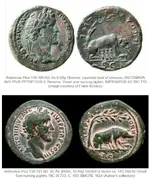
Despite that, I still don’t see the coin/medallion as Roman, largely because of Athena in a Greek helmet facing a character that doesn’t seem to have a Roman (or Greek) helmet and what appears to be a legend in Greek on the other side.
Upvote
3

Red-Coat
Gold Member
- Joined
- Dec 23, 2019
- Messages
- 7,933
- Reaction score
- 25,198
- Golden Thread
- 0
- Location
- Surrey, UK
- Primary Interest:
- All Treasure Hunting
Whats the diameter of it. Looks like it covers a good portion of your palm. Also where was this house that we can assume has now been demolished?. Was there anything else in this box you found and do you know who the box belongs to?
Unless the coin is being held by an infant, the diameter is too big for a Roman coin.
Don.....
It would help if the OP told us the exact diameter. Agreed it's too big for a Roman coin, but (1) we don't know if it's a coin and (2) for reasons already pointed out, I believe it to have Greek origins, not Roman.
As I already said, ancient Greek bronze coins can commonly be found in the region of 30-40mm and the largest confirmed coins in circulation were around 47mm. If it's a medallion rather than a coin (whether Greek or not) then all bets are off with respect to possible maximum sizes.
Upvote
0

NHBandit
Silver Member
- Joined
- Feb 21, 2010
- Messages
- 3,599
- Reaction score
- 3,302
- Golden Thread
- 0
- Location
- Formerly NH now East Tennessee
- Detector(s) used
- Garrett GtaX1250
Don't forget to write....
Upvote
1
Benclark
Jr. Member
- #20
Thread Owner
The box belonged to an Italian soldier that gave it to my great uncle as payment for transporting his things from Italy to Mexico. My great uncle had an import/export company.Whats the diameter of it. Looks like it covers a good portion of your palm. Also where was this house that we can assume has now been demolished?. Was there anything else in this box you found and do you know who the box belongs to?
The rest of the box contained Nazi memorabilia which I’m not sure what to do with :/
Upvote
1


Featured Treasure Finds
Featured Treasure Finds
Similar threads

- Replies
- 2
- Views
- 502

- Replies
- 2
- Views
- 254

Users who are viewing this thread
Total: 1 (members: 0, guests: 1)