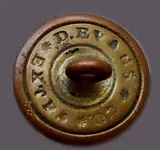
According the McGuinn-&-Bazelon book on button backmarks, the firm of D. Evans & Co. was in business as a button-manufacturer from 1848 to 1945. As Nhbenz's post indicates, some of the varieties of D.Evans backmarks were used for a long timespan. An example of that, and its effect on a Military button's collector-value, is the VMI (Virginia Military Institute) button with an 1860-through-1880s D. Evans & Co. backmark. Those particular VMI buttons are considered "less desirable" among collectors, because there's no way we can know for certain whether the button was made in 1860-61 or in the 1870s (the latter meaning it could not have been worn by a Confederate soldier). I can tell you from personal experience that hundreds of D. Evans VMI button's were dug at the school's campus, with most of all of those coming from students' uniforms in the 1870s and later.
Now, about your 3-piece button with a "D. Evans & Co. Extra" backmark:
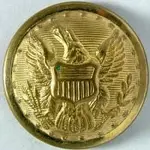
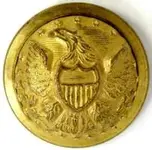
When a 3-piece button has a backmark which dates from slightly before the civil war though a decade or more) after 1865, we collectors rely on the fact that the width of the flat rim on 3-piece buttons was significantly increased soon after the civil war. See the photos (below) for comparison of 3-piece buttons with a narrow rim and a wide rim. Your button has the wider version of rim, so in the opinion of the top Button-Scholars (Tice, Binder, Albert, McGuinn and Bazelon) it was manufactured after the civil war.
Sidenote:
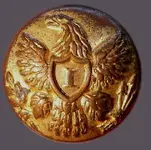
There are just two versions of pre-1865 American military 3-piece buttons which have "the wide rim." So, the wide-rim-means-postwar rule has two known exceptions. One is the earliest version of Michigan State Seal button -- shown in the Albert button book as MG-1. I can't recall the other one at the moment.
For easy visual comparison, here are the photos showing the narrow-rim and wide-rim versions of the same kind of button.